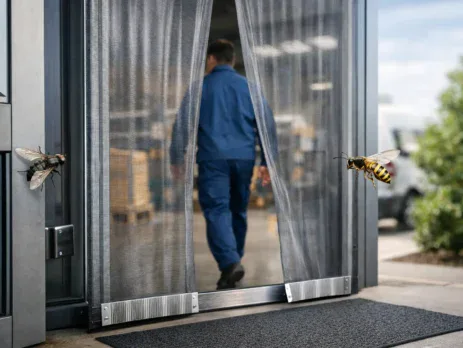
A propped-open rear door can undo a great deal of careful hygiene work. Flies, wasps and other flying insects follow food smells, light and airflow straight into kitchens, stores and preparation areas. The best commercial door insect barriers keep that route protected while allowing staff, deliveries and customers to move through the building without unnecessary delay.
There is no single barrier that suits every commercial entrance. A café kitchen with regular foot traffic needs a different solution from a warehouse loading bay or a care home servery. The right choice comes down to opening size, traffic volume, the level of hygiene required and whether the door must remain usable throughout the working day.
What makes a commercial insect barrier effective?
An effective barrier must cover the full opening, return to position reliably after use and stand up to the way the doorway is actually used. A loosely fitted domestic-style net may reduce the number of insects entering, but it is rarely suitable for a commercial setting where doors are opened frequently and hygiene standards are closely managed.
For food preparation, catering and hospitality premises, the priority is preventing insect access without restricting ventilation. For industrial units, stockrooms and warehouses, durability and access for trolleys, pallet lorries or deliveries may carry more weight. In customer-facing premises, appearance, quiet operation and ease of use can matter just as much.
Made-to-measure sizing is central to performance. Gaps around the top, sides or threshold give insects an easy route in. A correctly sized aluminium-framed screen or properly overlapping strip curtain provides much more dependable coverage than a standard product cut to fit on site.
Best commercial door insect barriers by application
PVC strip curtains for busy and wide openings
PVC strip curtains are often the most practical choice for loading doors, storerooms, service corridors and other high-traffic access points. Overlapping clear strips create a physical barrier while allowing people, stock trolleys and wheeled equipment to pass through. Once traffic has passed, the strips fall back into place.
They are particularly useful where a conventional door would be left open for long periods. Clear PVC maintains visibility between areas and lets daylight through, which can make busy workspaces safer and more pleasant to use. It can also help reduce draughts and keep airborne debris out of a work area.
The trade-off is that strip curtains are not a sealed screen system. Insects can occasionally pass through if strips are too widely spaced, too short, damaged or pushed aside for prolonged periods. They work best when the strip width, overlap and material thickness are selected for the opening and traffic level. A light-duty curtain may be suitable for an internal service doorway, while a busy loading entrance needs a heavier-duty specification.
Hinged fly screens for kitchens and staff doors
For commercial kitchens, food preparation rooms, cafés and small hospitality premises, a hinged fly screen door gives controlled, full-height protection. It is fitted to the door opening and operates like a secondary door, with insect mesh held in a rigid aluminium frame.
This arrangement is well suited to rear access doors used by staff, especially where the opening is not constantly in use. A self-closing option is valuable because it reduces the risk of the screen being left open during a busy service. Fine fly mesh allows fresh air and light into the room while keeping out common flying insects.
Hinged screens are a strong choice where hygiene is the main concern and the doorway needs a neat, permanent finish. They are less convenient where a continuous stream of staff or wheeled deliveries passes through, as the frame and door action can slow movement. Measure carefully for handles, closers, steps and outward-opening doors before specifying the screen.
Sliding insect screens for wide doorways
Sliding fly screens suit wider openings where hinged doors would take up too much space. They are useful for servery areas, patio-style commercial doors, staff rest areas and buildings with broad glazed access doors. The screen runs in its own track, giving a tidy barrier that can be opened and closed as needed.
A sliding system is usually chosen where presentation matters as well as function. Restaurants, hotels, offices and care settings can maintain airflow without leaving a large opening exposed to insects. As with any framed screen, the benefit depends on accurate measuring and a secure fit around the complete opening.
For very frequent through-traffic, a sliding screen may be less suitable than PVC strips. It gives excellent coverage when closed, but it relies on users closing it after every passage. Consider how staff use the door at peak times, not only how it appears during a quiet inspection.
Chain screens for lower-intensity access
Chain screens provide a simple hanging barrier for doorways that need airflow and regular pedestrian access. They are commonly considered for pubs, cafés, small shops and domestic-style commercial entrances. The chains create movement at the doorway that can discourage insects while allowing people to walk through without operating a door.
They are not usually the first choice for hygiene-sensitive food preparation areas, where fine mesh or an overlapping strip curtain provides more reliable physical exclusion. However, for a lower-risk doorway where convenience and ventilation are the priorities, they can be a practical option.
Roller fly screens where doors are only opened occasionally
Roller fly screens can be useful for doors that are opened for ventilation rather than as a main access route. The mesh retracts neatly when it is not required, keeping the opening clear in colder months or outside trading hours.
This is a sensible option for offices, treatment rooms, small catering spaces and staff rooms. It is not designed for a doorway used repeatedly for deliveries or constant staff movement. Choosing a system that matches the frequency of use will prevent avoidable wear and frustration.
Choosing the right mesh and frame
The mesh is as important as the frame. Standard fly mesh is suitable for keeping out flies, mosquitoes and wasps while allowing good airflow. Where smaller insects are a concern, a finer mesh may be appropriate, though finer apertures can slightly reduce airflow and light transmission.
For sites exposed to heavier wear, aluminium-framed screens provide a stable, long-lasting structure. They are easier to keep clean than temporary mesh solutions and can be made to the exact dimensions of the opening. In settings where staff may push equipment close to the doorway, consider the risk of impact and specify a solution built for that level of use.
Do not overlook the threshold. A barrier that stops short of the floor, or leaves an uneven gap because of a sloping surface, will be less effective. Similarly, door furniture, architraves, external brickwork and existing closers all affect where and how a screen can be fitted. A few accurate measurements taken before ordering are far cheaper than adapting an unsuitable product later.
Practical questions before you buy
Start with the door’s daily pattern of use. Is it opened occasionally for ventilation, used by staff every few minutes, or kept open for goods movement? Then consider who passes through it. Pedestrians can use a hinged or sliding screen comfortably, while trolleys, wheelie bins and delivery loads generally point towards PVC strips.
Next, assess the area behind the door. A food preparation room needs a more controlled barrier than a general workshop. If the door opens directly into a kitchen, bakery, bar service area or food store, choose a solution that creates consistent coverage and can be cleaned easily. A barrier supports good site practice, but it should sit alongside sensible waste management, clean-up routines and closed food storage.
Finally, think about maintenance. Strip curtains should be checked for split, curled or missing strips. Screen frames need occasional cleaning, and mesh should be inspected for tears or loose edges. A barrier only works when it closes the opening properly.
Why made-to-measure barriers are worth considering
Commercial entrances are rarely standard. Older buildings may have uneven reveals, unusual door furniture or non-standard widths, while newer premises may have double doors and large service openings. Off-the-shelf barriers can create the very gaps insects exploit.
A bespoke system allows the barrier type, dimensions and mesh to be matched to the job. Premier Screens manufactures commercial fly screen and PVC strip curtain solutions for varied door configurations, helping businesses protect work areas without closing off fresh air. The aim is straightforward: a barrier that staff will use, that fits properly and that remains effective through a busy working season.
The best result is not necessarily the most expensive screen or the heaviest curtain. It is the barrier that suits the doorway, closes the gaps and keeps working when the premises are at their busiest. Choose for the way your team moves, not just for the size of the opening.
See our complete range of commercial fly screens for more heavy-duty options.