
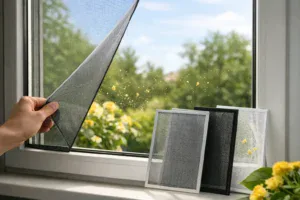
If you get hay fever, the advice to keep your windows shut through the summer is a miserable trade: a stuffy house, or a streaming nose. A pollen screen is the third option. It’s a fly screen fitted with a finer, allergy-certified mesh instead of standard insect mesh, so you can have the window open and still filter what’s coming through it.
What a pollen screen actually is
There’s no such thing as a separate “pollen screen” product, and anyone selling you one is selling you a screen with different mesh in it. That’s what this is: our standard window and door screens, made to your measurements, with pollen mesh fitted in place of the usual insect mesh.
That matters when you’re comparing options, because it means you choose the screen first — based on the window or door it’s going into and how you want it to work — and the mesh second. A roller screen with pollen mesh is still a roller screen. It retracts into its cassette the same way.
The mesh
Our pollen mesh is certified by the European Centre for Allergy Research Foundation (ECARF), a German non-profit that has run an allergy certification scheme since 2006. It’s worth knowing what that certification actually means, because it’s the one claim on this page that comes from outside our own company: ECARF publishes its criteria openly, awards the seal only where studies or expert assessment show a product meets them, and re-inspects certified products without notice during the two-year term.
The mesh itself is a knitted polyester filter woven to 80 microns with a 0.8 aperture — 22.5 strands per centimetre, 62g per square metre, around 0.22mm thick. In plain terms, the gaps are small enough to catch pollen grains rather than just insects.
The honest trade-off is airflow. Pollen mesh has an openness factor of roughly 45%, meaning a little under half of its surface area is actually open gap. A mesh fine enough to catch pollen is finer than one designed to stop a bluebottle, and less air comes through it. On a still day you will notice the difference. That’s the deal, and it’s worth knowing before you order rather than after.
Antibacterial as standard
Whichever mesh you choose, it carries an antibacterial treatment as standard, at no extra cost. Titanium dioxide is worked into the mesh while it’s woven rather than coated on afterwards, so it doesn’t wash out or wear off, and in ordinary daylight it breaks down bacteria settling on the mesh itself. It’s a property of the material rather than an air filter — the pollen filtering is what the weave does.
Pollen mesh is also available by the metre at £28 + VAT, 1.2m wide, if you’re re-meshing a screen you already own.
Which screens can take pollen mesh
Seven of our screens can be made up with pollen mesh. You choose it in the price calculator on the product page, in the mesh dropdown, and the cost is added to the screen price.
| Screen | Best for | Screen from | Pollen mesh |
|---|---|---|---|
| Hinged panel fly screens for windows | Casement windows, lifts out for cleaning | £35 + VAT | + £20 |
| Magnetic fly screens for windows | Renters, removable in winter | £39 + VAT | + £20 |
| Roller fly screens for windows | Out of sight when you don’t need it | £62 + VAT | + £24 |
| Vertical sliding fly screens | Sash windows | £169 + VAT | + £20 |
| Horizontal sliding fly screens | Sliding windows and wide openings | £181 + VAT | + £20 |
| Roller fly screen doors | Back doors and patio doors | £270 + VAT | + £24 |
| Double roller fly screen doors | Wide openings and French doors | £295 + VAT | + £39 |
For a patio or back door, the roller screens are the ones to look at. The screen pulls across when you want it and retracts into its cassette when you don’t, which matters more with pollen mesh than standard mesh — you’re not leaving a filter sitting in the opening collecting dust for nine months of the year.
Choosing between them
For bedrooms, the room where hay fever tends to cost you most sleep, roller screens are usually the right call. The screen is only in the opening when you want it there, and it isn’t collecting dust on the frame for the nine months of the year you don’t need it.
For a run of similar windows on a budget, hinged panel screens are the cheapest way in, and the panel lifts out and goes under the tap. That’s worth more with pollen mesh than with standard mesh, because a filter mesh only keeps working if it’s clean.
Magnetic screens suit renters and anyone who doesn’t want to drill. They come off entirely at the end of the season.
For sash and sliding windows, the vertical and horizontal sliding screens follow the way the window itself moves, so you keep half the opening usable.
What a pollen screen won’t do
We’d rather set the expectation properly than have you disappointed in July.
A screen filters the air coming through that one opening. It doesn’t filter your house. Pollen still comes in on clothes, hair, pets and through every other door you open, and on a high-count day the air in your home will not be pollen-free because you fitted a screen to the bedroom window.
It isn’t a medical device and it isn’t a treatment. It’s a way of reducing what comes through an open window, which for a lot of people is the difference between sleeping with the window open and not. If your symptoms are difficult to manage, that’s a conversation for your GP or pharmacist, not something a screen replaces.
And it won’t help at all if the window is open somewhere else in the house. Screens work per opening.
Ordering
Choose your screen, enter your measurements, and select Pollen Mesh from the mesh dropdown in the price calculator on the product page. It adds £20 + VAT on most window screens, £24 + VAT on roller window screens and single roller doors, and £39 + VAT on double roller doors, on top of the made-to-measure price.
Screens are made to your measurements in our own UK factory. Lead times run from 2 to 10 working days depending on the product, and the current time is shown on each product page.
Screens are supplied ready to fit, with fitting instructions. Most people put them up themselves — there’s no cutting to do, because the frames arrive pre-cut to your measurements.
Common questions
Does pollen mesh keep insects out as well?
Yes. It’s finer than standard insect mesh, so anything standard mesh stops, pollen mesh stops too — including midges, which get through ordinary mosquito mesh.
Can I have pollen mesh in some screens and standard mesh in others?
Yes, and it’s often the sensible approach. Pollen mesh in bedrooms where it matters most, standard mesh elsewhere where you’d rather have the airflow.
How do I clean it?
Vacuum it gently with a brush attachment, or take the panel out and rinse it. Don’t scrub it. A pollen mesh clogged with dust filters worse and passes less air, so it’s worth doing more often than you would with standard mesh.
Can I re-mesh an existing screen with pollen mesh?
If it’s one of our screens, usually yes — pollen mesh is sold by the metre. Whether it’s worth doing depends on the screen; email us and we’ll tell you honestly.
Talk to us
If you’re not sure which screen suits your windows, send us the window type and rough sizes and we’ll tell you what fits. Email sales@premier-env.co.uk.