
A lot of UK sites face the same daily tension. The kitchen, café floor, office back door, or staff entrance needs fresh air, especially when heat builds up indoors. But the moment that door stays open, you also create a direct route for flies and other pests.
That's why commercial fly screen doors shouldn't be treated as a finishing touch. In the right setting, they're part of the building's operating kit. They help keep air moving, support cleaner working conditions, and reduce the constant compromise between ventilation and hygiene.
For facilities managers, the core question isn't whether a screen keeps insects out. It's whether the door you specify will survive traffic, suit the way staff move, and support the standards your site is expected to maintain. That's where good buying decisions are made.
Why Commercial Fly Screens Are a Business Essential
On a warm day, the wrong door policy creates problems either way. Keep doors shut and the space gets stuffy, uncomfortable, and harder to work in. Keep them open and you increase the chance of insect ingress where food, drink, stock, or staff areas need protection.
That's why screens matter most in premises that can't afford casual shortcuts. The UK has a large hospitality base — around 45,000 pubs as of 2024, according to the British Beer & Pub Association. The Food Standards Agency also expects food businesses to keep premises clean and protect food from contamination by pests, which makes screened access points highly relevant in pubs, cafés, kitchens, and loading areas that need ventilation without leaving openings unprotected.
Where the business value shows up
A commercial screen door earns its place when it solves more than one problem at once.
- Ventilation without a compromise: Staff can work with fresh air moving through the building rather than relying on a closed, overheated workspace.
- Pest exclusion at key access points: Delivery doors, kitchen exits, bin routes, and staff entrances are common weak spots.
- Operational consistency: A proper door system is easier to use repeatedly than improvised measures such as keeping one leaf partly shut or relying on ad hoc barriers.
- A cleaner standard of presentation: Customers notice when a site looks controlled and well maintained.
Practical rule: If a door is opened often enough to affect hygiene, comfort, or workflow, it's no longer just a doorway. It's an access point that needs specifying properly.
Why simple domestic thinking fails on commercial sites
A commercial site doesn't behave like a house. Traffic is heavier, opening cycles are more frequent, and cleaning regimes are harsher. Staff also won't tolerate anything that slows them down during service or deliveries.
That's why lightweight, one-size-fits-all products usually disappoint in business settings. They often fail at the edges first. The issue isn't always the mesh. It's poor fit, weak frames, awkward operation, or a door type that doesn't match how the opening is used.
Facilities teams usually get better results when they treat the screen door as part of the access strategy. That means looking at the opening, the user behaviour, the cleaning routine, and the compliance risk together rather than buying on appearance alone.
Choosing the Right Door Type for Your Workflow
The best door type is the one staff will use properly without having to think about it. If the system slows movement, clashes with equipment, or gets in the way of service, people start bypassing it. Once that happens, the specification has already failed.
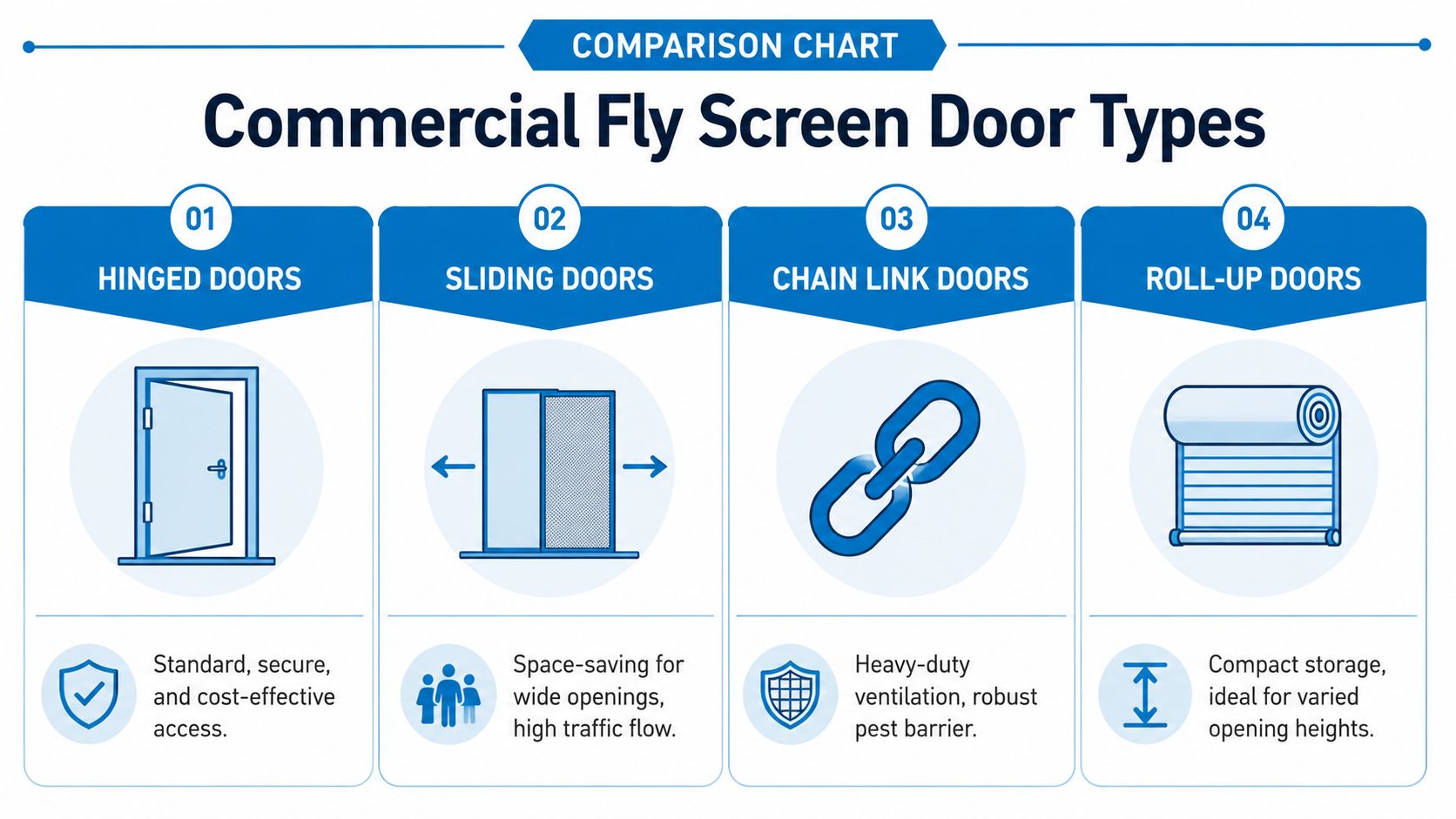
Door types compared by site use
| Door type | Best suited to | What works well | What often goes wrong |
|---|---|---|---|
| Hinged or double-action doors | Kitchens, food prep areas, busy staff routes | Fast passage, familiar operation, good for repeated use | Poor if the swing path conflicts with trolleys, walls, or nearby equipment |
| Sliding systems | Wider openings, patios, staff access where side room exists | Saves swing space, neat in use, practical for broad apertures | Weak choice where there's no run-back space or tracks won't stay clear |
| Roll-up or retractable doors | Openings used only at certain times | Can be discreet when not needed, useful for flexible use | Not ideal where doors are being passed through constantly all day |
| Chain link or PVC strip solutions | Service yards, loading areas, robust utility spaces | Allows movement and airflow in harsher environments | Less suitable where appearance, tight sealing, or finer insect exclusion matters most |
Matching the system to real movement
In a commercial kitchen, double-action doors are usually the practical answer when staff carry trays, stock, or waste through the opening. They suit repeated movement because people can push through naturally in both directions.
A sliding screen makes more sense where swing space is limited or where the opening is wide and used in a more controlled way. Staff entrances, servery connections, and patio thresholds often fall into this category.
For sites that only need screening at certain times of day or year, a retractable format can be sensible. If that's the route you're considering, this overview of roller fly screens for doors is useful for understanding where a retractable system fits and where it doesn't.
If your team has to stop, turn, lift, or hold the door every time they pass through, the design is working against the building.
A simple selection filter
Use these questions before choosing:
- How often is the opening used? Constant traffic usually pushes you toward a more durable hinged solution.
- Do you have swing space or side clearance? If not, sliding or retractable options may be more workable.
- Is the opening customer-facing or back-of-house? Visual appearance matters more at front-of-house thresholds.
- Will stock, bins, or equipment pass through? That affects frame durability, kick protection, and operating style.
- What happens if staff prop it open incorrectly? The best system is the one least likely to be misused.
Understanding Mesh and Frame Specifications
Mesh choice is where many specifications go vague. Buyers often ask for “insect mesh” as if it's one universal category. It isn't. In practice, selecting mesh is more like choosing tyres for a vehicle. The right option depends on the ground you're covering, not on what looks acceptable in a catalogue.
A kitchen door, a bin store entrance, and a school office don't face the same pressures. Pest size, washdown routine, visibility requirements, and corrosion risk all change what makes sense.
Mesh is a trade-off, not a tick-box
The key trade-off is simple. Finer mesh improves exclusion of smaller insects and some specialist variants also address other environmental irritants. But as mesh becomes tighter, airflow resistance and cleaning burden can increase.
A useful reference point is the broader discussion around uses for fine mesh screens, which helps explain why finer screening is chosen for specific conditions rather than used by default.
Here's the practical way to think about common options:
- Standard insect mesh: Often suitable where the main concern is routine flying insects and you want a balanced solution.
- Finer mesh: Better where smaller pests are a concern, but it needs realistic expectations on airflow and maintenance.
- Pollen-focused mesh: Useful where occupant comfort matters and the environment calls for more than simple insect control.
- Tougher-duty mesh: Better in openings exposed to wear, knocks, or rougher use.
Frame quality decides whether the screen stays effective
Mesh gets attention, but frame design usually determines how long the door performs properly. If the frame twists, loosens, corrodes, or loses its alignment, the mesh can still be intact while the opening starts leaking around the perimeter.
A technically useful benchmark comes from a UK commercial product listing for stainless steel insect mesh. It specifies woven Grade 304 stainless steel, 31 wire gauge, 0.3 mm wire thickness, 1.29 mm aperture and 65.78% open area, balancing airflow with insect exclusion, as described in this commercial door fly screen specification.
That kind of detail matters because it forces the right conversation. You're no longer buying “a screen”. You're selecting aperture, material, and durability for a specific environment.
For harsher settings, many specifiers look at stainless options because hygiene and corrosion resistance matter over time. This guide to stainless steel mesh is a useful reference when you're weighing durability against visibility and airflow.
Buy mesh for the insects you need to stop, but buy the frame for the abuse the doorway will take.
Meeting Food Safety and Commercial Compliance
For food businesses, fly screen doors aren't just a convenience item. They're part of how you show that pest prevention has been thought through at the points where contamination risk is most obvious.

The important point is broader than a label on a product page. The UK Food Standards Agency's food-hygiene framework makes pest prevention a core expectation for food businesses. That matters across a sector of real scale, because the UK food chain generated £148.2 billion in Gross Value Added according to the referenced industry context in this food safety and pest prevention discussion.
How a screen supports due diligence
A properly specified screen helps at the practical points inspectors and managers both care about. It shows that the business has identified an access route for pests and put a physical control in place without blocking normal operations.
That only works if the system is credible in use. A torn mesh, a warped frame, or a door wedged open won't support a due diligence argument. In some premises, the screen becomes part of the day-to-day hygiene discipline in the same way as door closers, cleaning records, and waste handling controls.
For facilities teams who also manage wider indoor environment issues, a broader guide for facility managers can be useful as background reading on building air considerations, even though the local compliance context for UK food premises needs to be addressed on its own terms.
What compliance-minded buyers should ask suppliers
Don't stop at “is it approved”. Ask operational questions:
- How is the perimeter sealed? Gaps around the reveal undermine the point of the screen.
- What mesh material suits the cleaning regime? Some environments need tougher, more hygienic materials.
- How will the door behave during peak service? A door that disrupts movement will be bypassed.
- Can the specification match the entrance risk? Staff entrances, delivery points, and bin routes often need different thinking.
A practical reference for this type of environment is fly screens for commercial kitchens, especially where buyers need to align access, washdown, and pest-control requirements in one specification.
In food premises, a screen door is strongest when it fits into routine behaviour. If staff use it naturally, it supports compliance. If they fight it, they work around it.
Sizing Installation and Maintenance Best Practices
A commercial fly screen door only performs as well as its fit. You can choose good mesh and a strong frame, but if the opening is measured poorly or the clearance isn't right, the installation will create the very gaps you were trying to prevent.
That's why made-to-measure matters on commercial work. These aren't decorative inserts. They're working doors installed into real openings that may be out of square, busy, exposed, or affected by thresholds, reveals, and adjacent hardware.
What to check before ordering
The engineering baseline for heavy-duty doors is worth noting. One UK commercial specification describes 50 mm x 15 mm aluminium sections with mitred, riveted corners for high-traffic double-action doors, and advises checking opening width and threshold clearance because a 10 mm bottom clearance and overlap allowances are used to preserve operation while reducing pest pathways, as detailed in this heavy-duty double-action fly screen door specification.
That should change how you measure. You're not only capturing width and height. You're checking whether the door can operate freely while maintaining a controlled perimeter.

A maintenance routine that actually works
Most failures aren't dramatic. They build from neglect. Hinges loosen, thresholds collect debris, mesh gets greasy, and small damage is ignored until staff stop trusting the door.
A workable schedule for facilities teams looks like this:
- Weekly cleaning: Remove grease, dust, and residue so airflow and visibility don't deteriorate.
- Routine visual checks: Look at corners, mesh tension, edges, and contact points around the frame.
- Hardware inspection: Check hinges, closers, handles, and any sliding track components for wear or stiffness.
- Threshold housekeeping: Keep the swing path and bottom edge clear so the door doesn't drag or distort.
- Prompt repairs: Small tears and alignment problems should be fixed before they become a bypass point.
Installation choices
Professional installation usually makes sense where traffic is high, hygiene risk is significant, or the opening condition is imperfect. Supply-only can still work for competent trade teams, but only if they understand reveal conditions, clearances, and how commercial tolerances affect final performance.
One practical example of a bespoke route is Premier Screens Ltd, which manufactures made-to-measure commercial screen systems and offers both supply-only and installed options for UK sites. That model suits buyers who need dimensional control rather than stock-size compromises.
Calculating the ROI of Your Fly Screen Investment
The return on a fly screen door rarely sits in one neat line item. It shows up across risk reduction, staff comfort, daily efficiency, and avoided operational friction.
That matters more now because overheating is becoming a more practical building issue. The Met Office reported 2024 as the second warmest year on record, which strengthens the case for passive ventilation strategies in commercial premises, as noted in this commercial bug door screens article discussing UK overheating and airflow.
Where the payback usually comes from
A sensible ROI assessment looks at several categories together.
| ROI area | What to assess on your site |
|---|---|
| Compliance protection | Whether the opening currently creates avoidable hygiene or pest-control concerns |
| Reduced disruption | How often staff improvise around heat, doors, or insect problems |
| Energy and comfort | Whether screened natural ventilation could reduce dependence on mechanical cooling during warm periods |
| Asset life and maintenance | Whether a robust system will outlast repeated repairs or unsuitable light-duty products |
| Customer and staff experience | Whether the site feels cleaner, calmer, and better controlled |
A practical way to evaluate the investment
Start with the openings that cause the most complaints or workarounds. These are often rear kitchen doors, servery exits, or staff entrances that are regularly left open because the space overheats.
Then ask three direct questions:
- Does this opening create risk? If pests can enter where food, waste, or sensitive work happens, the answer is usually yes.
- Does this opening affect comfort or workflow? If staff keep defeating the door arrangement to get air in, it's already affecting productivity.
- Will a durable screen be used properly every day? If yes, the investment usually justifies itself better than repeated stopgap measures.
A cheap screen that staff avoid isn't low cost. It's a recurring problem disguised as a purchase.
The strongest ROI cases tend to come from doors with frequent use and clear consequences when left unmanaged. Those are the points where one well-specified screen can reduce several ongoing headaches at once.
How to Order and Specify Bespoke Commercial Screens
Commercial fly screen doors have moved a long way from simple historic wire barriers. As noted in this history of screen doors and modern commercial development, while wire-mesh screens emerged in the mid-19th century, the modern UK market is built around durable aluminium frames, specialist mesh, and made-to-measure systems designed for commercial buildings.
That matters at procurement stage because you're no longer buying a generic accessory. You're specifying a working component that has to match the building, the users, and the operating conditions.
What to have ready before requesting a quote
A good enquiry usually includes:
- Accurate opening sizes: Width, height, and any notes on out-of-square conditions.
- Photos of the opening: Include the surrounding wall, threshold, and obstructions.
- Traffic description: Explain whether the doorway is occasional, frequent, or constant-use.
- Site type: Kitchen, café, office, school, warehouse, or service area.
- Preferred operating style: Hinged, sliding, retractable, chain, or another format.
- Special requirements: Corrosion risk, finer mesh, visibility concerns, or heavy cleaning routines.
Questions that prevent expensive mistakes
Before placing an order, ask these:
- Will the door open into a clear area, or will it clash with equipment or circulation?
- Is the threshold level enough for reliable operation?
- Do you need supply-only for a trade fit-out, or does the site need installation support?
- Is the chosen mesh appropriate for the actual insect pressure and cleaning regime?
- Will the frame finish and material suit the environment long term?
If pricing is based on size, it also helps to understand how dimensions are commonly quoted and calculated. For buyers comparing bespoke products, this explanation of what a linear metre means in screen pricing can make quotations easier to interpret.
The main goal is simple. Remove uncertainty before manufacture. When the supplier has clear measurements, photos, access details, and performance requirements, the final product is far more likely to fit, operate well, and stay in use.
If you're reviewing options for commercial fly screen doors, Premier Screens Ltd can help you specify a made-to-measure system around your opening, traffic pattern, and hygiene requirements. For facilities managers, trade buyers, and commercial operators, that usually means a more reliable fit, clearer product choice, and fewer compromises once the door is in daily use.
Compare our commercial heavy duty fly screen doors or browse the full fly screens for doors range. Or see our full commercial fly screens range for other commercial options.
