
You open the kitchen window because the room feels heavy. Ten minutes later, the air still feels stale, condensation sits on the glass, and now you've invited flies inside. That's the point where occupants realise ventilation isn't just about getting a window open. It's about whether fresh air reaches the part of the room where people live, work, cook, and breathe.
That's where ventilation effectiveness matters. In practice, it answers a more useful question than “is air moving?” It asks, “is the incoming air removing heat, moisture, odours, and contaminants from the occupied space, or is it just passing through badly?” For UK homes and businesses using insect screens, that distinction matters even more. A screen can make natural ventilation workable year-round, but only if the screen, opening size, and airflow path are treated as one system.
Why Just Opening a Window Is Not Enough
A window can be wide open and still do a poor job of cleaning the air in a room. Fresh air might short-circuit straight back out. It might stay near the opening while the far side of the room remains stuffy. In kitchens and utility spaces, moisture can linger even when the room seems “well ventilated”.
That's why so many condensation and mould problems persist in buildings where occupants swear they “always open the windows”. Moisture control depends on where the air goes, how long it moves, and whether it removes damp air from the right places. If condensation is already damaging finishes, this guide on preventing paint peeling from condensation gives useful context on the building damage poor ventilation can cause.
Fresh air has to reach the occupied zone
The part that matters most is the occupied zone. That's the area where people sit, sleep, cook, and work. If fresh air enters high up, hugs one wall, or gets blocked by layout and furnishings, the room can still perform badly even though air is technically entering the building.
In homes, the common signs are familiar:
- Bedrooms that feel stuffy by morning even with trickle vents or a cracked window
- Bathrooms that stay damp long after showers
- Kitchens where odours hang around instead of clearing quickly
- Living rooms with one comfortable spot near the window and stagnant air elsewhere
For a broader look at practical indoor air improvements, Premier's guide to improving indoor air quality is worth reading alongside this topic.
Practical rule: Don't judge ventilation by the position of the window. Judge it by what happens to moisture, odours, and stale air in the occupied part of the room.
Pest control changes the real-world decision
Theory meets daily use here. People often stop ventilating properly because open windows bring insects in. That's especially common in kitchens, bedrooms, cafés, and food preparation areas. So the effective choice isn't “open or closed”. It's whether you can keep openings usable for long enough, and often enough, without creating another problem.
A good insect screen supports that behaviour. A poor one can interfere with airflow, fit badly, or get used less because it's awkward. Ventilation effectiveness sits in that gap between technical design and everyday use. If the opening doesn't work for people, the room won't be ventilated well in practice.
Understanding Ventilation Effectiveness vs Air Changes
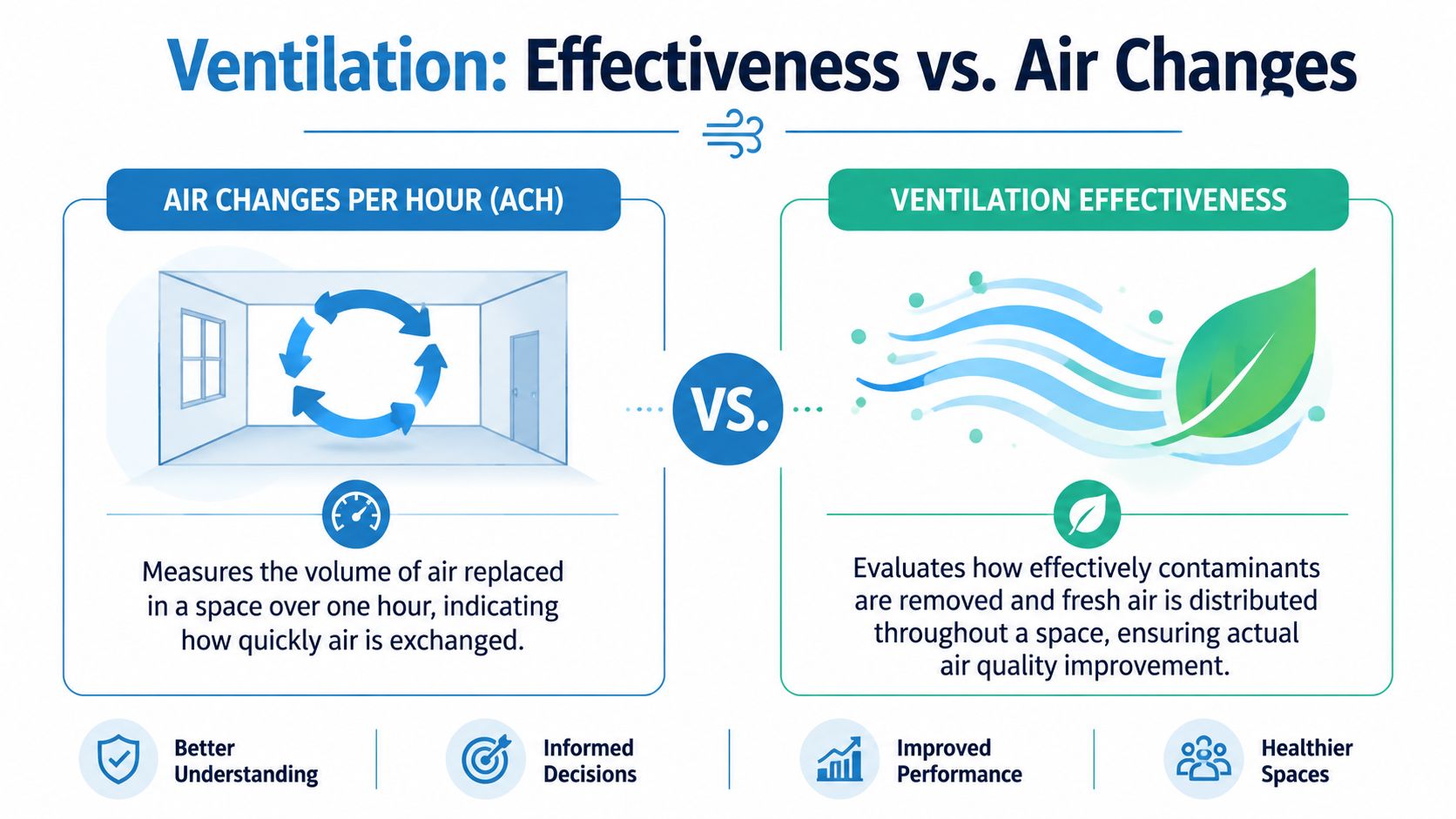
People often confuse air changes per hour with ventilation effectiveness, but they are not the same thing. Air changes tell you how much air is replaced over time. Ventilation effectiveness tells you how well that air is distributed and how well it removes contaminants from the space people occupy.
A simple analogy helps. If you run clean water into a dirty bucket, you are adding fresh water. But unless the water mixes properly and pushes the dirty water out, parts of the bucket remain contaminated. Rooms behave in a similar way. Air can be entering and leaving without doing much useful work where it matters.
Air changes measure volume
Air changes per hour, often shortened to ACH, are useful for sizing and benchmarking systems. If you want a clear refresher on the basic calculation, this piece on understanding air changes per hour is a practical primer.
But ACH on its own can mislead. A room can show decent air change numbers while still leaving dead spots around desks, beds, prep areas, or seating. That happens when supply and extract locations, opening geometry, or obstructions create poor circulation.
Ventilation effectiveness measures results
Professionals use several ways to think about this, but one important benchmark is the Zone Air Distribution Effectiveness, or Ez Factor. According to ASHRAE Standard 62.1-2022 guidance summarised here, the Ez Factor is a key metric for evaluating air distribution, and for UK commercial spaces like kitchens, an Ez Factor of 0.8 or higher is an important target for effective contaminant removal. The same source notes that some mesh types can reduce effective airflow by 5-12%, which needs to be accounted for in design and selection.
That matters because a screen doesn't just “sit there”. It introduces resistance. Sometimes that resistance is minor and entirely manageable. Sometimes it's enough to change how a room performs, especially if the opening was marginal to begin with.
A room with high air movement near the window can still have poor ventilation effectiveness at head height across the rest of the space.
Why facilities managers and homeowners should care
For a homeowner, the practical question is simple. Does the room clear moisture and stale air reliably without forcing you to leave openings unprotected?
For a facilities manager, the question is broader:
- Is fresh air reaching the breathing zone
- Are contaminants leaving the occupied space
- Do screens, doors, blinds, layout, or heat sources alter the intended airflow path
- Will the room still perform when windows and doors are used as they are in normal operation
That's why “more airflow” isn't always enough. You need useful airflow in the right place, for long enough, under real operating conditions.
Key Factors That Influence Airflow Quality
A room can meet an airflow target on paper and still feel stale in daily use. I see this most often where windows have been fitted with insect screens after the original ventilation approach was set. The opening is still there, but the room no longer breathes in quite the same way.

Room shape and layout control where fresh air actually goes
Air does not spread evenly just because a window is open. A shallow room with a clear path from inlet to outlet will usually perform well. A deeper room with alcoves, tall furniture, or a door kept shut can leave parts of the occupied zone under-ventilated, even if there is noticeable air movement near the opening.
A few layout issues come up repeatedly on site:
- Tall storage or wardrobes beside windows divert incoming air away from the room
- Partitions, booth seating, and screens create dead spots where stale air lingers
- Closed internal doors break the flow path needed for cross-ventilation
- Heat-producing appliances and solar gain can drive air upward or sideways instead of through the breathing zone
Ceiling height matters too. In warmer rooms, stale air can collect high up while the occupied area gets less mixing than expected. That matters more when an insect screen has already reduced the free area of the opening.
Ventilation type affects pollutant removal
Natural ventilation, continuous extract, and balanced mechanical systems all move air differently. Guidance from the Chartered Institution of Building Services Engineers on ventilation and indoor air quality makes the key point clearly. Good ventilation depends on air reaching occupants and removing contaminants from where they are generated, not solely on the total volume of air supplied.
In practice, that means two rooms with similar air change rates can perform very differently. One clears moisture and odours quickly. The other leaves stagnant pockets near desks, beds, cookers, or seating areas.
Day-to-day use changes the result
Buildings are used, not staged. A blind gets lowered against glare. A bedroom door is shut overnight. A kitchen window opens only a small amount because of weather or security concerns. Each of those decisions changes pressure and flow path.
The best setup is the one that still works under normal use.
That is why small fixed vents and background openings still matter. If a room depends heavily on one screened window, check whether other openings are supporting the airflow path. In some properties, air brick ventilation covers can also affect how easily background air enters or leaves the space, so they need to be considered as part of the same system rather than as separate details.
Insect screens add resistance, so specification matters
This is the part many general guides miss. UK Building Regulations Part F sets minimum ventilation provisions, but it does not tell you how a specific fly screen, frame depth, or mesh pattern will alter a naturally ventilated room in service.
That gap matters because screens change the opening itself. Finer mesh improves insect protection but increases resistance. A thicker frame can reduce clear area. Poor fitting around the reveal can interrupt the intended air path. If the original window opening was only just adequate, those losses can be enough to tip the room from acceptable to disappointing.
A study in Indoor and Built Environment on natural ventilation through windows found that opening configuration and effective opening area have a direct effect on airflow performance under real conditions, which is exactly why screened openings should be assessed as installed, not assumed to behave like an unobstructed window (study here).
For facilities managers and homeowners, the practical lesson is simple. Treat the screen as part of the ventilation design. Choose mesh and frame details that match the room, the opening size, and how the space is used.
Meeting UK Ventilation Standards and Regulations
Regulation doesn't focus on “nice fresh air” as a vague idea. It focuses on minimum performance because poor ventilation leads to predictable building and health problems. That is why ventilation effectiveness matters in compliance conversations, not just in comfort discussions.
What Part F means in practice
Under the 2021 revisions to Approved Document F, new homes must achieve whole-dwelling ventilation rates of at least 0.3 litres per second per square metre. The same source notes that poor ventilation effectiveness contributes to damp and mould issues in 21% of UK homes.
For homeowners, that means ventilation isn't optional background advice. It is a core part of moisture control, indoor air quality, and basic building performance. A house can be modern, warm, and well insulated, but if fresh air isn't being delivered effectively, those benefits can turn into trapped humidity and stale air.
Compliance is about delivered performance
A common mistake is to think compliance ends when an opening or fan is installed. It doesn't. What matters is whether the system or natural opening arrangement delivers the intended air movement in the lived space.
That includes practical accessories around the opening. If you fit screens, covers, or restrictors, they become part of the ventilation pathway. In some homes, that extends to subfloor and background ventilation too. If that area is part of your problem, these air brick ventilation covers are relevant because airflow protection and pest exclusion often overlap.
Commercial kitchens have less tolerance for poor airflow
For food businesses, airflow is tied to hygiene, heat removal, and pest control. The same Approved Document F source above notes that for commercial kitchens, FSA compliance is tied to maintaining these airflow levels even with screens fitted. In practice, that means you cannot treat the screen as separate from the ventilation plan.
A kitchen that depends on openable doors or windows for part of its make-up air needs those openings to remain usable during service. If staff avoid opening them because of insects, the room loses one part of its intended ventilation route. If the wrong mesh or frame arrangement adds too much resistance, the opening may be technically open but operationally weak.
How effectiveness is checked
Professionals often assess ventilation effectiveness using methods such as tracer gas decay and air distribution analysis. You don't need to run those tests to grasp the principle. The test is asking whether contaminants are removed from the occupied zone at the rate the design assumes.
That's the reason standards exist. They are trying to protect real performance, not just box-ticking.
How Screen Mesh Choice Impacts Ventilation
Mesh choice is where ventilation effectiveness becomes a specification issue rather than a theory problem. Different mesh types solve different problems, and they do not behave the same way in airflow terms. If you ignore that, you can end up with a screen that keeps pests out but weakens the room's ventilation performance.
For homes using natural ventilation, that trade-off deserves attention. UK domestic ventilation standards require 0.5 air changes per hour, and field measurements show that while many systems over-ventilate, about 17% of systems fail to meet the 10 L/s per person outdoor air requirement, according to this NIST report. In practice, screened openings can help occupants keep windows open more consistently, which supports passive ventilation rather than relying solely on mechanical operation.
The right question isn't “does mesh reduce airflow”
It does. The better question is: how much reduction can the room tolerate while still delivering useful ventilation?
Standard insect mesh usually creates the least concern in ordinary domestic use because it balances open area with pest control. Finer products such as midge or pollen mesh add resistance, but they may still be the correct choice where biting insects or allergies drive occupant behaviour. A slightly more resistive screen that people keep in use can outperform an unrestricted opening that stays shut most of the time.
The guide to best fly screen mesh options for UK homes is a useful reference when you're matching mesh type to room use rather than buying on appearance alone.
Premier Screens Mesh Options vs Airflow Permeability
| Mesh Type | Primary Use | Estimated Airflow Reduction | Best For |
|---|---|---|---|
| Standard insect mesh | General flying insect protection | Lower end of the 5-12% range noted for some mesh types in airflow guidance | Kitchens, bedrooms, living spaces where maintaining airflow is the main priority |
| Superfine midge mesh | Protection against smaller insects | Higher than standard insect mesh | Areas affected by midges or smaller biting insects |
| Pollen mesh | Reducing pollen ingress alongside insect control | Higher than standard insect mesh | Bedrooms and living areas where allergy reduction matters |
| Toughened pet-resistant mesh | Greater durability against scratching and impact | Depends on build and opening arrangement | Doors and openings used heavily by households with pets |
Only one point should drive the choice: select the lightest mesh that still solves the actual problem in the room. If insects are occasional, don't overspecify. If the room faces a known midge issue, don't under-specify and then stop opening the window.
Choose mesh by use pattern, not by catalogue order. A bedroom, back kitchen door, and café serving hatch rarely need the same balance of openness and protection.
What works in practice
Three habits usually produce the best outcome:
- Match mesh to exposure. Use finer mesh only where the pest pressure or allergy issue justifies it.
- Preserve opening area. A larger screened opening can offset some airflow loss better than a small screened opening.
- Think in systems. Window size, room depth, internal door position, and extract behaviour all affect whether the screen's resistance matters.
This is also the one place where a product choice can be discussed plainly. Premier Screens Ltd supplies made-to-measure insect screens with different mesh options, which is useful because the ventilation answer is rarely “fit the same mesh everywhere”.
Practical Tips for Maximum Fresh Air and Protection
A common failure looks like this. The bedroom window is open on a warm evening, the insect screen is fitted, and the room still feels stale by midnight. In most cases, the screen is not the whole problem. The opening is too small, the air has no clear route through the room, or the mesh is finer than the space needs.
The practical aim is straightforward. Keep openings usable for long enough to remove heat, moisture, odours, and indoor pollutants, while still stopping the insects that would otherwise make people shut the window.
For homeowners
Start by checking whether the room can flush through. A screened window on its own often gives disappointing results if the door stays shut, the landing is stagnant, or furniture blocks the air path. I usually advise clients to test the room in the conditions that matter most: bedtime in summer, after a shower, or during cooking.
A few habits make the biggest difference:
- Open for through-flow, not just intake. Use a second opening or an open internal door so air crosses the occupied part of the room instead of pooling near the window.
- Ventilate before the room peaks. Bedrooms benefit from airing before sleep and again in the morning. Kitchens and bathrooms need ventilation during use and after, not once condensation is already running down the glass.
- Keep the screened free area meaningful. If insects are the problem, a screen helps. If the opening is already small, adding a fine mesh to a narrow casement can leave too little effective area for useful purge ventilation.
- Fit the screen people will live with. Retractable or removable screens suit rooms where full opening is only needed at certain times. A fixed screen can work well, but only if it does not discourage cleaning or window use.
- Judge performance by the room, not the product. If humidity hangs around, odours linger, or the far side of the room stays stuffy, the setup needs adjustment.
For commercial operators
Commercial buildings add another layer of difficulty because the air demand changes with occupancy, equipment, and process heat. In practice, the key question is simple: does the screened opening still support the way the building is meant to run?
That matters most where extract is doing heavy work. A rear door with an insect screen may help pest control, but if it cuts the make-up air path too far, fans pull harder, doors become awkward to open, and the room can slip into poor conditions during the busiest part of the day. In kitchens, food prep areas, and bin stores, I look first at the actual operating pattern rather than the screen in isolation.
Focus on these checks:
- Confirm make-up air is still available when extracts, canopy systems, or toilet fans are running.
- Use screen formats that suit the traffic level at external doors and serving points. Durability and ease of opening matter as much as mesh type.
- Test during live conditions with staff, heat, and equipment operating, not during a quiet morning walkthrough.
- Avoid turning one opening into a bottleneck. If a screened door is the only realistic air route, the screen specification and frame design need more care.
If your site includes food prep space, these fly screens for commercial kitchens are relevant because hygiene control only works in practice if staff can keep openings in use without undermining airflow.
One rule holds across both homes and commercial buildings. The best screen is the one that preserves enough usable airflow that people keep ventilating the space.
If insect protection is needed without giving up practical day-to-day ventilation, Premier Screens Ltd manufactures made-to-measure fly screens for UK homes, commercial kitchens, and public buildings. The screen type and mesh should be chosen as part of the ventilation plan, with the opening size, room layout, and usage pattern all considered together.
See our commercial fly screens range for kitchen and public-building options.
