
A room can feel wrong long before anyone can explain why. The office gets heavy by mid-afternoon. A bedroom feels stale even with the window open. A café kitchen has extraction running, but steam still hangs in the air and flying insects become a problem the moment staff try to bring in more fresh air.
That's usually where airflow measurements stop being a technical extra and become a practical necessity. If you don't measure airflow, you're relying on guesswork. You might blame the fan, the window, the weather, or the screen, when the actual issue is somewhere else entirely.
Why Measuring Airflow Is Your First Step to a Better Space
Poor ventilation shows up in ordinary ways. Condensation lingers. Smells don't clear. Heat builds up in one corner while another stays draughty. In commercial settings, the consequences go further. Air movement affects comfort, hygiene, and whether a space is operating as intended.
Airflow measurements matter because they turn a vague complaint into something you can test. Instead of saying a room feels stuffy, you can check whether air is moving where it should. Instead of assuming a screen or vent cover is the problem, you can compare conditions before and after a change. That's how sensible ventilation decisions get made.
Ventilation problems are rarely caused by one thing
Most buildings don't have a single neat fault. They have a combination of factors. A fan may be running, but the intake is poor. A window may open wide, but the air path across the room is weak. A fly screen may be fitted correctly, but a blocked extract grille is doing the primary damage.
That's why airflow measurement developed into a proper engineering discipline alongside modern ventilation standards in the mid-20th century. The standardisation of testing and balancing in the 1960s established the principles still used to check whether systems are delivering the right balance of fresh air, comfort, and energy control, as outlined in this history of airflow measurement and balancing practice.
Practical rule: If you haven't measured it, you don't yet know whether you have an airflow problem, a distribution problem, or a maintenance problem.
For homeowners, that might mean checking whether a home office gets enough fresh air once the window is screened. For facilities teams, it might mean proving that a meeting room, classroom, or kitchen still ventilates properly after a retrofit.
Why screens belong in the conversation
Ventilation and insect control are often treated as separate jobs. In practice, they're linked. The whole point of a screen is to let you keep openings usable without inviting pests indoors. But the right way to judge that setup isn't by assumption. It's by measuring airflow with the opening clear, then measuring it again with the screen in place.
That's especially useful if you're trying to improve comfort without losing hygiene standards or outdoor access. A data-led approach helps you make better choices about mesh type, opening size, and placement. If indoor freshness is part of the wider goal, this guide to improving indoor air quality is a sensible companion read.
Choosing Your Airflow Measurement Tools
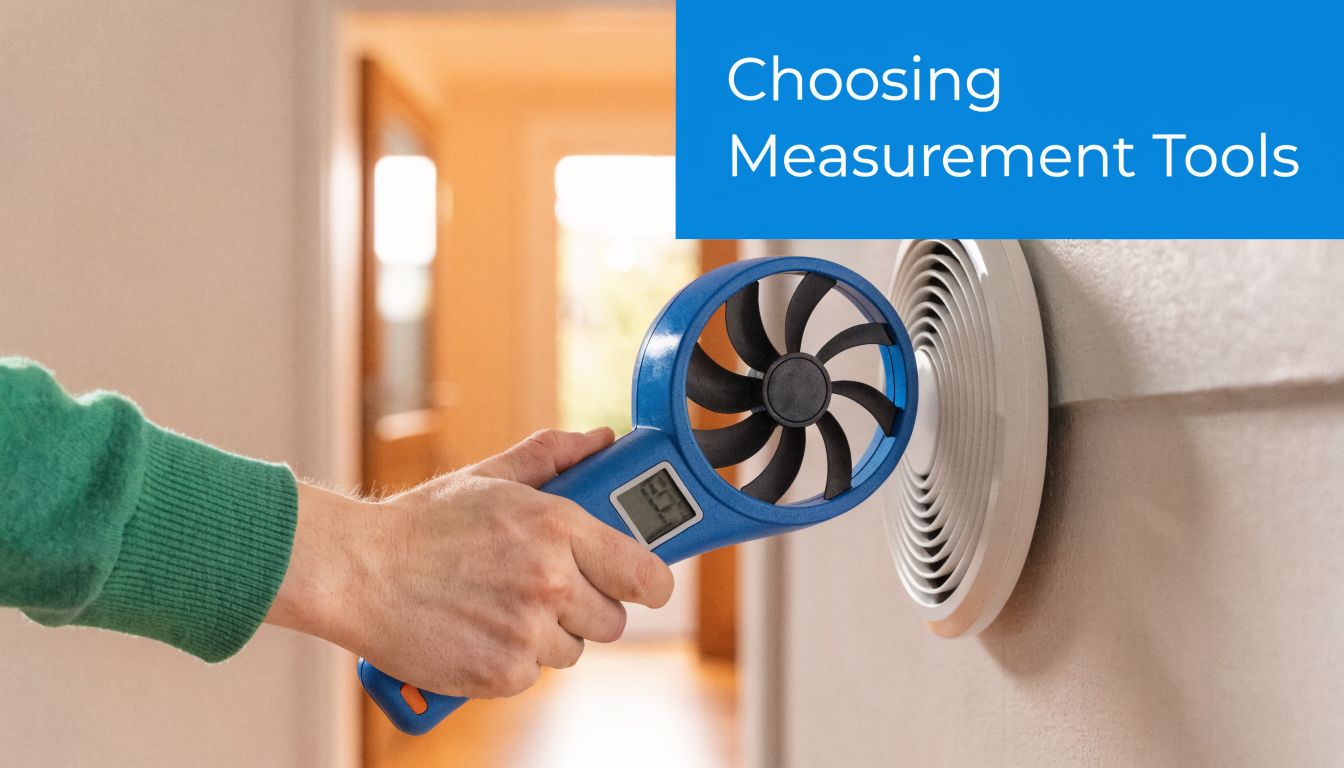
You don't need a van full of specialist kit to learn something useful from airflow measurements. You do need the right tool for the right job. That's where many people go wrong. They buy one device, use it everywhere, and then wonder why the readings don't line up with what they feel in the room.
What each tool does best
A basic toolkit usually comes down to three categories.
- Vane anemometer. Best for quick checks at grilles, vents, open windows, and doorways where air movement is reasonably direct. It's easy to use and gives practical readings fast.
- Hot-wire anemometer. Better for lighter or less stable air movement, where subtle changes matter. It can be useful for delicate checks around openings, though it also demands steadier handling and more care.
- Flow hood or balometer. Best when you need total air volume from a supply or extract terminal rather than just local air speed. This is more common in professional balancing and commissioning work.
- Smoke pencil. Not for a number, but for a pattern. It shows direction, leakage, dead spots, and whether air is short-circuiting near a window, vent, or screen.
A homeowner usually gets the most value from a vane anemometer and a smoke pencil. A facilities manager may need those plus access to a hood or specialist contractor support for supply and extract terminals.
When simple tools beat advanced ones
More technology doesn't always mean a better answer. If you're checking whether a kitchen window still provides usable natural ventilation after fitting an insect screen, a straightforward comparison is often enough. Measure the incoming air with the opening unobstructed. Fit the screen. Measure again in the same conditions as closely as you can. Then use a smoke pencil to see whether the air path into the room has changed.
That combination tells you more than a single isolated number ever will.
A smoke test often reveals the issue faster than a display screen does. You can see the draught bypassing the occupied area, curling back on itself, or stalling against a reveal.
Choosing by situation, not by spec sheet
Here's a practical way to match the tool to the task.
| Task | Most useful tool | Why it works |
|---|---|---|
| Checking a trickle vent or open sash | Vane anemometer | Good for direct spot checks |
| Looking for leakage around frames | Smoke pencil | Shows movement patterns clearly |
| Measuring a supply or extract grille | Flow hood | Captures total delivered airflow |
| Testing gentle movement near a screened opening | Hot-wire anemometer | More sensitive to low-speed air |
| Comparing before-and-after screen performance | Vane anemometer plus smoke pencil | Gives both a number and a visual check |
The important point is this. Airflow measurements are only useful when the method suits the opening, the air pattern, and the question you're trying to answer. If the question is “is this screen ruining ventilation?”, use a method that compares like with like. If the question is “is this extract terminal moving enough air?”, use a method designed for terminal airflow, not a quick spot reading at one edge.
A Practical Guide to Taking Accurate Measurements
Most bad airflow measurements come from bad setup, not bad equipment. The sensor is held in the wrong place. The room conditions change halfway through. Someone takes a single reading in turbulent air and treats it as a fact.
Good practice is repetitive by design. You follow the same steps each time so that your numbers mean something.

Start by controlling the test conditions
Before you switch on a meter, decide what exactly you're testing. Is it the airflow through a window opening, the performance of an extract point, or the effect of a screen on a naturally ventilated room?
Then keep the conditions as steady as possible.
- Set the opening position. If a window is half open for the first reading, keep it half open for the next one.
- Keep doors and nearby windows consistent. Random changes elsewhere in the building will alter the result.
- Note fan settings. If mechanical ventilation is involved, don't change speeds between readings unless that's part of the test.
- Record the basics. Location, time, opening size, and whether the screen is fitted.
If you're measuring around a recessed opening, understanding the geometry helps. The depth and shape of the reveal can affect local turbulence around a window and influence where you place the sensor. This overview of what a window reveal is is useful if you're checking airflow close to frames and recesses.
Measure where the airflow is representative
This is the point many people miss. Air doesn't move evenly across every opening. It speeds up at some points, slows down at others, and becomes messy near edges, corners, bends, dampers, and fittings.
For commercial ductwork, the most defensible practice is to test in a straight section away from disturbances. A common professional guideline is to measure at a plane about 2.5 duct diameters away from a disturbance because elbows, dampers, and transitions can distort the profile and make readings misleading, as explained in this guidance on proper use of air velocity instrumentation.
That principle applies outside ductwork too. Don't press a handheld meter into a corner of a window opening and assume it represents the whole opening. Move across the usable area and sample multiple points.
Avoid reading too close to edges, fittings, or obstructions. Turbulence there can make a healthy airflow look weak, or a weak airflow look stronger than it is.
Use a repeatable method for windows and screens
For natural ventilation, a simple before-and-after method works well.
Open window baseline
Take several readings across the opening with no screen in place. Keep the sensor orientation consistent. If the airflow direction changes with gusts, spend longer observing and note that the air is variable rather than pretending the result is precise.
Screened window test
Fit the screen and repeat the same pattern. Same opening. Same sensor position. Same room conditions. If the readings change, you've isolated the screen's effect far better than by relying on feel alone.
Visual confirmation
Run a smoke pencil around the opening after the numerical test. That helps confirm whether the screen is creating an even intake, redirecting air, or exposing a dead zone near the sill or head.
Take averages, not heroic single readings
A one-off number is weak evidence. Airflow shifts from moment to moment, especially near natural openings. Multiple readings give a truer picture.
A practical routine is to sample across the opening or grille in a consistent pattern, then calculate an average. In ducts, the professional equivalent is a traverse across the cross-section, averaging multiple points before converting velocity into volume flow. The logic is the same at any scale. One point rarely tells the full story.
Know when the setting is working against you
Real buildings are awkward. Ceiling voids are tight. Duct runs are short. Retrofit work leaves little room for ideal test positions. When you can't get a clean straight run or a stable opening condition, be honest about the limitation and adapt the method.
That may mean using pattern checks and comparative measurements rather than chasing a supposedly exact figure. It may also mean bringing in a more suitable approach for constrained systems rather than forcing a handheld reading where turbulence dominates.
From Raw Numbers to Real Insights
A display reading only becomes useful when you connect it to a decision. Air speed by itself won't tell you whether a room is well ventilated. It won't tell you whether air is reaching the occupied zone. It won't tell you whether one screened opening is enough, or whether the room needs a different air path altogether.
What matters is what the readings mean in context.
Velocity is local, airflow is overall
If you measure air speed at an opening, you're measuring what's happening at that point. That's helpful, but ventilation performance is broader than one point reading. In proper room studies, engineers often take far more detailed samples. One experimental study recorded air velocity, velocity fluctuation, temperature, and tracer-gas contaminant concentrations at 54 points in displacement-ventilated rooms, which shows how granular serious ventilation assessment can be in practice, as described in this AIVC study on air movement and contaminant measurement.
For everyday building checks, you won't map a room that densely. But the lesson still applies. Don't overinterpret a single figure from one spot.
Turn readings into decisions
Here's a practical way to think about your results.
- Strong reading, poor comfort. Air may be entering or leaving the room, but not reaching where people sit, stand, or work.
- Weak reading, obvious stuffiness. Ventilation is likely underperforming, or the opening path is too restricted.
- Good reading before a screen, poor reading after. The mesh choice, free area, or installation detail needs another look.
- Little difference before and after the screen. The screen probably isn't the limiting factor. Check extraction, room layout, or blocked vents.
Use this table as a room-by-room worksheet
The most useful benchmark for many people is Air Changes per Hour (ACH), which describes how often the air in a room is replaced. The exact requirement depends on the room, how it's used, and what guidance or compliance framework applies to that site.
Because requirements vary by application, the best use of an ACH table is as a working document for your own project. Populate it with the targets that apply to your building, then compare your measured or commissioned performance against those figures.
| Space Type | Recommended ACH (per hour) |
|---|---|
| Residential bedroom | Use the requirement or design target that applies to your project |
| Home office | Use the requirement or design target that applies to your project |
| Bathroom | Use the requirement or design target that applies to your project |
| Classroom | Use the requirement or design target that applies to your project |
| Office | Use the requirement or design target that applies to your project |
| Commercial kitchen | Use the requirement or design target that applies to your project |
| Café or restaurant dining area | Use the requirement or design target that applies to your project |
The number only helps if it's tied to room use. A bedroom, a kitchen, and a prep area shouldn't be judged by the same ventilation expectation.
What to do with the result
Once you've got your readings, ask practical questions.
| What you measured | What it may mean | Next action |
|---|---|---|
| Air moves well at the opening but the room still feels stale | Distribution problem | Check cross-ventilation and extract path |
| Extract airflow seems low | Maintenance or fan issue | Inspect filters, grilles, and fan operation |
| Screened opening performs noticeably worse | Too much resistance | Review mesh type or screen area |
| Results vary wildly between tests | Conditions unstable | Repeat with tighter control of doors, windows, and fan settings |
That's how airflow measurements become useful. Not as isolated data, but as evidence you can act on.
Troubleshooting and Optimising Poor Airflow
Low readings don't automatically mean the whole ventilation strategy has failed. They mean you need to work through the likely causes in the right order. Start with what's easiest to check. Dirt, blockage, poor positioning, and awkward airflow paths account for a lot of disappointing results.

Fix the obvious restrictions first
If a vent or grille is dusty, clean it before you conclude the system is undersized. If an extract fan is noisy but ineffective, inspect the path rather than trusting the sound. If a window opens into a cramped reveal or behind blinds, move the obstruction and measure again.
This sounds basic because it is. Good troubleshooting usually is.
For a simple maintenance reference on the impact of dirty terminals and duct openings, this guide on cleaning dusty air vents in Baltimore shows the sort of buildup that can interfere with airflow in real properties. The location is different, but the lesson carries over. Dirt changes performance.
Don't blame the screen too quickly
People often fit a screen, notice the room still feels stuffy, and assume the mesh is the entire problem. Sometimes it is part of the issue. Often it isn't.
A poor-quality screen can create unnecessary resistance, especially if the mesh is overly dense for the application, badly fitted, damaged, or loaded with dust and grease. A well-chosen screen in a sensible frame is a different matter. The key question isn't “does any screen reduce airflow?” Of course any barrier changes air movement. The core question is whether the reduction is acceptable for the room and whether the design still supports usable ventilation.
That's why comparative measurement matters so much.
If airflow was weak before the screen went on, the screen didn't create the whole problem. It only revealed a ventilation setup that was already marginal.
Work through the likely causes in order
- Check the opening itself. A partially obstructed window, stuck trickle vent, or undersized vent panel can limit flow before the air even enters.
- Look at the air path across the room. Fresh air needs somewhere to go. If doors are shut and extract is poor, incoming air stalls.
- Inspect the extract side. Kitchens, bathrooms, and utility rooms often fail at the discharge side rather than the intake side.
- Review the screen specification. Standard insect mesh, finer midge protection, pollen-focused mesh, and tougher pet-resistant options don't behave identically.
- Clean and retest. Dust, grease, and lint can alter results enough to mislead you.
Retrofit buildings need flexible methods
Older UK buildings and modern retrofits rarely give you ideal testing conditions. Tight ceiling voids, short duct runs, and odd façade details make classic measurement methods harder to apply cleanly. That matters because some techniques depend on low turbulence and stable flow to stay trustworthy.
Where straight duct runs aren't available, alternative strategies become valuable. Technical guidance shows that measuring pressure drop across known components such as louvres or screens can provide useful airflow information in constrained settings, as discussed in this guide to outside-air measurement methods in difficult installations.
That same logic helps with façade ventilation and screened openings. If you can't create an ideal test section, use an approach that suits the geometry you have.
Match the airflow fix to the type of opening
Air bricks are a good example. They help background ventilation, but only if they remain open, appropriately protected, and free from blockage. If an air brick has been screened, covered, or adapted poorly, airflow may drop for reasons that aren't obvious at a glance. Anyone reviewing that part of the envelope should understand how air brick ventilation covers affect protection, weathering, and free air passage.
The broader lesson is simple. Don't chase one miracle fix. Test, clean, compare, and adjust the components that shape the full air path.
Achieving the Ideal Balance of Fresh Air and Protection
Good ventilation isn't an accident. It's the result of choices that have been checked, not assumed. Airflow measurements give you a way to verify those choices in the physical world, under the conditions your building operates in.
That matters because fresh air and insect protection shouldn't be treated as opposing goals. You can keep openings usable, improve hygiene, and still preserve the airflow a space needs. But the only reliable way to know you've struck that balance is to measure before and after, then respond to what the building tells you.
The best result is a usable opening
An opening that stays shut because insects get in isn't really providing ventilation. An opening that allows air in but creates maintenance headaches or hygiene risks isn't solving the full problem either.
The practical answer is to choose a screening approach that suits the room, the use, and the airflow requirement, then verify performance. For straightforward domestic openings, options such as magnetic fly screens for windows can be part of that wider strategy when they're matched to the opening properly and checked as part of the ventilation picture.
Better buildings are rarely created by adding more components. They improve when each component is measured, understood, and made to work with the rest.
Airflow measurements do exactly that. They replace hunches with evidence and help you create spaces that are healthier, more comfortable, and easier to keep clean.
If you want made-to-measure insect screening that supports fresh air without compromising on fit, finish, or practicality, speak to Premier Screens Ltd. They manufacture bespoke fly screens for homes, kitchens, hospitality sites, offices, and public buildings across the UK, with options for different mesh types, DIY supply, and professional installation.
For commercial-specific systems, see our commercial fly screens range.
