
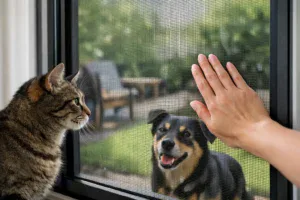
Standard insect mesh is designed to stop a fly. It is not designed to survive a cat that has decided the windowsill is hers, or a dog that leans on it. The answer is the same screen with a tougher material in it — and we make two, depending on the screen: pet mesh for fixed-frame window screens, and toughened mesh for roller screens and roller doors.
What pet mesh actually is
Our pet mesh is PVC-coated fibreglass in a 16 x 14 gauge, triple-coated for strength, manufactured to ISO 1421. It’s noticeably heavier and stiffer in the hand than standard insect mesh, and it comes in grey only.
Two things follow from that. It holds up to about 50% openness, so airflow is barely affected — better than pollen mesh, roughly comparable to standard mesh. And because it’s a stiffer material, it suits screens that hold the mesh in a fixed frame rather than winding it into a cassette — which is why roller screens use a different mesh instead.
Pet mesh is also sold by the metre at £40 + VAT, 1.2m wide, for re-meshing a screen you already own — which is often exactly what a pet owner needs, because the frame is usually fine and only the mesh has been shredded.
Toughened mesh on roller screens
Roller screens wind their mesh into a cassette, so they need a material that will roll. For those we use toughened mesh: our fine 20/30 midge weave with an additional coating that helps it stand up to the occasional swipe from a claw. It’s part of the roller system rather than something we sell on a roll — you get it by choosing it when you order the screen.
It’s worth being straight about how the two differ, because they’re not the same thing under different names. Pet mesh is the heavier, coarser material — a 16 x 14 PVC-coated fibreglass built to take repeated punishment. Toughened mesh is a fine mesh with added protection, designed for the occasional claw swipe rather than an animal that goes at it daily. If your cat treats the screen as furniture, a fixed-frame screen with pet mesh is the tougher answer. If you want a door that stands up to normal life with a pet in the house, the roller with toughened mesh is the right call.
This matters most for doors. A back door or patio door is where a dog actually pushes, and it’s the opening pet owners ask about most — so if that’s your problem, a roller door with toughened mesh is the answer rather than pet mesh.
Two different pet problems
It’s worth being clear which one you have, because they need opposite solutions.
You want the pet kept away from the mesh. This is the window case — a cat that scratches at the screen, or sits against it. Pet mesh in the frame solves it.
You want the pet to come and go. Here mesh is the wrong answer entirely — any screen a dog is meant to walk through is a screen that won’t last. Chain fly screens and PVC strip curtains are designed to be pushed through and fall closed again. Pets learn them quickly, and there’s nothing to tear.
Which screens can be made pet-resistant
Seven screens can be built to stand up to a pet. Which mesh you get depends on the screen — you select it in the price calculator on the product page, in the mesh dropdown.
| Screen | Best for | Screen from | Tougher mesh option |
|---|---|---|---|
| Hinged panel fly screens for windows | Casement windows; panel lifts out for cleaning | £35 + VAT | Pet mesh + £16 |
| Magnetic fly screens for windows | Renters; no fixings, comes off in winter | £39 + VAT | Pet mesh + £16 |
| Roller fly screens for windows | Out of sight when not in use | £62 + VAT | Toughened mesh + £24 |
| Vertical sliding fly screens | Sash windows | £169 + VAT | Pet mesh + £16 |
| Horizontal sliding fly screens | Sliding windows and wide openings | £181 + VAT | Pet mesh + £16 |
| Roller fly screen doors | Back doors and patio doors | £270 + VAT | Toughened mesh + £24 |
| Double roller fly screen doors | Wide openings and French doors | £295 + VAT | Toughened mesh + £39 |
For a cat that pushes rather than climbs, the hinged panel is usually the sensible starting point — it’s the cheapest way in, and if the mesh ever does get damaged the panel comes out and can be re-meshed rather than replaced.
What pet mesh won’t do
This part matters more than the sales copy, so we’d rather say it plainly.
Our screens are not designed to keep pets indoors. That’s what we say on the product pages and it’s worth repeating here. Pets are individuals, and we can’t guarantee that one won’t find its way through the mesh — so give an animal time to get used to a new screen, and use something more robust if escape is a real risk.
A fly screen is not a safety barrier. It is mesh in a light frame, and it is not designed or tested to hold an animal’s full weight against it. Do not rely on any insect screen — ours or anyone else’s — to stop a cat falling from an upstairs window or balcony. If that’s the risk you’re solving, you need window restrictors or a purpose-made pet barrier, and it’s worth asking your vet what they recommend.
It isn’t chew-proof. It resists claws and pushing. A determined dog with time and teeth will get through it, as it will get through most things.
It won’t change behaviour. If a cat is trying to get out of a window because something is wrong, a stronger mesh addresses the symptom.
Ordering
Choose your screen, enter your measurements, and pick the mesh from the dropdown in the price calculator — Pet Mesh on the window screens at £16 + VAT, or Toughened Mesh on the rollers at £24 + VAT, £39 + VAT on the double roller door.
Screens are made to your measurements in our own UK factory. Lead times run from 2 to 10 working days depending on the product, and the current time is shown on each product page.
Whichever mesh you end up with, it carries an antibacterial treatment as standard, at no extra cost. Titanium dioxide is worked into the mesh during weaving rather than coated on afterwards, so it doesn’t wear off, and in daylight it breaks down bacteria on the mesh surface. Worth having on a screen a dog noses at every day.
Screens are supplied ready to fit, with fitting instructions. The frames arrive pre-cut to your measurements, so there’s no cutting to do.
Common questions
Will my cat get through it?
Almost certainly not by scratching or pushing at it, which is what most cats do. But see the section above: don’t treat any screen as a guarantee, and don’t rely on one where a fall is possible.
Does pet mesh still keep insects out?
Yes. The gauge is 16 x 14, which stops flies and mosquitoes. It’s a coarser weave than pollen mesh, so it won’t filter pollen and it won’t stop midges — if you need those, that’s a different mesh.
What’s the difference between pet mesh and toughened mesh?
Pet mesh is the heavier of the two — a coarse 16 x 14 PVC-coated fibreglass that goes in fixed-frame window screens. Toughened mesh is our fine 20/30 weave with an extra coating, and it goes in roller screens and roller doors because it has to wind into a cassette. You don’t really choose between them: the screen you pick determines which one you get.
Can I put pet mesh in just one window?
Yes. Most people do exactly that — the tougher mesh where the animal actually goes, standard mesh everywhere else, since there’s no reason to pay the extra on a window the cat ignores.
My screen is already shredded. Can it be re-meshed?
If it’s a hinged, panel, magnetic or sliding screen, usually yes — the frame is almost always reusable and only the mesh needs replacing, and pet mesh is sold by the metre for exactly this. Roller screens are different: the mesh is part of the cassette assembly, so it isn’t a job you can do from a roll at home. Email us with a photo either way and we’ll tell you honestly whether it’s worth repairing or replacing.
Talk to us
If you’re not sure which screen suits your windows, or whether pet mesh is the right answer at all, tell us the window type, rough sizes and what your animal actually does. Email sales@premier-env.co.uk.