A fly problem at a commercial doorway is rarely solved by leaving a window shut. Kitchens, serving areas, warehouses and staff entrances need fresh air, frequent access and reliable protection at the same time. The best commercial fly barrier systems stop insects at the point of entry, without making daily work awkward for staff or customers.
For food preparation and hygiene-sensitive premises, a properly fitted physical barrier is a practical first line of defence. It reduces the opportunity for flies, wasps and other flying insects to enter while preserving airflow and natural light. The right choice depends on the opening, how often it is used, the level of wear expected and whether the barrier needs to remain in place all day.
What makes a commercial fly barrier effective?
A commercial fly barrier works only when it suits the way a site operates. A screen that staff have to unclip, force open or step around will soon be left aside. Equally, a poorly sized off-the-shelf screen can leave gaps around the frame, allowing insects to bypass the mesh entirely.
The most effective systems combine a close, made-to-measure fit with a durable frame or hanging arrangement and mesh appropriate to the environment. Aluminium-framed screens offer a firm, long-lasting solution for windows and lower-traffic doors. For busy access points, flexible systems that staff can pass through easily are often the better option.
Mesh selection also matters. Standard insect mesh provides dependable everyday protection while maintaining good ventilation. Where tiny biting insects are a concern, finer mesh can be considered, although a finer weave can slightly reduce airflow and visibility. In greasy, dusty or high-use areas, choose a screen format that can be cleaned and maintained without disrupting operations.
Best commercial fly barrier systems by opening type
There is no single best system for every premises. The right barrier starts with the opening rather than the building category.
Heavy-duty hinged fly screens for service doors
Hinged fly screens are a strong choice for external personnel doors, back-of-house access and kitchen doors that are used regularly but not continuously. A rigid aluminium frame is fixed to the opening, and the screen opens in the same familiar way as a standard door. This gives staff a clear route through the entrance while keeping the mesh taut and protected.
They are particularly useful where a close perimeter seal is needed and the doorway can accommodate an outward or inward opening screen. Self-closing arrangements are valuable in busy working areas because the screen returns to position after use, reducing the chance that a door is left open. The trade-off is clearance: the swing of the screen must not obstruct a walkway, shelving or another door.
PVC strip curtains for frequent traffic
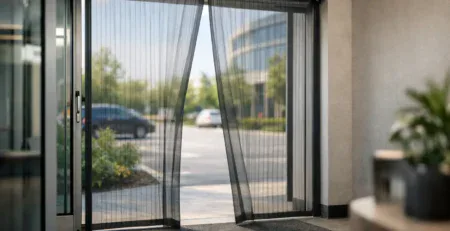
PVC strip curtains are often the most practical fly barrier for loading areas, stock rooms, walk-in storage access and high-traffic commercial doors. Overlapping strips create a flexible barrier that people, trolleys and equipment can pass through without needing to operate a handle or latch.
For premises where doors are open repeatedly throughout the day, this ease of passage is a major advantage. Strips can also help separate working zones while allowing light through. They are not a substitute for a fully sealed door, and the overlap and strip weight need to match the opening and traffic level. A light-duty arrangement may be suitable for pedestrian use, while busier or wider openings need a more substantial specification.
Sliding and plissé screens for wide openings
Wide doorways, patio-style openings and serving hatches can be difficult to protect with a conventional hinged screen. Sliding fly screens provide a tidy solution where there is enough side room for the panel to move across. They are well suited to openings where access is controlled and a rigid, framed finish is preferred.
Plissé screens are another option for larger openings where a compact retracting design is useful. Their concertina-style mesh gathers neatly when not required, making them suitable for areas that need flexible access at different times of day. These systems should be selected carefully for commercial use, particularly where handling is frequent. The track must remain clear of debris, and staff need to use it correctly to protect the mesh and mechanism.
Roller fly screens for windows and hatches
Roller fly screens are especially effective on kitchen windows, office windows, preparation-area windows and occasional-use serving hatches. The mesh retracts into a cassette when the screen is not required, helping to keep the opening clear during cleaning, maintenance or colder months.
They are best for openings that do not need people to walk through. A made-to-measure roller screen gives a cleaner fit than a cut-to-size alternative and is less likely to sag or pull away at the sides. For sites that ventilate through several windows, roller screens can provide consistent protection without permanently changing the look or operation of the room.
Choosing mesh for hygiene, airflow and visibility
A frame is only as effective as the mesh within it. Standard fly mesh is suitable for many commercial applications, keeping common flying insects out while letting air circulate. This is usually the sensible starting point for restaurants, cafés, staff rooms, offices and general workspaces.
Food-preparation areas may need closer attention to cleaning routines and the condition of the mesh. Any tears, loose edges or accumulated residue compromise the barrier and should be dealt with promptly. Where a screen is exposed to stronger use, selecting a durable mesh and a stronger frame from the outset is more cost-effective than repeatedly replacing lightweight products.
Consider visibility as well. Dark mesh can provide a clearer outward view in some settings, while finer mesh may be preferable where smaller insects are prevalent. The choice is always a balance: maximum insect exclusion, airflow, light transmission and ease of upkeep should be assessed together rather than in isolation.
Measure the opening, not the old screen
Commercial fly barrier systems should be sized to the actual finished opening. Measuring an existing screen can reproduce its fitting errors, particularly if it has bent, shrunk or been installed with uneven gaps. Take width and height measurements at several points, as older door frames and reveals are not always square.
For doors, also check which way the main door opens, the available clearance around the frame, handle positions, closers and threshold details. For windows, identify whether the screen will be fitted inside or outside the reveal and whether opening handles project into the intended screen position. These checks prevent a well-made product from becoming difficult to use once it arrives.
Made-to-measure systems are particularly valuable for commercial sites because openings are often non-standard. They provide proper edge coverage and reduce the weak points that insects exploit. Premier Screens manufactures bespoke fly screen systems for this reason, offering configurations for windows, doors and demanding commercial access points rather than asking customers to adapt a generic screen on site.
Installation and daily use matter as much as the product
Even the strongest screen benefits from sensible installation and a straightforward routine. Fixings must suit the substrate, whether that is timber, uPVC, aluminium or masonry. The frame should sit square, mesh should remain under even tension and moving parts should operate without catching.
Once installed, the system needs to become part of normal site practice. Staff should understand when a screen must remain closed, how to pass through strip curtains without pulling them aside, and how to report damage before it becomes a hygiene issue. Screens should be checked during regular cleaning, particularly around corners, hinges, tracks and lower edges where wear is most likely.
A physical fly barrier works best alongside good operational habits. Keep external doors closed where possible, manage waste carefully, clean spills promptly and avoid creating easy access routes around the protected opening. In food businesses, the chosen system should support the site’s own pest-control and hygiene procedures rather than be treated as a standalone answer.
How to make the right commercial choice
Start with the busiest opening on the premises. If people and stock pass through it constantly, PVC strip curtains may offer the most usable protection. If a kitchen or staff door needs a secure, framed barrier, a heavy-duty hinged screen is likely to be more suitable. For windows and non-walk-through hatches, roller or fixed screens provide unobtrusive everyday coverage, while sliding or plissé formats can solve the problem of wider openings.
The best commercial fly barrier system is the one staff will use correctly, that fits the opening without gaps and that stands up to the working environment. Choose for the traffic pattern first, then specify the frame, mesh and fitting details needed to keep insects out while fresh air continues to come in.
Browse our full range of commercial fly screens to compare systems built for exactly this kind of doorway.