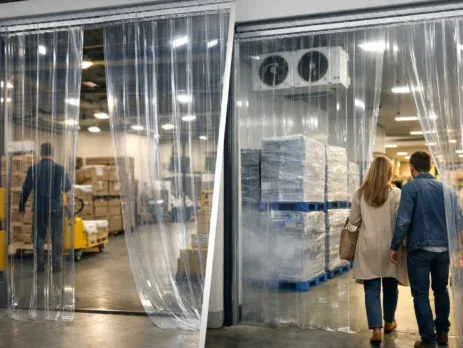
When a doorway needs to stay open for people, trolleys or regular deliveries, it can quickly become the easiest route in for flies, wasps and airborne dust. That is exactly where PVC strip curtains for doors make practical sense. They create a simple physical barrier that still allows movement, airflow and visibility, which is why they are widely used in both domestic and commercial settings.
Unlike a fully rigid door screen, strip curtains are designed for frequent traffic. The overlapping PVC strips part easily when someone walks through and then fall back into place. In the right setting, that gives you a straightforward way to reduce insect entry, support hygiene and keep access points working as they should.
What pvc strip curtains for doors actually do
The main job of a PVC strip curtain is to separate one area from another without fully closing the opening. In practice, that can mean helping to keep flying insects out of a kitchen, reducing draughts through a service entrance, or limiting the movement of dust and debris between work areas.
For many customers, the attraction is that strip curtains solve a very specific problem. A standard door has to be opened and closed. A fly screen door can be the better answer in many domestic openings. But where access is constant, hands are full, or larger items need to pass through, flexible PVC strips are often the more practical option.
They also allow natural light to pass through. Clear PVC maintains visibility, which matters in busy workplaces where staff need to see approaching people or moving equipment on the other side of a doorway.
Where PVC strip curtains for doors work best
Some products suit almost every opening. Strip curtains are not one of them. They are at their best in higher-use doorways where convenience, hygiene and durability matter more than a refined domestic finish.
In commercial kitchens, food preparation areas and hospitality premises, they are a familiar choice because they support access while helping to reduce insect ingress. In storerooms and back-of-house doorways, they can limit contamination from external areas without slowing staff down every time they pass through.
They are also useful in workshops, warehouses and trade counters. If a doorway is used repeatedly throughout the day, a rigid system can become impractical. PVC strips cope well with that kind of traffic, provided the material thickness and overlap are chosen to suit the opening.
In domestic settings, they can work well on utility rooms, garage personnel doors, outbuildings and certain rear access points. They are less commonly chosen for a main family patio entrance, where homeowners often prefer a more discreet made-to-measure insect screen solution. That is one of the key trade-offs to understand from the start.
Why they are popular in hygiene-sensitive environments
Hygiene is one of the strongest reasons people choose strip curtains. An open doorway can invite flies into areas where food is stored, prepared or served. Even if that door is only open for part of the day, the risk can be enough to create repeated problems.
PVC strips help reduce that exposure while still allowing ventilation. That balance matters. In kitchens, prep rooms and commercial premises, staff often need fresh air and regular movement through access points. Closing everything off completely is not always realistic, particularly in warmer weather.
There is also a maintenance advantage. PVC strips are straightforward to wipe down, and replacement strips can usually be changed without replacing the whole system. For environments where cleanliness and upkeep are part of day-to-day operation, that makes them a practical long-term option rather than a temporary fix.
Choosing the right specification
Not all strip curtains are the same, and a poor match between product and doorway usually leads to disappointment. Size, strip width, thickness and overlap all affect how the curtain performs.
A smaller pedestrian doorway may only need a lighter-duty setup that is easy to pass through. A wider commercial opening, or one exposed to stronger air movement, may need heavier strips and greater overlap to maintain coverage. If the strips are too light, they can move excessively and leave gaps. If they are too heavy for the application, they can become awkward for regular users.
Door height matters as well. Longer drops need the correct material weight to hang properly and return into place after use. This is where made-to-measure supply makes a real difference. A strip curtain that is built for the actual opening will perform more reliably than a generic off-the-shelf kit that needs compromise fitting.
For customers comparing options, it is worth thinking about three things at once: who uses the doorway, how often it is used, and what you are trying to keep out or separate. A back door used by family members a few times an hour is very different from a service entrance used by staff all day long.
Installation and day-to-day use
One of the reasons strip curtains remain popular is that installation is generally straightforward. The curtain is fixed above the opening, and the strips hang down with the required overlap. The exact fixing arrangement depends on the door structure and the size of the curtain, but the concept is simple.
Everyday use is simpler still. There are no hinges, no closing mechanism and no need to stop and operate the barrier. That is especially useful where staff are carrying trays, boxes or stock. The strips move out of the way and then settle back into position.
That said, it is sensible to think about user comfort. In some domestic applications, people may find repeated contact with PVC strips less appealing than a framed screen door. In trade and commercial environments, this is rarely an issue because function comes first. In a home, appearance and feel may carry more weight. It depends on the opening and how visible it is within the property.
PVC strip curtains compared with other insect-control options
Strip curtains are highly effective in the right place, but they are not the answer to every doorway. If the goal is insect control on a patio, French doors or a main rear entrance, a dedicated fly screen door often gives a neater finish and a more comfortable everyday experience.
Hinged, sliding, roller and plissé insect screens are usually the better choice where homeowners want a fitted look, easy operation and a barrier that suits living spaces. They are designed around regular domestic use and can be less visually intrusive.
PVC strip curtains come into their own when access is frequent, the opening is practical rather than decorative, and durability matters more than appearance. They are also useful where larger items need to pass through without opening and closing a framed screen each time.
That is why many properties and businesses use more than one solution. A customer might choose a made-to-measure screen for the main house door and a PVC strip curtain for the garage or utility entrance. A commercial site might use aluminium-framed screens on some openings and strip curtains on others. The best result usually comes from matching the product to the job rather than trying to make one type of barrier do everything.
What to look for before you buy
The basic idea may be simple, but quality still matters. Good PVC should hang consistently, stay clear enough for visibility and cope with regular use without quickly splitting or distorting. The fixing hardware needs to be suitable for the weight of the curtain and the type of doorway.
Accurate sizing is just as important as material quality. A curtain that is too narrow or too short will leave obvious weak points. One that is oversized without proper planning can interfere with movement and look poorly fitted. Bespoke sizing avoids those compromises and gives a more dependable result.
It is also worth checking whether replacement strips are available. In busy premises, individual strips can take the brunt of wear over time. Being able to replace sections rather than the whole curtain is more economical and easier to manage.
For buyers who need a dependable supply, particularly in hygiene-sensitive or commercial settings, working with an experienced UK manufacturer such as Premier Screens also means you are dealing with a specialist that understands fit, use case and product longevity rather than treating strip curtains as a generic add-on.
If your doorway needs to stay usable, ventilated and better protected against insects, PVC strip curtains can be a very sensible choice. The key is to use them where they genuinely fit the way the entrance works, because the right barrier is not just the one that covers the opening, but the one people will keep using properly every day.
Compare PVC strip curtains alongside our other options in our commercial fly screens range.