A busy kitchen back door is often the easiest route in for flies, wasps and other airborne pests. It is also the doorway staff need open for fresh air, deliveries and daily movement. This guide to commercial doorway screens explains how to protect that opening without making the working day harder for the people using it.
For food preparation areas, hospitality venues, workshops and staff entrances, the right screen is not simply a barrier. It needs to suit the width of the opening, the amount of traffic, the type of door and the hygiene expectations of the premises. A made-to-measure system usually performs better and lasts longer than a loose, off-the-shelf curtain that does not properly cover the gap.
Why commercial doorways need a different approach
Domestic fly screens tend to serve a single purpose: keeping insects out while a window or door is open. Commercial entrances are more demanding. They may be opened hundreds of times a day, need to accommodate trolleys or stock, and sit between areas with very different temperatures or cleanliness requirements.
The key is to allow people, goods and air through while reducing opportunities for insects to enter. That calls for a screen that returns to position after use, covers the full opening and can stand up to regular contact. A system that looks adequate when fitted but catches on deliveries, leaves edge gaps or becomes difficult to clean soon stops doing its job.
In food-facing environments, doorway screens can support good pest-control practice by helping to exclude flying insects from preparation and storage areas. They do not replace routine cleaning, waste management, proofing or a professional pest-control plan. They are, however, a practical first line of defence at a point where doors need to remain usable.
Choosing the right commercial doorway screen
The best format depends on how the doorway operates. Start with the traffic pattern, rather than choosing on appearance alone. A personnel door used occasionally has different requirements from a loading entrance used continuously during a service period.
Heavy-duty hinged fly screens
A hinged aluminium-framed screen is a strong option for a conventional outward or inward opening personnel door. It provides a defined barrier with taut mesh, and can be fitted with a self-closing arrangement so it returns after someone passes through.
This type suits kitchens, cafés, prep rooms, offices and small commercial premises where staff use the doorway regularly but do not need to push large stock through it. A properly measured hinged screen offers a neat finish and reliable perimeter coverage. Check the swing direction carefully before ordering, particularly where there are shelves, bins, steps or another door close to the opening.
PVC strip curtains for frequent traffic
PVC strip curtains are often the practical choice for wider openings and high-throughput access. Individual strips overlap to form a barrier, allowing staff, wheeled equipment and goods to pass through without operating a handle or latch. They are commonly used on warehouse doors, stockroom openings, cold rooms and service entrances.
For insect control, the strips need sufficient overlap and a good fit across the full width and height. Clear PVC maintains visibility, which is useful where people and trolleys approach from both sides. Heavier grades cope better with demanding use, although thicker material creates more resistance when passing through. That trade-off can be worthwhile where the opening is exposed to draughts or repeated impact.
Magnetic doorway screens
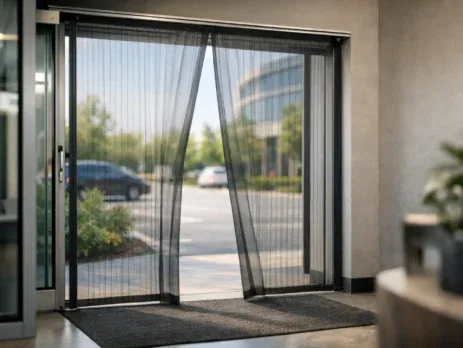
Magnetic screens are useful where fast hands-free access matters but the opening does not receive constant industrial traffic. The central magnetic closure separates as a person walks through, then closes behind them. They can work well on staff doors, temporary summer openings and lower-traffic commercial spaces.
They are generally less suitable for entrances used by bulky deliveries, pallet trucks or constantly moving staff. Magnets must align cleanly for the screen to close reliably, so accurate fitting and a reasonably even doorway are essential.
Sliding and retractable options
Sliding screens can suit patio-style commercial doors, glazed entrances and openings where a hinged screen would obstruct a walkway. Roller and plissé systems are useful where the screen needs to be opened fully at quieter times or when access is required for larger items.
These systems offer a tidy solution, but moving parts should match the expected level of use. For a busy kitchen exit that is opened all day, a simple heavy-duty hinged screen or strip curtain may be more appropriate. Retractable formats are often better for controlled access points where staff can operate them carefully.
Mesh choice matters as much as the frame
A frame may be durable, but the mesh determines what the screen will stop and how much air and visibility it allows. Standard insect mesh is suitable for keeping out common flies, mosquitoes and wasps while allowing ventilation and daylight through.
Where very small insects are a problem, a finer mesh can provide improved protection. Fine mesh reduces the size of the openings, so there can be a modest reduction in airflow compared with standard insect mesh. For a hot commercial kitchen, that balance needs consideration: the most restrictive mesh is not always the most practical if ventilation is already limited.
For locations exposed to heavier handling, reinforced or pet-resistant mesh can be worth considering. It is designed to resist tearing better than standard mesh, although no mesh should be treated as indestructible. In a doorway used for deliveries, the screen design and traffic route are usually more important than simply choosing the toughest mesh available.
If the main concern is airborne debris, privacy or solar glare, specialist mesh options may be relevant. Be clear about the primary job of the screen. A product chosen for shade or visibility control may not offer the same insect-exclusion performance as purpose-made fly mesh.
Measuring a commercial doorway correctly
Accurate measurements are the foundation of an effective screen. Measure the actual clear opening in several places, not just one point. Brickwork, frames and thresholds are not always square, especially in older premises.
Record the width at the top, middle and bottom, then the height on the left, centre and right. Note the smallest measurement where the screen needs to sit within an opening. If the system will fix to the face of the frame or surrounding wall, check that there is enough flat, solid fixing space on every side.
Also consider the threshold. A raised sill, uneven floor, drainage channel or door closer can affect both fit and operation. For a hinged screen, identify which side will carry the hinges and whether it should open in the same direction as the existing door. For PVC strip curtains, measure from the intended mounting point to the finished floor level, allowing for the required overlap at the bottom.
It is worth checking the area around the doorway before placing an order. Wall-mounted handrails, alarm boxes, pipes, extractor controls and signage can all interfere with a frame. A few minutes spent assessing these details avoids an awkward installation later.
Installation and everyday care
Commercial screens work best when they are installed square, securely fixed and checked after the first few days of use. A frame that is twisted or pulled out of alignment can leave gaps, prevent a magnetic closure from meeting properly or cause a hinged screen to drag.
Keep mesh clean by removing dust, grease and debris with a soft brush or a gentle wash using mild detergent and water. In kitchens, cleaning should form part of the regular hygiene routine, especially around lower sections that receive the most contact. Avoid harsh solvents or abrasive pads that could damage mesh, PVC or powder-coated aluminium.
Inspect the screen periodically for loose fixings, torn mesh, worn strips and gaps at the edges. Replacing a damaged strip or mesh panel promptly is more cost-effective than allowing a small fault to become a full screen replacement. It also helps maintain the standard of protection expected in hygiene-sensitive areas.
Common mistakes to avoid
The most common mistake is selecting a screen based only on doorway size. Size is essential, but traffic level, opening direction and use of the space determine whether the screen will be practical. A lightweight magnetic screen may fit the measurements perfectly yet be unsuitable for a delivery entrance.
Another issue is treating a screen as a fit-and-forget item. Doors change over time, hinges settle and staff may alter the way an entrance is used. Regular checks keep the screen functioning as intended.
Finally, do not leave obvious side or bottom gaps in the hope that the mesh alone will solve the problem. Flies will use the easiest available route. A tailored system, fitted to the real dimensions of the opening, gives far better protection than a nominally correct product with poor edge coverage.
Premier Screens manufactures made-to-measure commercial systems for the practical realities of working doorways, from framed fly screens to PVC strip curtain arrangements. The right choice is the one that staff will use without slowing down, while keeping insects outside where they belong.
See our commercial heavy duty fly screen doors and commercial fly screen door ranges, built for exactly this kind of doorway. Or explore our full commercial fly screens range.