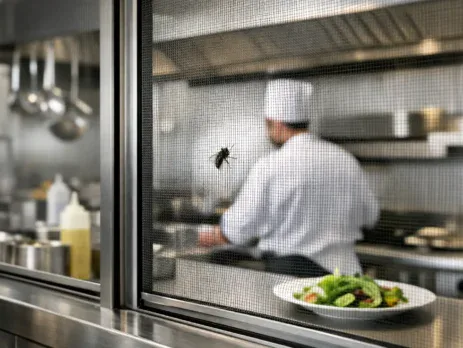
A kitchen that needs its back door open through service cannot afford flies on worktops, wasps near prep stations, or staff propping open exits with no protection in place. That is exactly where commercial kitchen fly screens stop being a convenience and start becoming part of day-to-day hygiene control. In food prep environments, the right screen has to do more than block insects. It also needs to cope with traffic, cleaning routines, heat, and repeated use without becoming a nuisance itself.
For commercial kitchens, there is rarely a single off-the-shelf answer that works well for every opening. A small serving hatch, a staff entrance, a rear delivery door and a kitchen window all behave differently. The best results usually come from choosing screen types by opening size, frequency of use and how demanding the environment is.
Why kitchen fly screens commercial settings depend on
In a domestic kitchen, an occasional fly is irritating. In a commercial kitchen, it can quickly become a hygiene issue, a staff distraction and a sign that ventilation is not being managed properly. Kitchens generate heat, moisture and food odours, which naturally attract insects. At the same time, they need regular airflow to keep working conditions safer and more comfortable.
Closing every window and door is not a realistic fix during warmer months. It can make the space uncomfortable and create knock-on problems with temperature and ventilation. Fly screens allow fresh air in while creating a physical barrier that does not rely on sprays, zappers or doors being kept shut at all times.
That matters in takeaways, restaurants, pubs, cafés, canteens, bakeries and food production areas alike. The screen is doing a simple job, but it has to do it reliably, every day, with minimal fuss.
Matching the screen to the opening
The biggest mistake in commercial screening is treating every opening the same. A kitchen window used only for ventilation needs a different solution from a doorway used by staff every few minutes.
Window screens for prep and cooking areas
For fixed ventilation points, aluminium-framed hinged or removable fly screens are often the most practical route. They provide a neat, made-to-measure fit and can be specified to suit the exact reveal or frame dimensions. In kitchens, that matters because gaps around the edge defeat the purpose.
A well-fitted window screen allows regular airflow and natural light without encouraging flies indoors. It also tends to be lower maintenance than temporary mesh products because the frame keeps the mesh tensioned properly over time. Where regular access is needed for cleaning or opening mechanisms, a hinged arrangement can make day-to-day use easier.
Door screens for frequent access
Doors are more demanding. Staff need to move quickly, often carrying trays, ingredients or cleaning equipment, so the screen cannot become an obstacle. For lower to medium traffic doors, hinged fly screen doors can work well because they are sturdy, straightforward and built for repeated opening and closing.
Where the opening is wider, or where there is a need to keep the footprint compact, sliding or plissé systems may be more suitable. These options can be especially useful when swing space is limited. The right choice depends on how the door is used, not simply on the door size.
High-traffic access points
Busy rear doors and service entrances often need a tougher answer. In these situations, heavy-duty commercial fly screens or strip-style barriers can make more sense than lighter domestic-style systems. They are better suited to constant use and more likely to stand up to trolleys, deliveries and the pace of a working kitchen.
This is one of those areas where buying purely on price can cost more later. If a screen tears, bends or starts catching after a short period, staff will stop using it properly. In practice, durability is part of usability.
What makes a commercial kitchen screen fit for purpose
Not every fly screen sold for general use belongs in a commercial kitchen. The demands are different, and the details matter.
A strong aluminium frame is usually the sensible choice because it offers rigidity without excessive weight and stands up well to regular use. A made-to-measure fit is equally important. Commercial openings are not always perfectly square, especially in older buildings, and generic screens can leave weak points where insects get through.
Mesh selection also deserves more attention than it often gets. Standard insect mesh may be enough in many settings, but some sites need finer mesh, stronger mesh or a material chosen with durability and cleaning in mind. Visibility and airflow both matter too. If the mesh is too restrictive, the kitchen loses some of the ventilation benefit. If it is too delicate for the location, its life expectancy drops.
Ease of cleaning is another practical issue. Kitchen environments create grease, steam and airborne residue. A screen that is difficult to remove, wipe down or maintain can end up neglected. The best commercial screen is not just one that fits on day one. It is one that still works well after months of service.
Common commercial kitchen scenarios
The right product often becomes clearer when viewed by use case rather than by category.
A small restaurant kitchen with opening side windows may only need framed fly screens that stay in place through the warmer months. The priority there is consistent ventilation and a tidy fit that does not interfere with daily cleaning.
A takeaway with a busy rear staff door may need a more hard-wearing door screen that can tolerate repeated traffic and occasional impact. The concern is less about appearance and more about keeping the entrance usable during peak periods.
A bakery or food production unit with multiple access points may require a mix of systems. Windows can use framed screens, while delivery or service routes may need a heavier-duty option. This is often the most effective approach because it avoids over-specifying every opening while still protecting the critical ones properly.
Installation and long-term performance
Commercial buyers usually want one of two things. They either want a screen that is easy to fit without disruption, or they want confidence that once fitted, it will not become a maintenance headache.
Made-to-measure systems help on both counts. When the frame is built for the actual opening, installation is generally more straightforward and the finished result is more dependable. There is less need for site improvisation, trimming or tolerating poor edge seals.
Long-term performance comes back to build quality and choosing the right configuration. A lightweight screen on a low-use window may give years of service. Put that same screen on a staff door that opens fifty times an hour and it will likely be the wrong product from the start. Good specification prevents unnecessary replacements.
For facilities managers and trade buyers, this matters because insect control is rarely a one-product decision. It is part of maintaining a workable environment. A screen should reduce problems, not create new ones through awkward access, weak fixings or short service life.
Kitchen fly screens commercial buyers should compare carefully
When comparing options, the first question should be how the opening is actually used. The second should be what level of durability the site needs. After that, details such as frame finish, mesh type and access style become much easier to judge.
It is also worth thinking about staff behaviour. If a screen is awkward, heavy or easy to damage, people will work around it. If it is simple and dependable, it becomes part of the routine. That human factor often decides whether a screen succeeds in practice.
For many businesses, a bespoke system supplied directly by a specialist manufacturer is the more reliable route than trying to adapt a generic retail product. Commercial kitchens are not standard environments, and the openings rarely behave like those in a house. A tailored fit, durable construction and the right screen style for each access point usually deliver better value over time.
Premier Screens focuses on exactly that sort of practical specification, with made-to-measure options built for kitchens, doors, windows and other access points where hygiene and airflow need to work together.
The best commercial kitchen fly screen is usually the one that staff barely have to think about. It keeps insects out, lets fresh air in, and carries on doing its job through the busiest part of the day.
See our full commercial fly screens range for more kitchen and hospitality options.