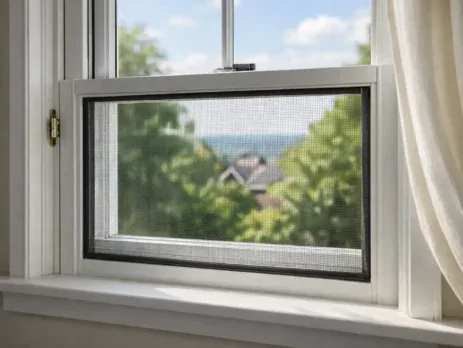
Sash windows look right in period homes and plenty of newer properties too, but they bring a familiar problem in warmer months. As soon as the lower sash goes up, flies, wasps and midges seem to treat the opening as an invitation. Fly screens for sash windows solve that neatly, provided the screen is designed around how a sash window actually opens and not treated like a standard casement.
That distinction matters more than many buyers expect. A poorly chosen screen can obstruct movement, sit awkwardly within the reveal, or leave enough gaps around the frame to make it ineffective. A well-made, made-to-measure screen does the opposite. It preserves ventilation, keeps the opening usable and gives a much cleaner finish, whether the property is a townhouse, a rental flat or a commercial premises with sliding sash windows.
Why sash windows need a different approach
Sash windows do not open on side hinges, so the usual assumptions about window screening do not apply. Instead of a panel swinging outwards or inwards, the sash slides vertically. That changes where the screen can sit, how it is accessed and whether it needs to be removable, fixed or retractable.
In practical terms, the key question is not simply whether a screen will cover the opening. It is whether it will work with the sash movement and the depth of the reveal. In some installations, a slim fixed frame inside the recess is the most straightforward option. In others, especially where regular access is needed, a roller fly screen gives a more convenient result because the mesh can be retracted when not required.
This is where bespoke sizing makes a clear difference. Sash windows vary widely, especially in older UK housing stock. Timber frames can be slightly out of square, reveals are not always consistent, and decorative mouldings can affect how much usable fixing area is available. Off-the-shelf screens rarely account for that. A made-to-measure system does.
The best fly screens for sash windows
There is no single answer for every sash window. The right option depends on how often the window is opened, whether access is needed for cleaning or escape, and how visible you want the screen to be when it is not in use. Check our product pages for different types, fly screens for windows
Fixed frame fly screens for sash windows
A fixed frame screen is often the simplest and most cost-effective choice. It provides a taut mesh panel within an aluminium frame, made to the exact size of the opening. For sash windows that are opened regularly in one preferred position, this can be an excellent fit. It gives constant protection and requires very little day-to-day attention.
The main advantage is reliability. There are fewer moving parts, and the frame holds the mesh firmly in place. For landlords, homeowners and facilities teams looking for straightforward insect control, that simplicity is often a benefit. It also tends to suit windows where the screen can be clipped in place and removed when needed.
The trade-off is access. If you need to reach through the opening frequently, a fixed screen may be less convenient than a retractable option. That is not necessarily a problem in bedrooms, bathrooms or upper-floor rooms where the screen stays in place for most of the season.
Roller fly screens
For many sash windows, a roller screen is the most versatile solution. The mesh rolls neatly into a cassette when not required and pulls into position when the window is open. This keeps the screen discreet and allows the opening to be used more flexibly.
Roller systems are especially useful where appearance matters or where access to the window needs to change throughout the day. In a kitchen, for example, you may want ventilation and insect protection while cooking, but prefer the screen retracted at other times. In a commercial setting, staff may need a dependable screen that can still be operated quickly and cleanly.
A quality roller unit needs accurate measuring and solid components. If the frame is poorly fitted or the guide rails are not aligned, the mesh will not run properly. For sash windows with uneven reveals or limited space, that is why tailored manufacture is preferable to a one-size product.
Magnetic and removable screens
Removable fly screens can also suit sash windows in some domestic applications. These are useful where a non-permanent solution is preferred, particularly in rented properties or where the screen is only needed during part of the year.
They are usually best for lighter-duty use. If the window is opened and closed repeatedly, or if the property deals with higher insect pressure near gardens, bins or water, a more rigid framed system will normally last better and seal more effectively. Convenience is the advantage here, but durability and finish may be stronger with a fully framed made-to-measure screen.
Measuring for fly screens for sash windows
Accurate measuring is the difference between a screen that works properly and one that becomes a nuisance. With sash windows, you need to assess more than width and height. The reveal depth, any handles or catches, and the position of the moving sash all affect the final specification.
The first step is deciding where the screen will sit. Some screens fit within the reveal, while others mount to the face of the frame or surrounding surface. Once that is clear, measurements should be taken carefully in more than one place, because older windows are not always perfectly square.
It is also worth checking whether the lower sash, upper sash or both are used for ventilation. Many buyers only open the lower sash and need screening at that point alone. Others use both openings to improve airflow. The screen design should match how the window is used in real life, not just how it appears on paper.
If the window is in a food preparation area, staff room or commercial kitchen, access and cleaning routines should also be considered from the outset. A screen that is easy to remove or wipe down may be preferable to one that offers a slightly neater look but takes longer to maintain.
Choosing the right mesh
The frame matters, but the mesh determines how the screen performs day to day. Standard insect mesh is suitable for many homes and general workplaces, providing dependable protection against common flying insects while maintaining good airflow and visibility.
There are cases where a specialist mesh is the better choice. A finer mesh can help where very small insects are a recurring issue. Stronger pet-resistant options may be worthwhile in homes where claws or pushing against the screen are likely. In hygiene-sensitive environments, the balance between ventilation, durability and easy cleaning becomes even more important.
This is one of those areas where it depends on the setting. A bedroom in a detached house and a back-of-house kitchen area do not have the same demands. A family home may prioritise appearance and ease of use, while a commercial site may place more emphasis on hard-wearing construction and repeat cleaning.
What makes a good long-term screen
Not all fly screens are built for the same level of use. For sash windows, long-term performance usually comes down to three things: a properly sized frame, durable mesh retention, and materials that cope well with repeated use and changing weather.
Aluminium-framed screens are a sensible choice for most buyers because they are stable, corrosion-resistant and suited to regular operation. They also give a cleaner, more precise fit than many lightweight alternatives. If the product is made to measure and manufactured with the opening in mind, it should sit securely without looking like an afterthought.
Ease of installation matters too. A screen can be well made but still frustrating if the fitting method is overly complicated. Domestic customers often want something straightforward to install with basic tools. Trade and facilities buyers want consistency across multiple openings. In both cases, a clear specification and dependable manufacturing standard save time later.
Domestic and commercial use cases
In homes, fly screens for sash windows are most often used in bedrooms, kitchens and living areas where natural ventilation is wanted in spring and summer. They are especially useful in properties near gardens, fields or water, where evening insects become a regular irritation.
For landlords, they can be a practical upgrade that improves tenant comfort without major alteration to the property. They also make sense in heritage-style homes where owners want to preserve the character of the window while adding a discreet modern benefit.
In commercial settings, the priorities can be stricter. Food preparation areas, hospitality premises and staff kitchens need airflow, but they also need effective insect control and a finish that supports hygiene standards. In those environments, a made-to-measure screen is less about convenience and more about keeping the space operational and compliant with day-to-day cleanliness requirements.
Premier Screens focuses on that practical balance – keeping insects out, allowing fresh air in, and supplying made-to-measure systems that suit the opening properly rather than forcing a generic fix.
Is made to measure worth it?
For sash windows, usually yes. The more unusual the opening, the stronger the case. Standard sizes can seem cheaper at first, but any saving disappears quickly if the fit is poor, the screen rattles, or insects can still enter around the edges.
Made-to-measure screens are not just about neatness. They improve effectiveness, reduce installation compromise and generally last better because the frame is not being forced into a space it was never designed for. If the window is used often, that extra precision tends to pay for itself in everyday use.
If you are choosing a screen for a sash window, the best starting point is to think about how the opening is actually used, how much access you need, and what level of durability the space demands. Once those points are clear, the right screen type usually becomes obvious. A good fly screen should feel like part of the window, not a workaround added after the fact.