

Warm weather in the UK always creates the same argument between comfort and practicality. You want the back door open for air. Within minutes, flies start circling the kitchen, a wasp turns up near food, or midges drift in as soon as the light starts to fade.
That’s annoying in a home and a genuine operational problem in a workplace. In a family kitchen, it means wiping down surfaces again, chasing insects out, and giving up on the airflow you wanted in the first place. In a café, prep area, office breakout room, or public entrance, it becomes a hygiene issue and a daily irritation for staff and visitors.
A hinged fly screen for single doors solves that in the most straightforward way possible. It gives you a proper framed barrier on the opening you use most. You keep the fresh air, daylight, and visibility, but stop relying on temporary mesh curtains or screens that look fine for a week and then start sagging, tearing, or leaving gaps.
Enjoy Fresh Air Without Unwanted Guests
On warm evenings, the problem usually shows up fast. Someone opens the kitchen door while cooking. The dog wants to go out. The door stays open longer than planned. By the time you notice, insects are already inside and the room you were trying to cool now needs sorting out.
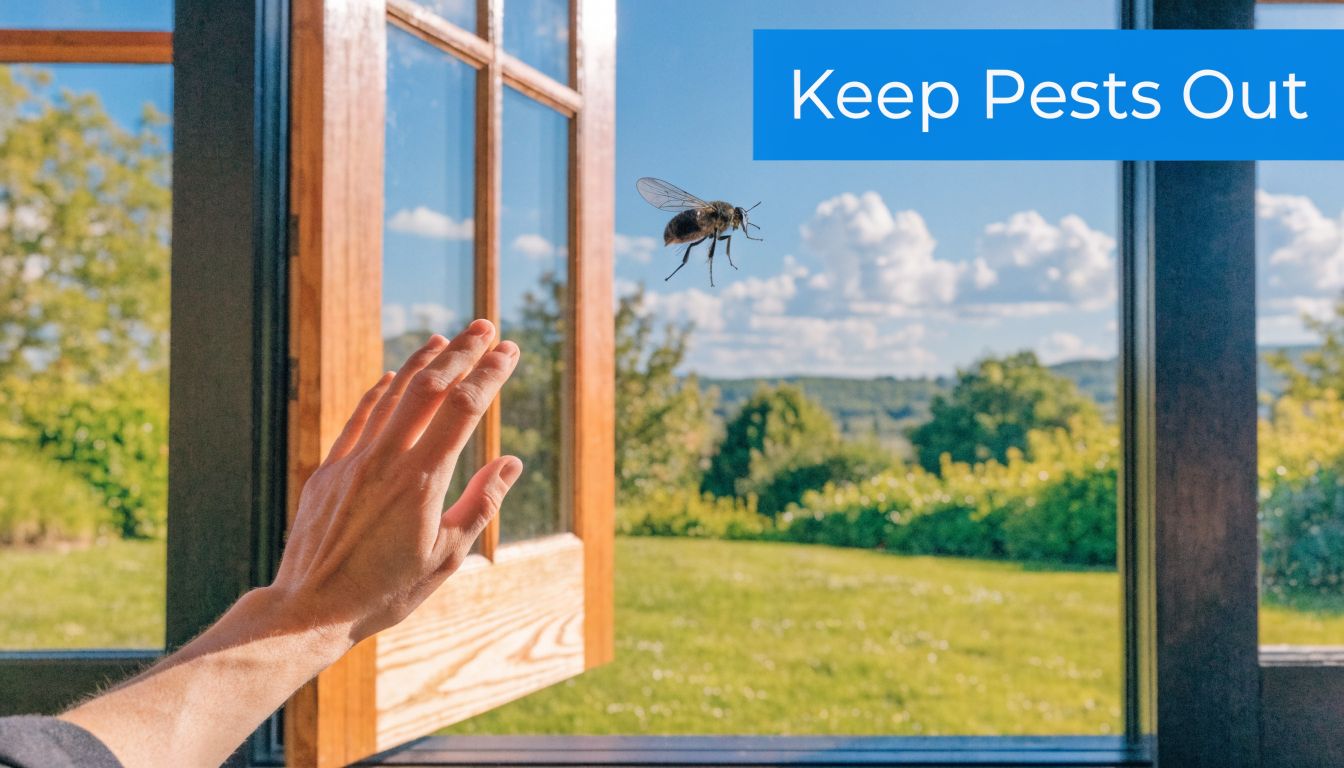
This has become more pressing, not less. Recent UK pest data from DEFRA reveals a 25% increase in midge numbers across Scotland and England, which makes reliable screening more important for both homes and businesses (recent UK pest data from DEFRA reveals a 25% increase in midge numbers across Scotland and England).
Why single-door hinged screens suit real daily use
A single hinged screen works like a normal door. That matters more than many people expect.
You don’t have to unclip fabric, pull mesh across a track, or hope magnets line up after somebody walks through carrying shopping trays, bins, or a child’s bike. You open it, pass through, and let it close properly behind you.
That’s why this format suits:
- Back doors and kitchen doors where people are in and out constantly
- Utility and side entrances that need ventilation without inviting pests in
- Commercial prep and service routes where the opening gets used all day
- Public and staff entrances where a flimsy domestic screen won’t last
A fly screen only works if people will actually use it every day without thinking about it.
Where temporary screens fall short
Many people start with a low-cost stopgap. Magnetic curtains and stick-on mesh can seem fine in the box. In practice, they struggle on busy doors.
They move in draughts, catch on footwear, peel away from awkward frames, and rarely hold their shape on openings that get repeated use. The weak point is usually not the mesh itself. It’s the fit, the fixing, or the fact that the screen was never built for regular traffic.
A proper hinged unit is different because it’s built as a door system, not an accessory. That makes it the right answer when you need one route in and out, solid pest control, and a finish that doesn’t look temporary.
Homes and businesses need different things, but the same principle applies
For home use, a screen should be neat, easy to live with, and resilient enough for family use. In a business, the priorities often become hygiene, durability, and consistency.
The common requirement is simple. The door must close cleanly, sit correctly in the opening, and stand up to repeated use without bowing, dragging, or leaving gaps.
The Anatomy of a High-Performance Hinged Screen Door
A good hinged screen isn’t just mesh inside a frame. It’s a set of parts that have to work together under daily use, changing weather, and repeated opening and closing.
The difference between a screen that lasts and one that becomes a nuisance usually comes down to frame depth, corner strength, hinge quality, and how well the door closes against the opening.
Start with the frame
The frame does most of the hard work. If it flexes too easily, the mesh won’t stay true and the door won’t keep an even seal.
UK-manufactured hinged fly screens from firms like Premier Screens Ltd use slim extruded aluminium frames with crimped metal corners, providing superior structural integrity. These frames are typically 33% deeper, enhancing rigidity against wind loads and reducing failure rates by 70% compared to riveted designs (UK-manufactured hinged fly screens from firms like Premier Screens Ltd use slim extruded aluminium frames with crimped metal corners).
That matters on exposed elevations, side passages, and commercial doors that never really stay still in summer airflow.
The hinges matter more than most buyers expect
A lot of poor installations are blamed on the frame when the actual issue is the hinge choice or hinge positioning. Weight, swing direction, fixing surface, and clearance all matter.
If you want a useful grounding in hinge formats before ordering or fitting, this guide to understanding different types of hinges is worth a read. It helps when you’re working out why one screen door feels planted and another feels loose after a few months.
A proper hinged fly screen for single doors usually benefits from:
- Steel hinges that hold alignment under repeat use
- Secure fixing points into a suitable flat mounting area
- Lift-off design where appropriate for easier removal and cleaning
- Correct handing so the screen works with the main door, not against it
Small details decide daily usability
The best units tend to look simple because the details have been sorted.
Mid-bar
A reinforced mid-bar stiffens the frame and gives the door more resistance to twist. On busy doors, that extra support helps the screen keep its shape instead of gradually dropping out of line.
Magnetic catch
The catch is what makes the screen feel finished. It should pull the door shut positively and hold it in place without needing a slam.
If the catch is weak, the screen can drift open in a breeze. If it’s badly aligned, users start pushing the frame to make it shut, which creates wear at the corners and hinges.
Kick plate
On family and commercial doors, a kick plate is practical. Shoes, trolleys, bins, prams, and cleaning gear all hit the lower section sooner or later. A protected bottom section saves the mesh from damage.
Practical rule: If the door is near a kitchen, garden, or service route, assume the lower panel will get knocked.
Powder-coated aluminium finish
The finish isn’t just cosmetic. A coated aluminium frame resists corrosion better and stands up well in humid rooms and external exposure.
Why this setup beats curtain-style screens
A curtain screen relies on fabric tension and light fixings. A framed hinged screen relies on rigid structure. That’s the key difference.
When the opening is used often, rigid framed construction wins because it keeps the mesh square, protects the edges, and gives you a repeatable close every time. That’s what makes it suitable for homes that use the back door constantly and workplaces that can’t afford a screen that fails mid-season.
How to Choose the Perfect Mesh for Your UK Home or Business
The frame keeps the screen in shape. The mesh decides what the screen does.
That’s where many buyers get stuck. They choose the first option labelled “insect mesh” and only realise later that their real problem was midges, pet damage, or pollen.

Match the mesh to the problem
Different mesh types solve different issues. If you pick the right one from the start, the whole screen performs better in daily life.
| Fly Screen Mesh Comparison |
|---|
| Mesh Type | Primary Use | Blocks | Best For |
|---|---|---|---|
| Standard Mesh | Everyday insect control | General flying insects | Most homes, kitchens, utility doors |
| Pet-Resistant Mesh | Durability against claws and knocks | Insects plus physical wear from pets | Households with cats or dogs |
| Midge Mesh | Fine insect exclusion | Midges and other very small insects | Scotland, coastal areas, rural settings |
| Pollen Mesh | Allergy reduction | Pollen and insect ingress | Allergy-prone households, offices |
| Visibility Mesh | Clearer outward view | General insect control | Doors where view and light are priorities |
Standard mesh for general use
Standard mesh is the all-rounder. It’s usually the right starting point for homes dealing with typical flies, wasps, and everyday summer insect traffic.
It gives a good balance between airflow, visibility, and protection. If your main concern is opening the kitchen or back door without letting insects in, standard mesh is often enough.
This is the option I’d point to first for:
- Urban and suburban homes with normal insect pressure
- Side entrances that don’t face open fields or water
- Business doors where visibility matters and pest pressure is moderate
Midge mesh for finer protection
Midges are a different problem. If you live in Scotland, near water, or in rural spots where tiny insects are the main irritation, standard mesh may not be fine enough.
A tighter weave helps stop the insects that usually get through ordinary screening. The trade-off is simple. Finer mesh can reduce airflow slightly compared with a more open weave.
That trade-off is usually worth it when the alternative is not being able to keep the door open at all during peak midge periods.
If your complaint is “the screen stops flies but not the tiny ones”, you probably need midge mesh rather than a different frame.
Pet-resistant mesh for active households
This is the option many buyers should choose earlier than they do. If a cat climbs at the door, a dog pushes against it, or children regularly shove past with bags and toys, standard mesh can get damaged sooner than expected.
Specialist pet-resistant polyester mesh can withstand tensile strength over 250N/cm², showing zero tears after 10,000 test cycles in benchmark tests, whereas standard fiberglass mesh showed a 20% failure rate (specialist pet-resistant polyester mesh can withstand tensile strength over 250N/cm²).
That doesn’t mean it’s indestructible. It means it’s far better suited to real family use.
Choose it when:
- Cats scratch at doors
- Dogs lean or push through openings
- You want fewer repairs on a frequently used route
- The screen sits on the main garden access
Pollen mesh for allergy-prone spaces
If insects aren’t the only issue, pollen mesh becomes a practical upgrade. It’s especially useful where people want ventilation but struggle during high pollen periods.
For homes, that often means bedrooms, kitchen doors, or living areas opened in the morning and evening. For offices and education buildings, it can help make naturally ventilated rooms more usable for staff and occupants who react to pollen.
The trade-off is similar to any specialist mesh. You’re choosing function over the widest possible openness.
Visibility mesh when the view matters
Some buyers care as much about sightlines as pest control. If the door looks onto a garden, courtyard, or patio and you don’t want the mesh to feel visually heavy, a visibility-focused option makes sense.
It won’t be the right answer for every pest pressure level, but it can improve the feel of the opening where aesthetics and outlook matter most.
One practical buying rule
Don’t choose mesh by product name alone. Choose it by the problem you need solved most often.
If you’re unsure, list the one complaint that matters most:
- insects in food prep areas
- tiny insects at dusk
- pet damage
- allergy irritation
- obstructed view
That one answer usually points you to the right mesh faster than any brochure language.
Measuring for a Perfect Fit on UK Door Frames
Most failures with a hinged fly screen for single doors don’t start with the hinge or the mesh. They start with measuring.
That’s especially true in the UK, where a large share of homes use uPVC doors and many older properties have openings that aren’t perfectly square. An estimated 70% of UK homes have uPVC doors, and DIY installation failure rates on uneven frames are estimated at 15-20%, which is why door-specific measuring matters so much (a key challenge for UK homeowners is compatibility with diverse door types).

First check the mounting area
Before you touch a tape measure, inspect the frame. You’re looking for a flat, usable fixing surface around the opening.
Common UK trouble spots include:
- Projecting handles that can foul the screen frame
- Decorative trims or mouldings that reduce flat fixing area
- Deep cills that affect hinge side clearance
- Uneven timber liners in older properties
- Bevelled uPVC profiles where the face isn’t as flat as it first appears
If you’re not sure what part of the opening counts as the usable recess or face, it helps to understand what installers mean by a reveal. This guide on what is a window reveal explains the principle clearly, and the same habit of checking the true fixing surface applies when assessing door openings.
Measure the opening properly
Take measurements in more than one place. Don’t assume the frame is square because it looks tidy at a glance.
Width
Measure the width at the top, middle, and bottom.
If the numbers differ, work from the narrowest practical point and check whether the screen will still clear handles, locks, or trims on the closing side.
Height
Measure height on the left, centre, and right.
Older timber frames often vary more than people expect. Even a small difference can matter once the door starts swinging and the margins tighten near the threshold or head.
Diagonals
Measure corner to corner both ways if you suspect the opening is out of square.
If the diagonal measurements differ noticeably, the frame may need packers, adjustment, or professional fitting rather than a straightforward DIY install.
On period properties, the frame that looks straight to the eye often tells a different story once you measure top, middle, bottom, and both diagonals.
How door type changes the job
uPVC single doors
uPVC is common and usually clean to work with, but the shape of the frame can catch people out. Many profiles have rounded or bevelled edges, and not every visible surface is suitable for secure fixing.
Check for enough flat face to mount the outer frame and make sure the main door handle won’t clash as either door opens.
Composite doors
Composite doors often have chunkier frames, decorative mouldings, and more prominent hardware. The opening may look generous, but the usable fixing zone can be tighter than expected.
Watch the handle depth carefully. Also check whether letterplates, escutcheons, or external furniture will interfere with the swing of the screen.
Timber doors
Timber can be the trickiest. It may be the easiest material to fix into, but it’s also the one most likely to have movement, old repairs, paint buildup, or liners that aren’t true.
Check for:
- Twist in the frame
- Uneven head or threshold lines
- Soft or damaged fixing areas
- Previous trim additions that create misleading edges
What to note before ordering
A useful measuring note should include more than width and height.
Write down:
- Door opening direction
- Hinge side preference
- Handle projection
- Any obstructions nearby, such as downpipes, walls, or meter boxes
- Threshold shape if the lower area is uneven or stepped
Photos help as well. A front-on photo and one from each side usually reveal issues that raw dimensions don’t.
When made-to-measure is the safer option
If the opening is modern, square, and clear of obstacles, a supply-only kit can work well. If the door sits in an older frame, has awkward hardware, or offers very little flat mounting area, bespoke measurement becomes the difference between a neat installation and a screen that never shuts quite right.
DIY Kit or Professional Installation Which Is Right for You
This decision comes down to risk, not ambition. Plenty of people can fit a screen door well. Plenty of people would rather avoid spending half a Saturday correcting a frame issue they didn’t spot when ordering.
The right choice depends on the opening, the building, and how much tolerance you have for adjustment work.
DIY works well in the right conditions
A DIY kit makes sense when the opening is straightforward and the person fitting it is comfortable with accurate measuring, drilling, and alignment.
DIY is usually the better fit if:
- The frame is modern and square
- There’s a clear flat fixing surface
- The door hardware doesn’t protrude awkwardly
- You’re happy checking levels, clearances, and swing
- The site is domestic rather than compliance-sensitive
In those cases, a made-to-measure kit can be a sensible route. You save on fitting labour and keep control of timing.
A clean DIY install usually comes from patience more than speed. Most problems happen when someone rushes the hinge positioning or assumes the frame is true without checking.
Professional installation earns its keep on difficult openings
There are jobs where fitting support is the sensible option.
That usually includes:
- Older timber properties
- Composite doors with awkward trims or handles
- Openings with limited fixing area
- Commercial kitchens and food prep settings
- Multi-door projects across one site
- Buildings where downtime matters
In those situations, professional fitting removes the guesswork around packing, frame position, hinge adjustment, and final close.
Cost versus certainty
DIY usually lowers upfront cost. Professional fitting usually lowers installation risk.
That’s the true trade-off. Not cheap versus expensive. More control versus more certainty.
If the opening is standard, the risk is low and DIY can be entirely reasonable. If the opening is irregular, exposed, or business-critical, paying for correct fitting often saves money later because you avoid call-backs, refitting, replacement fixings, or a screen that never performs properly.
If you already suspect the frame is awkward, you’re usually better off treating that as a fitting job, not a weekend experiment.
A practical way to decide
Ask yourself four direct questions:
- Is the frame square and easy to measure?
- Do I have a proper flat mounting surface?
- Will a poor fit cause more than minor annoyance?
- Am I comfortable adjusting hinges and catches if needed?
If most answers are yes, DIY may suit you. If several answers are no, professional installation is usually the safer path.
For businesses, reliability often matters more than saving on fit
A homeowner can tolerate a bit of adjustment. A busy kitchen or staff entrance usually can’t.
If the screen is there to support hygiene, airflow, and repeated daily traffic, it needs to work from day one and keep working. That’s where professional measuring and fitting often make the most sense, especially if the site manager wants a single point of responsibility rather than separate supply and installation decisions.
Ensuring Longevity Compliance and Easy Maintenance
A good screen door shouldn’t need constant attention, but it does benefit from basic upkeep. Most maintenance is simple and takes far less time than replacing damaged mesh or living with a door that no longer shuts properly.
The main aim is to keep the frame clean, the mesh intact, and the closing action consistent.
Simple maintenance that prevents bigger problems
Clean the mesh gently
Use a soft brush, cloth, or light vacuum attachment to remove dust and surface debris. If needed, wash with mild soapy water and rinse carefully.
Don’t scrub aggressively or use harsh chemicals. They can shorten the life of the coating or strain the mesh where it meets the frame.
Check hinges and fixings
Hinges take repeated load, especially on busy doors. Check that screws remain secure and the door hasn’t started to drop or rub.
If movement appears, deal with it early. A small alignment issue is easier to correct before it becomes frame strain or catch failure.
Keep the closing edge clear
Dirt, paint buildup, or debris around the closing side can stop the screen sitting flush. That can create tiny gaps and weaken pest exclusion.
A quick wipe around the contact area and magnetic catch makes a noticeable difference.
Commercial compliance is about the full installation
In food-related settings, a screen is not just a comfort upgrade. It needs to support pest exclusion in practice.
That means the screen must be durable, fit the opening properly, and close consistently. A poorly fitted door with visible gaps won’t deliver the standard a commercial operator needs, even if the materials themselves look suitable.
For kitchens, cafés, prep areas, and service entrances, pay attention to:
- Reliable self-closing action
- Secure fit around the opening
- Damage-resistant lower sections
- Materials suited to humid, hard-working environments
- A layout that staff will use correctly every time
If staff have to fight the door, prop it open, or force the latch, the system is wrong for the space.
Quick troubleshooting
The door doesn’t close flush
Check hinge alignment first. Then inspect whether the frame was fixed out of square or the catch position has shifted slightly.
The mesh looks loose
Look at the frame corners and overall door alignment before blaming the mesh. Sagging appearance often starts with movement in the structure.
The screen catches at the bottom
Check for door drop, threshold interference, or a frame that was measured too tightly on an uneven opening.
Most screen door faults show up first as alignment issues. If you correct them early, the mesh and frame usually stay in better condition.
What long life actually looks like
Longevity doesn’t come from one feature. It comes from decent materials, a correct fit, suitable mesh choice, and occasional maintenance.
In homes, that means a screen that still opens cleanly after regular summer use. In commercial settings, it means a door that continues to shut properly under constant traffic without becoming another maintenance item on the list.
Why a Premier Screens Door is the Smart Investment
A hinged fly screen for single doors is one of those products that proves its value through daily use. You notice it every time the door stays open and the room stays usable.
The smart buy is rarely the one that looks acceptable on day one. It’s the one that still fits, closes, and keeps pests out after real use in a UK property.
What makes the investment worthwhile
The value sits in four things.
First, a made-to-measure fit. Single doors in the UK often look standard until you start checking the frame properly. A screen that matches the opening is more likely to close cleanly and avoid the usual gap problems.
Second, the right mesh for the actual problem. General insects, midges, pets, and pollen are not the same brief. Matching the mesh to the job avoids compromise you’ll notice every day.
Third, a frame built for repeated use. A kitchen back door, side entrance, or prep-room access point gets handled constantly. The screen needs to behave like proper joinery, not a seasonal add-on.
Fourth, the option to choose supply-only or installed service. That flexibility matters because not every opening needs the same level of support.
Why UK manufacturing matters in practice
For this type of product, local manufacturing isn’t just a badge. It usually means better understanding of UK door formats, common frame issues, and the kind of weather exposure these screens face.
It also helps when the order is bespoke. Clear sizing, responsive support, and a product built around UK openings make a noticeable difference when you’re dealing with uPVC back doors, composite side doors, or older timber frames.
Premier Screens Ltd supplies made-to-measure hinged fly screens for UK homes and businesses, with options for different mesh types, DIY kits, and professional installation. That’s useful if you need a single source for measuring support, manufacturing, and fit.
The practical return
For homeowners, the return is comfort and fewer compromises. You stop choosing between fresh air and insects. You also stop buying temporary fixes that look tired by the end of the season.
For businesses, the return is operational. Staff can ventilate the space without turning an open doorway into a pest route. That matters in kitchens, service areas, offices, universities, and public buildings where reliability counts.
A well-specified screen door doesn’t just solve a summer irritation. It improves how the space works.
If you want a made-to-measure solution for a home, kitchen, café, office, or public building, Premier Screens Ltd offers bespoke UK-manufactured fly screen systems with mesh options for insects, midges, pets, and pollen. You can order a DIY kit for a straightforward opening or speak to the team about professional installation for more complex or commercial sites.
See the full range of fly screens for doors we manufacture.
