

A warm day arrives, the patio doors go open, and within minutes the room starts filling with more than fresh air. Flies drift in from the garden. Wasps circle drinks. In a kitchen or dining space, that quickly turns from nuisance to problem.
A slide screen door solves that neatly. It keeps the opening usable, preserves the view, and lets air move through the space without turning the doorway into an invitation for insects. Done properly, it feels almost invisible in daily use. Done badly, it rattles, sticks, and leaves gaps exactly where you don’t want them.
For many households, screening is only one part of the decision. People also want shade, privacy, and a finish that suits the room. If you're weighing up options around sliding patio door privacy, it helps to think of the screen and the rest of the opening as one system rather than separate purchases.
For homeowners looking at broader options for door screening, a useful starting point is this guide to fly screens for doors. The key is choosing a screen that matches how the opening is used, not just what looks good in a brochure.
Enjoy Fresh Air Without Unwanted Guests
One doesn't typically start by searching for a slide screen door. They start with a practical problem. They want the back door open while cooking, they want airflow through a conservatory, or they want a business entrance ventilated without losing control of hygiene.
A good sliding screen answers all three. It moves with the door opening instead of blocking it, it doesn't swing into furniture or foot traffic, and it keeps the threshold clear enough for everyday use. That matters in homes with children and pets, and it matters even more in workplaces where people are carrying trays, stock, or equipment.
Why sliding works so well
A hinged screen can be perfectly suitable in some openings, but wide patio and terrace doors usually suit a sliding format better. The movement is simple and predictable. Open, close, and park the panel without needing extra floor space.
There’s also a visual advantage. A well-made screen keeps the opening light and usable instead of making the doorway feel boxed in.
A screen should disappear into the routine of the building. If people have to fight it, they stop using it.
Where it makes the biggest difference
- Patio doors: You get ventilation in living areas without constantly checking for insects.
- Kitchen doors: Air can circulate while food prep spaces stay protected.
- Garden-facing rooms: The view stays open, which is one reason sliding designs remain popular.
- Commercial rear doors: Staff can move through regularly without the opening being left exposed.
The benefit sounds simple because it is simple. Fresh air in, insects out. The challenge is making sure the door does that every day, not just in the first week after installation.
Understanding Slide Screen Door Mechanics and Types
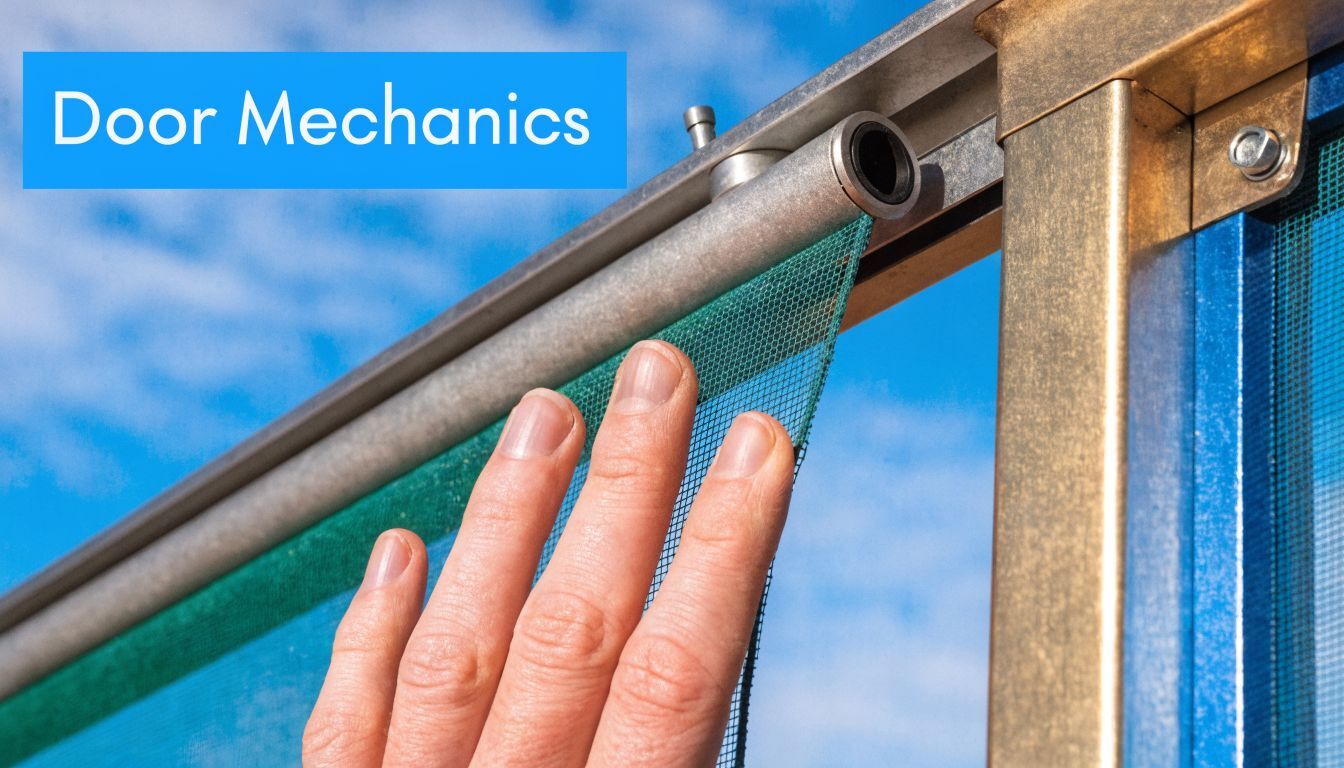
A slide screen door is only as good as its basic engineering. The three parts that matter most are the frame, the mesh, and the track system. If any one of those is wrong for the opening, the result is usually poor movement, edge gaps, or premature wear.
The parts that control performance
The frame gives the door its shape and rigidity. It needs to stay straight under regular use and changing temperatures. The mesh does the obvious job of stopping insects, but it also affects visibility, airflow, and durability.
The track is where smooth operation is won or lost. The operational integrity of a sliding screen door relies on precise track dimensions. The industry standard thickness for all categories is approximately half an inch (0.5"), with top tracks engineered to accommodate doors within a 5/8 inch (15.875mm) specification, ensuring smooth guidance and support, as outlined in this guide to sliding screen door tracks and thickness.
That matters in practice because the top track takes repeated stress from opening and closing. If the track is flimsy, badly aligned, or the wrong profile for the frame, the door will tell you very quickly.
Horizontal and vertical sliding options
Homeowners and contractors typically refer to a horizontal slide screen door when discussing this product. That is the standard choice for:
- Patio doors
- Balcony access
- Wide domestic openings
- Commercial serving or access points with side clearance
A vertical sliding screen is a different solution. It suits openings where side travel isn't practical, such as sash windows or serving hatches. The principle is similar, but the way the screen is stored and operated changes.
What works and what doesn't
What works is a door that glides with very little effort and stays aligned along the full run of the track. What doesn't work is trying to force a residential-style system into a high-use opening, or assuming all sliding screens are interchangeable.
For readers comparing options for larger glazed openings, this overview of fly screens for sliding glass doors is useful because it focuses on application rather than marketing language.
Practical rule: If the screen is being used many times a day, the track and frame matter as much as the mesh.
How to Choose the Right Frame and Mesh
Choosing a slide screen door properly means separating two decisions that often get blurred together. First, pick a frame that will stay stable in the opening. Then choose the mesh according to the actual problem you’re solving.

Start with the frame
For UK conditions, polyester-coated aluminium is usually the right answer because it combines rigidity with low maintenance. It doesn't ask for the ongoing upkeep that timber does, and it suits both modern and traditional properties when finished well.
The reason frame quality matters is simple. A slide screen door is in motion. It isn't just filling an opening. A frame that dents easily, twists, or loses alignment will affect the rollers, the track contact, and the seal at the edges.
Here’s a practical comparison:
| Frame option | Best point | Main trade-off |
|---|---|---|
| Polyester-coated aluminium | Strong, weather-resistant, clean finish | Usually a more deliberate made-to-measure purchase |
| Basic aluminium | Lightweight and straightforward | Can feel less robust in heavy daily use |
| Timber | Traditional appearance | Needs more maintenance and is less forgiving around moisture |
Then choose the mesh by use case
Mesh selection shouldn't be random. Different households and businesses need different levels of protection.
- Standard insect mesh works for general fly and wasp control. It's the sensible default for many homes.
- In areas where smaller insects are the primary issue, superfine midge mesh is often the better call.
- Pollen mesh suits people who want ventilation without inviting as much airborne irritation into the room.
- Homes with active cats or dogs usually benefit from pet-resistant mesh, especially on doors that get pushed, scratched, or leaned against.
Match the mesh to the environment
A rural property near water has different pressure points from a city flat. A family kitchen door gets different treatment from a little-used guest room opening. A business entrance has different wear again.
The wrong choice is usually obvious in hindsight. Mesh that's too light for pets gets damaged. Mesh chosen only for toughness can reduce the open feel people wanted from the doorway. The best specification balances protection with everyday usability.
If you want the room to feel open, don't overbuild the screen. If the opening takes abuse, don't underbuild it.
A useful reference when comparing options is this guide to the best fly screen mesh options for UK homes. It helps narrow the choice based on living conditions rather than guesswork.
A simple decision guide
Use this quick filter when deciding:
General household insect control
Standard mesh is usually enough.Small biting insects or exposed locations
Go finer on the mesh.Allergy concerns
Prioritise a mesh designed with pollen reduction in mind.Pets and rougher use
Choose durability first, then refine the appearance and finish.
That approach avoids one of the most common mistakes. People often choose the frame by appearance and the mesh by price. It should be the other way round. Choose the frame by workload and the mesh by purpose.
A Guide to Sizing and Bespoke Measurements
Off-the-shelf sizing causes more trouble with slide screen doors than almost any other part of the buying process. A screen can look close enough on paper and still fit badly in the opening.

There are common sizes in the market. 36 inches wide by 80 inches tall is often used for older residential properties, while 36 inches wide by 96 inches tall is common in newer construction. Widths also commonly span 30 inches, 36 inches, and 48 inches, with height ranges around 77 to 80 inches and 93 to 96 inches. Even so, true universality is a myth. For a perfect fit, bespoke measurements are critical, accommodating tolerances as fine as 1/8 inch (3.175mm), with a maximum top clearance of 1/4 inch (6.35mm) for smooth operation without gaps, as explained in this article on sliding screen door standard size variations.
That single point changes the buying decision. A slide screen door isn't like buying a loose accessory. It has to work with the opening you already have.
Why bespoke usually wins
A made-to-measure screen does three things better than a guessed standard size:
- It seals properly, so insects don't find the weak points at the frame edges.
- It runs more smoothly, because the clearances are controlled.
- It lasts better, because the rollers and track aren't being forced to compensate for poor fit.
What doesn't work is relying on the nominal door size alone. Openings vary. Frames settle. Previous installations aren't always perfectly square.
How to measure the opening properly
If you're measuring for a quote, keep it straightforward and write every figure down immediately.
Measure the width at three points
Check the top, middle, and bottom of the opening. Use the smallest figure.Measure the height at three points
Check the left side, centre, and right side. Again, use the smallest figure.Check the head and sill condition
Look for anything that may affect fitting, such as uneven thresholds, trim, or obstructions.Note the direction of travel
Decide which side the screen will park on and whether handles, walls, or furniture could interfere.
Common measuring mistakes
A quick table shows where people usually go wrong:
| Mistake | What it causes |
|---|---|
| Measuring only once | Hidden size variation across the opening |
| Using the largest figure | A panel that binds or won't sit correctly |
| Ignoring clearance | Rough sliding or installation difficulty |
| Forgetting surrounding obstacles | Handle clashes and awkward operation |
A screen door can only be as accurate as the measurements that order it.
If the opening is old, altered, or visibly out of square, a bespoke route is the safe route. It's the difference between a screen that feels integrated and one that always feels slightly wrong.
Deciding Between DIY Kits and Professional Fitting
There isn't one right installation route for every customer. Some people are comfortable measuring accurately, handling tools, and making small adjustments on site. Others want the door supplied, fitted, and checked with no guesswork.
When a DIY kit makes sense
A supply-only kit can be the right option if the opening is straightforward and you're confident with practical work. It often suits trade buyers, property owners who regularly handle maintenance, and homeowners replacing an existing screen like-for-like.
The main advantages are clear:
- Control over timing because you can fit it when it suits you
- Lower overall project cost compared with a full fitting service
- Useful for repeat buyers who already know the system and the opening type
The catch is that DIY only works well when the measurements are right and the installer understands alignment. A sliding screen that is slightly out won't usually fail dramatically. It will just annoy you every day.
When professional fitting is worth it
Professional fitting earns its place when the opening is awkward, the finish matters, or the screen will get heavy use. That's often the case with larger patio doors, renovated properties, and commercial sites.
A fitting service usually brings:
- Accurate final adjustment so the screen sits and slides as intended
- Cleaner finishing around the opening
- Less risk of damage to the frame, track, or surrounding surfaces
- Better peace of mind when the installation has to perform from day one
The real trade-off
This isn't only about cost. It's about risk, time, and tolerance for troubleshooting.
| Option | Best for | Watch out for |
|---|---|---|
| DIY kit | Straightforward openings and practical buyers | Measuring errors and alignment issues |
| Professional fitting | Complex openings, premium finishes, commercial use | Higher upfront spend |
One practical test helps. Ask yourself whether you'd be happy adjusting rollers, checking clearances, and correcting a tight run if the screen doesn't move perfectly first time. If the answer is no, professional fitting usually saves frustration.
In commercial settings, the decision is even simpler. If the door affects hygiene control, staff movement, or customer-facing areas, a properly fitted system is the safer route.
Slide Screens for Commercial Kitchens and Businesses
A slide screen door in a commercial building has a different job from one in a house. In a home, comfort and convenience lead the decision. In a food business, hygiene and operational reliability come first.
For UK restaurants and food preparation areas, fly screen compliance is not optional. A significant content gap exists online regarding how sliding screens must meet Food Standards Agency (FSA) guidelines for hygiene and durability, and that's a major differentiator for commercial-grade systems.
What commercial buyers should look for
A business shouldn't specify a screen on appearance alone. In kitchens, prep areas, and service corridors, the system needs to cope with repeated use and regular cleaning.
The practical requirements usually include:
- Sturdy frames that won't loosen or distort under constant traffic
- Mesh and finishes that are easy to keep clean
- Reliable sliding action so staff don't start bypassing the screen
- A layout that supports movement, not one that creates bottlenecks
A domestic-style product in a commercial kitchen often fails for a simple reason. It was never designed for the workload.
Why residential logic doesn't transfer
Homeowners may accept a screen that needs the occasional nudge or adjustment. A business can't rely on that. If staff are moving quickly between spaces, the screen needs to open cleanly, close properly, and stay in service without becoming a nuisance.
That is especially important where hygiene inspections, food handling routines, and back-of-house discipline are involved. The screen isn't a decorative add-on. It's part of the working environment.
For managers researching industrial door applications more broadly, Wilcox Door's Rytec projects show how specialised door systems are treated in demanding commercial settings. The lesson carries across. Products for commercial use need to be chosen around workload, cleaning, and compliance.
Suitable settings for commercial sliding screens
A commercial slide screen door can work well in:
- Restaurants and cafés
- Commercial kitchens
- Food prep spaces
- Hospitality back-of-house openings
- Offices and public buildings where ventilation and pest control both matter
For a closer look at application in regulated food environments, this page on fly screens for commercial kitchens is especially relevant.
In a food business, a screen that staff avoid using is almost as bad as no screen at all.
The best commercial result is a system that supports the way the building already operates. Smooth movement, straightforward cleaning, and a specification that stands up to repeated use. Those are the details that matter.
Long-Term Care and Simple Maintenance Tips
Even a well-made slide screen door needs basic care. The good news is that maintenance is usually simple, and small habits prevent most of the problems people associate with sliding screens.
Keep the track clean
The track collects dust, grit, pet hair, and garden debris. Once that builds up, the rollers stop gliding and start dragging.
A quick routine works well:
- Vacuum first to remove loose debris from the channel
- Use a soft brush for compacted dirt in the corners
- Wipe the track dry after cleaning so residue doesn't hold more grime
If a door starts feeling heavy, the track is the first place to check.
Clean the mesh gently
Mesh doesn't need aggressive treatment. In fact, rough cleaning causes avoidable damage.
Use a soft cloth or soft brush with mild soapy water, then wipe or rinse lightly and let it dry. That keeps the screen looking clear and helps airflow remain unobstructed.
Watch for early signs of wear
A few checks every so often are better than waiting for the door to become difficult.
| Check | Why it matters |
|---|---|
| Track condition | Debris affects movement |
| Mesh tension | Loose or damaged mesh reduces protection |
| Frame alignment | Small issues can turn into rubbing or gaps |
| Handle and fixing points | Frequent use can loosen hardware |
Clean tracks solve more sliding complaints than people expect.
What not to do
Don't force a sticking door repeatedly. That tends to shift the problem from a simple clean-up to roller, frame, or track damage. Don't scrub mesh with harsh tools. And don't ignore a small tear if the point of the door is insect control.
Most maintenance is preventative. A few minutes spent cleaning and checking the screen keeps the movement smooth and avoids the slow decline that leads people to think the whole unit has failed when it only needed attention.
Frequently Asked Questions
Are slide screen doors suitable for both homes and businesses
Yes, but they shouldn't be specified the same way. A domestic opening often prioritises appearance, ease of use, and discreet screening. A commercial opening usually needs a tougher specification, easier cleaning, and closer attention to compliance.
Can a slide screen door be made to fit an older property
Usually, yes. Older openings are exactly where bespoke manufacturing helps most because frames and reveals are often less predictable than people expect. Careful measuring matters more than assuming the opening matches a nominal standard.
Which mesh is best if I have pets
Pet-resistant mesh is the most sensible starting point if cats or dogs regularly push against the door. It won't make the screen indestructible, but it copes better with scratching and rougher everyday contact than lighter mesh options.
Will a sliding screen spoil the view
A good one shouldn't. The whole point of a slide screen door is to preserve airflow and visibility while protecting the opening. Frame profile and mesh choice both affect how open the doorway feels, so it's worth choosing those carefully rather than treating them as minor details.
Are these doors removable or seasonal
Some systems can be removed or adjusted more easily than others, but that depends on the design. In practice, homeowners typically leave a well-made sliding screen in place and maintain it as part of the door opening.
How do I know whether to choose DIY or fitting
If the opening is simple and you're comfortable measuring and adjusting hardware, DIY can work well. If the opening is uneven, heavily used, or part of a commercial site, professional fitting is usually the safer option.
What frame finishes are commonly chosen
Customers often look for finishes that sit neatly with existing doors and windows, including contemporary neutrals and clean standard colours. The right finish is less about trend and more about making the screen look like it belongs to the opening.
What matters most when ordering
Three things decide whether the result will feel right:
- Accurate measurements
- A frame suited to the level of use
- The right mesh for the environment
If those three are correct, the rest of the process becomes much simpler.
If you're choosing a made-to-measure slide screen door for a home, kitchen, patio, or commercial site, Premier Screens Ltd can help you specify the right system. As a UK manufacturer with over 30 years’ experience, the company supplies bespoke fly screens for residential and commercial openings nationwide, with options for DIY supply or professional installation.
About sliding screens for a patio opening? See our roller fly screen doors or, for wider openings, the double roller fly screen door.
