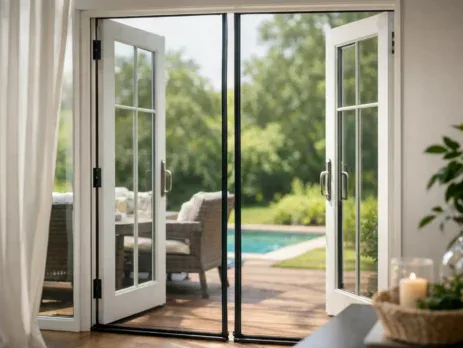
French doors are excellent for airflow, garden access and bringing more light into a room. They are also one of the quickest ways to let flies, wasps and mosquitoes indoors. That is why custom fly screens for French doors are rarely a cosmetic extra. In most homes and commercial settings, they are a practical way to keep insects out without losing ventilation.
Off-the-shelf screens often struggle on French doors because the opening is wider, traffic is heavier and the doors themselves vary far more than people expect. Frame depth, handle clearance, threshold detail and how often each leaf is used all affect which screen will work well long term. A made-to-measure option solves those fit issues properly, rather than asking the user to compromise.
Why French doors need a made-to-measure screen
French doors create a larger opening than a standard single door, and that changes the demands on the screen system. It has to cover a broader span, remain easy to pass through and cope with repeated use during warmer months when the doors may stay open for hours at a time.
A poor fit usually shows up quickly. Gaps at the sides or threshold let insects through. Weak frames flex over time. Cheap mesh can sag, especially where pets, children or regular footfall are involved. In kitchens, garden rooms and patio access points, that becomes frustrating very quickly.
Custom sizing matters for another reason too. Not every pair of French doors is symmetrical in day-to-day use. In some properties, one door leaf is the main access point and the other opens only occasionally. In others, both leaves are used constantly, particularly where the doors lead to a patio, terrace or dining area. A bespoke screen system can be selected around how the opening is actually used, not just its measurements.
Which custom fly screens for french doors work best?
There is no single best answer for every property. The right choice depends on access frequency, available fixing space, whether pets are present and how visible you want the screen to be when not in use.
Pleated and retractable options
Pleated screens are a strong choice for French doors because they suit wider openings and are designed for regular traffic. The mesh folds neatly away when not needed, which keeps the doorway clear through colder months or on days when insect control is not necessary.
They also work well where you want a lower visual impact. For domestic settings such as lounges, kitchen-diners and garden rooms, that can be a major advantage. The trade-off is that a retractable system needs correct measuring and fitting to operate smoothly. If the opening is uneven or the product is poorly installed, you may feel resistance in use.
Hinged door screens
Hinged fly screens offer a straightforward and durable solution. They are particularly useful where one side of the French door is used more often than the other, or where users want a familiar open-and-close action rather than a retracting screen.
For busy homes and commercial environments, hinged screens can be a dependable long-term option, especially with aluminium framing. They are simple to understand and generally very robust. The compromise is space. You need room for the screen door to swing, and that is not always ideal on tighter patios or where furniture sits close to the opening.
Sliding screen systems
Sliding screens can suit French doors where there is enough lateral space and the surrounding layout allows for a tracked solution. They are practical, neat and easy to operate once installed correctly.
This style is often considered where there is a modern patio arrangement or where swing clearance would be awkward. As with any track-based product, maintenance matters. If the lower track is likely to collect dirt, leaves or general debris from the garden, it will need occasional cleaning to keep movement smooth.
Magnetic screens
Magnetic mesh screens are usually chosen for lighter domestic use and quick installation. They can be useful in some situations, but they are not always the best long-term answer for French doors with heavy traffic.
Where children, pets or frequent garden access are involved, a framed made-to-measure system often gives better durability and a more secure seal. Magnetic options can still have their place, but for larger openings and regular use, the simpler product is not always the more cost-effective one over time.
Mesh choice matters as much as the frame
When customers think about fly screens, they often focus on the opening mechanism first. The mesh itself is just as important. It affects visibility, airflow, durability and suitability for the environment.
Standard insect mesh is suitable for many households and will stop common flying insects while allowing good air movement. If visibility is a priority, especially on garden-facing French doors, a finer and less intrusive mesh can help preserve the outlook.
In homes with pets, stronger mesh options are worth considering. A screen fitted to a frequently used patio doorway is more exposed to claws, pushing and accidental impact than a bedroom window screen. In commercial kitchens or hygiene-sensitive premises, screen specification needs to match the practical demands of the site, not just the size of the opening.
There is always a balance to strike. Finer mesh can improve insect control, but depending on the specification, it may slightly reduce airflow compared with a more open weave. Heavier-duty mesh improves resilience, but may appear more visible from certain angles. The right answer depends on what matters most in the space.
Measuring and installation – where many problems start
A French door opening may look square, but appearances can be misleading. Small differences in width, plaster finish, cill detail or handle projection can all affect the finished fit. That is why made-to-measure products are preferable to cut-down DIY kits when the goal is reliable everyday performance.
The main question is not simply the width and height. You also need to know where the screen will sit, whether there is enough fixing depth, how the doors open, and whether any obstacles could interfere with operation. A screen that fits the aperture but clashes with the handles is not a workable solution.
Installation should also reflect who will use the doors. In a family home, smooth and forgiving operation matters. In a rental property, durability and straightforward maintenance may come first. In food preparation areas, secure fitting and ease of cleaning can be more important than visual discretion.
For many buyers, the benefit of using a specialist manufacturer such as Premier Screens is that the product range is built around these real-world fitting variables. That tends to save time and reduce the risk of choosing a screen style that looks right on paper but is awkward in use.
Domestic and commercial use are not quite the same
In a home, custom fly screens for French doors are usually about comfort, cleanliness and making the most of warm weather. People want to leave the doors open in the evening without inviting insects into the kitchen or living area. They also want something that looks tidy and does not turn everyday access into a nuisance.
In a commercial setting, the priorities can be stricter. Restaurants, cafés, care settings and food preparation areas may need insect control as part of wider hygiene management. Here, durability and consistent operation become critical. The screen must cope with more frequent use and still maintain an effective barrier.
That is why product choice should be guided by use case, not just by opening size. A domestic solution for occasional summer use may not be suitable for a back-of-house kitchen door that opens repeatedly throughout the day.
What to look for before you buy
A good French door fly screen should do three things well. It should fit the opening accurately, stand up to repeated use and remain convenient enough that people actually use it properly.
Aluminium framing is generally a sensible choice for longevity, particularly on larger doorways where rigidity matters. A proper made-to-measure build reduces the chance of gaps and premature wear. It is also worth checking how easy the screen is to remove, clean or maintain if needed, especially in busier environments.
Cost matters, but cheapest rarely means best value with French doors. A low-cost screen that tears, catches or leaves gaps can end up being replaced far sooner than expected. A better specified bespoke system often proves more economical simply because it continues to work as intended.
If your French doors are a key access point to the garden, kitchen or patio, the right screen should feel like part of the opening, not an obstacle added afterwards. That is usually the clearest sign you have chosen well.
Fresh air is only useful if you can enjoy it without the distraction of flies indoors. Get the fit, style and mesh right, and French doors become far more practical through the warmer months.
Browse our full range of fly screens for doors to compare every style.