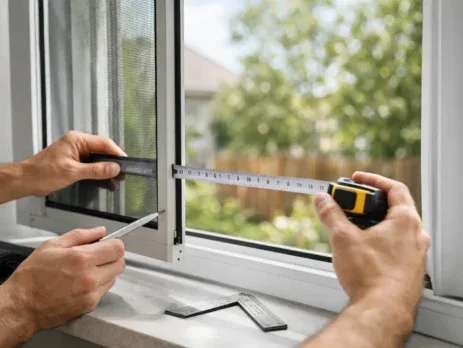
A fly screen that is even slightly off in size can rattle, catch, leave gaps, or simply not fit at all. That is why knowing how to measure fly screens properly matters before you place an order. A few careful checks at the start usually save far more time than trying to adjust the wrong screen once it arrives.
The right method depends on the opening, the frame, and the type of screen you need. A hinged door screen is measured differently from a magnetic window screen, and a recess-fit screen is not measured in the same way as a face-fit option. There is no single rule that covers every installation, but there is a reliable way to approach the job so you get accurate dimensions first time.
How to measure fly screens without guesswork
Start by deciding exactly where the screen will sit. This is the point many people miss. Before you reach for the tape measure, look at the window or door opening and identify whether the screen is going inside the reveal, onto the outer frame, or across the face of the opening.
If you measure the clear opening but order a screen designed to fix to the outer frame, the finished size will be wrong. Equally, if handles, trickle vents, cills, tiles, or architraves reduce the usable fixing area, those need to be considered before any dimensions are taken.
Use a steel tape measure rather than a cloth tape. Measure in millimetres, not centimetres, as this gives better accuracy and matches the way made-to-measure fly screens are normally produced. It is also worth taking each dimension at least twice. If your first and second readings do not match, measure again until you are confident.
What to check before you measure
Most measuring mistakes come from the surrounding frame rather than the opening itself. Check that the area is square, that there is a flat fixing surface, and that there is enough clearance for the screen to operate.
On windows, pay attention to handles, vents, and inward-opening sashes. On doors, check threshold levels, hinges, closers, and nearby walls or downpipes. A roller or plissé screen needs room to retract, while a hinged or sliding screen needs a clear path to open and close properly.
Older properties often need extra care because reveals are not always straight. In those cases, measure the width at the top, middle, and bottom, then measure the drop on the left, centre, and right. If the opening varies, the smallest measurement is usually the one that matters for an internal fit. That gives you the best chance of a screen fitting cleanly without binding.
The basic tools you need
You do not need specialist equipment. A steel tape measure, a pencil, paper, and a step ladder for taller openings are usually enough. Taking a quick photo of the opening can also help if you need to double-check where a measurement was taken from.
Measure the actual fixing point
Always measure the place where the frame or channel will be fitted, not the general area around it. That sounds obvious, but it is a common source of error, particularly on uPVC windows and patio doors where trims and mouldings can make one section look wider than it really is.
How to measure fly screens for windows
For window fly screens, begin by identifying the screen style. Magnetic and fixed-frame screens are commonly used on windows, but roller options can also be suitable where regular access is needed.
If the screen is fitting inside a recess, measure the internal width in three places and use the smallest figure. Do the same for the height. This accounts for any variation in the reveal. If the screen is fitting to the face of the frame, measure the overall area available for fixing and check there is enough flat surface all round for the frame or fixing system.
Window handles are especially important. If a handle projects into the opening, a flush-fitting screen may not sit correctly, or it may need stand-off clearance depending on the product design. Top-hung and side-hung windows also need checking for opening direction. You need to make sure the screen does not interfere with normal operation.
For loft windows, bay windows, and windows with tiled reveals, the measuring approach may differ because the available fixing area is less straightforward. In these situations, it helps to sketch the opening and note any obstructions rather than relying on one width and one height alone.
Measuring fly screens for doors and larger openings
Door screens need a little more attention because they are used more frequently and are exposed to more movement. A door screen that is a few millimetres out can affect operation far more than a static window screen.
For a hinged fly screen door, measure the overall height and width of the intended fixing area and then check for hinge-side clearance, handle position, and threshold level. You also need to know which side the door will open from and whether anything nearby could restrict the frame.
For sliding or patio door screens, measure the full opening width and height, then review how the screen will travel. The track position matters just as much as the opening size. If the floor is uneven or the head of the opening is out of level, that can affect the final fit.
Plissé and roller door screens often require a clean, square area for the side channels and cassette. Measure the installation space carefully and make sure there is enough room for the housing. On French doors and bifolds, each side should be checked independently because symmetry cannot be assumed, especially in older buildings.
Don’t ignore thresholds and cills
Thresholds, cills, and floor finishes can alter the usable height. Measure from the true fixing point at the top down to the actual point where the screen will stop. If there is a raised threshold, note it. If the floor covering is due to change, wait until the final level is known before ordering.
Recess fit or face fit
When people ask how to measure fly screens, this is often the real question underneath. Are you measuring the opening itself, or the area around it?
A recess fit sits within the reveal or opening. It can give a neat finish, but it depends on the opening being reasonably square and having enough depth. In this case, smallest measurements are usually critical.
A face fit mounts onto the surrounding frame or wall surface. It can be more forgiving where openings are uneven, but only if there is a continuous flat area for fixing. Here, you need to measure the full external area available and allow for the actual screen frame or channel position.
Neither option is automatically better. It depends on the window or door design, the screen type, and whether appearance or ease of installation is the priority.
Common measuring mistakes to avoid
The most common error is measuring only once. The second is assuming the opening is square when it is not. The third is forgetting projections such as handles, vents, closers, or drainage channels.
Another regular problem is rounding figures up or down. For made-to-measure products, give the exact millimetre measurement rather than what looks close enough. A bespoke fly screen is built to the dimensions supplied, so small errors can become visible at installation.
It is also easy to measure the brick opening rather than the actual frame, particularly on external doors. The screen will not be fixed to the brickwork if there is no suitable flat surface there, so the measurement needs to reflect the real fixing point.
When measuring is less straightforward
Some openings need more than a simple width and height. Commercial doorways, serving hatches, food preparation areas, and high-use access points often involve heavier-duty screen systems, and the surrounding structure may include kick plates, service channels, or irregular steelwork.
In those settings, clearances, traffic flow, and hygiene requirements matter as much as size. A screen for a commercial kitchen or rear service door has to be measured with practical use in mind, not just the nominal opening dimensions. The right screen will allow ventilation while helping maintain cleaner working conditions and limiting insect entry.
If you are measuring an unusual opening, it helps to note frame material, fixing surface depth, obstructions, and the intended use of the screen. That gives a much clearer basis for selecting the correct system.
A practical approach before you order
Take your measurements in millimetres, measure each opening in several places, note any obstacles, and confirm the intended fit position before ordering. If more than one screen is needed, label each opening clearly rather than relying on memory later.
For homeowners this keeps the process simple and reduces the risk of ordering the wrong size. For landlords, trades, and facilities teams, it also helps standardise repeat orders across multiple windows or doors. Premier Screens manufactures made-to-measure systems, so accurate dimensions at the start are the best route to a clean fit, reliable operation, and long-term insect control.
A careful measure is not wasted effort. It is the part that makes the rest of the job straightforward.