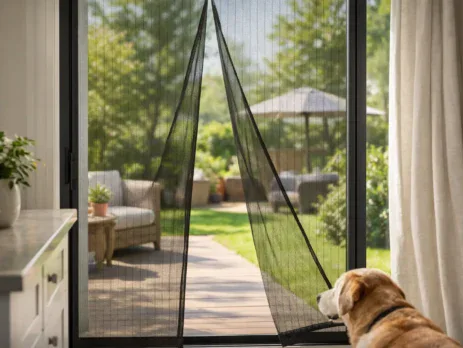
A back door is often the most useful opening in the house during warmer weather. It brings in air, connects the kitchen to the garden and gives children and pets an easy route outside. It can also become the main entry point for flies, wasps and mosquitoes. The best fly screens for back doors keep insects out without turning a frequently used doorway into an inconvenience.
The right choice depends less on appearance than on how the door is used. A screen for a rarely opened utility-room door can be simple and fixed. A busy kitchen door, patio entrance or commercial rear access point needs a screen that opens easily, withstands regular use and closes reliably behind the person passing through.
Choosing the best fly screens for back doors
Start with the door itself. Is it a single hinged back door, a sliding patio door, French doors or a wide bi-fold opening? Does it open inwards or outwards? Is there clear, flat frame space around the opening for fitting? These details determine which system will work properly and prevent the common mistake of choosing a screen that clashes with the door leaf, handle or threshold.
The next question is traffic. If the door is opened a few times a day, a magnetic screen may provide straightforward protection. If it is the household’s main route to the garden, a framed hinged or retractable screen is normally the more durable and practical option. For food-preparation areas, the priority may be hygiene, easy cleaning and a screen that staff can pass through without leaving the entrance unprotected.
A made-to-measure screen is usually worthwhile for a back door. Standard-size screens can leave gaps at the sides or bottom, especially on older properties where openings are not perfectly square. Insects need very little space to get through. A properly sized aluminium-framed system gives a neater finish, stronger fixing and more dependable seal around the perimeter.
Hinged fly screens for everyday access
A hinged fly screen is often the strongest all-round choice for a conventional single back door. It is a separate, slim aluminium frame fitted to the reveal or outer face of the doorway, opening in the same practical direction as the existing door arrangement allows. The mesh remains taut within the frame, providing constant protection whenever the main door is open.
For homes with a garden-facing kitchen or utility room, this style is particularly convenient. The screen can be fitted with a self-closing mechanism so it returns to the closed position after someone walks through. That matters when hands are full of washing, food or gardening equipment, and it reduces the chance of flies entering before the screen is pulled shut.
Hinged screens are also a sound option where durability is the deciding factor. The aluminium frame is more resistant to daily knocks than lightweight temporary products, while replacement mesh can be considered if damage occurs later. They do require sufficient room for the screen to swing, however. Where a wall, fence, plant pot or external step restricts the opening arc, a retractable design may be better suited.
When pet mesh is worth specifying
Standard insect mesh is designed to stop flying insects while maintaining good airflow and visibility. It is not intended to withstand repeated scratching or pressure from a dog or cat. If pets use the back door frequently, tougher pet-resistant mesh is a sensible upgrade. It offers greater resistance to claws and everyday contact, though the heavier weave can reduce visibility and airflow slightly compared with standard mesh.
That trade-off is generally worthwhile in a busy household. Replacing a damaged mesh panel is avoidable cost and disruption, particularly on the door used most often.
Retractable and roller screens for tight spaces
Retractable fly screens, including roller and pleated systems, are designed for doorways where a swinging screen would be impractical or visually intrusive. The mesh retracts into a compact side cassette when not needed, leaving the opening clear through winter or when moving bulky items outside.
A vertical roller screen can suit some door configurations, but side-pull retractable systems are more commonly used for back doors because they follow the natural direction of travel. The screen draws across the opening and locates securely at the opposite side. For wide openings, such as French doors or patio access, double-panel arrangements can meet in the middle.
Pleated, or plissé, fly screens are especially useful for wider doorways. Their concertina mesh folds neatly rather than rolling around a tube, allowing the screen to be positioned at different points across the opening. This is helpful where people regularly move in and out but do not want the screen fully closed all the time. They can be a premium choice, so they make most sense when clear access, a discreet appearance and flexibility are worth the additional investment.
Retractable systems should be fitted accurately. A screen that is too loose may not remain located in its track, while uneven frame surfaces can affect smooth operation. Measuring the actual opening at more than one point is essential, as brickwork and door reveals are often not perfectly consistent.
Magnetic screens: useful, but not for every door
Magnetic fly screens use a central magnetic closure to part as a person walks through and close again afterwards. They are popular for rented homes, temporary summer use and doors where a permanent framed system is not required. Installation is usually straightforward, and the screen can offer a quick barrier against insects at a lower initial cost.
Their limitations should be considered honestly. Magnetic screens can move in strong draughts, are more vulnerable to snagging, and may not stay neatly sealed around uneven or heavily used doorways. They are less suitable for homes with energetic pets, young children constantly passing through, or commercial premises where reliable insect exclusion is required.
For occasional domestic use, they can be a sensible practical answer. For a main kitchen back door, a bespoke framed screen is usually the longer-lasting option.
Match the mesh to the problem
The frame type controls how the screen operates, but the mesh determines what it stops. Standard fibreglass insect mesh is suitable for most UK homes, providing effective protection from common flies, midges, mosquitoes and wasps while allowing fresh air and daylight through.
Where very small insects are a persistent issue, finer midge mesh can be specified. This is useful near water, rural areas or rooms where bites are a regular summer problem. Finer mesh naturally restricts airflow a little more than standard mesh, so it should be chosen for a specific need rather than as a default.
Pollen-control mesh may help households looking to reduce airborne pollen entering through an open door. It will not make a home pollen-free, particularly when people and pets are moving in and out, but it can reduce the amount carried on the breeze. For pet-owning households, pet mesh remains the more relevant specialist choice.
Commercial kitchens, cafés and food-production areas may need a more considered approach. A screen must allow ventilation while supporting clean working conditions and helping to prevent flying insects entering food-handling spaces. Depending on traffic levels, a hinged self-closing screen, sliding arrangement or heavy-duty access solution may be more appropriate than a domestic-style magnetic screen.
Practical checks before ordering
Before choosing a back-door fly screen, check the direction in which the existing door opens and identify handles, letter plates, alarm contacts, drainage channels and raised thresholds that could affect fitting. Measure the width and height of the intended fitting area, not simply the glazed panel or door leaf. Take measurements in millimetres and check each dimension at the top, middle and bottom of the opening.
Also consider where the screen will sit when the main door is closed. An externally fitted screen needs to avoid obstructions such as downpipes, external lights and projecting brickwork. For inward-opening doors, an external screen is often straightforward; for outward-opening doors, the available space and preferred screen type need closer attention.
Colour and frame finish matter, but reliability should come first. A neutral aluminium frame can blend well with many uPVC, timber and composite doors, while the correct configuration will have a greater effect on daily satisfaction than a close colour match alone.
A back-door fly screen should make opening the house to fresh air easier, not create another task every time someone goes outside. Choose a system that matches the opening, traffic and mesh requirement, and it can provide quiet, dependable protection through every warm spell.
For a busy back or patio door, our roller fly screen doors are the most popular choice – see the full fly screens for doors range for hinged, sliding and bifold options.