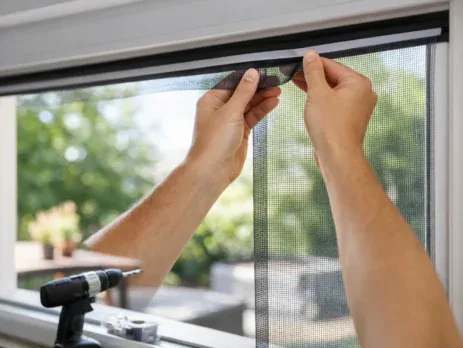
A rented flat, a newly finished kitchen, or a workplace where you cannot start putting holes into frames – these are exactly the situations where no drill fly screens make sense. They give you the airflow you want without opening the door to flies, wasps and other insects, and they do it without permanent fixing marks. For many homes and commercial settings, that balance of clean fitting and practical insect control is the main advantage.
The detail that matters is this: no-drill does not mean one-size-fits-all. Some options are temporary and low cost. Others are made to measure and designed for regular daily use. The right choice depends on the opening, how often it is used, and how tidy and durable the finished installation needs to be.
Where no drill fly screens work best
No-drill systems are especially useful where preserving the frame matters as much as stopping insects. That often includes uPVC windows in homes, aluminium frames in offices, rented properties, garden rooms, caravans, and refurbished spaces where customers do not want visible screw holes.
They are also a sensible option when speed matters. A screen that can be fitted without drilling is generally easier to install with basic tools and less disruption. For landlords, maintenance teams and trade buyers, that can make a real difference across multiple openings.
That said, suitability still comes down to the opening itself. A small kitchen window that is opened occasionally has different demands from a patio door used all day in summer, or a food preparation area where hygiene and repeat use are critical.
What counts as a no-drill fly screen?
The term covers several fixing methods. In simple terms, these are screens that attach without screwing directly into the window or door frame. Depending on the design, they may use magnetic fixing, push-fit tension, adhesive-backed profiles, hook-and-loop tape, or a frame system that sits securely within the reveal.
The better products in this category are not improvised DIY patches. They are purpose-built systems designed to stay in place, maintain tension in the mesh and allow the screen to be removed when needed. A clean fit matters because gaps around the edges are exactly where insects will find their way through.
For domestic use, magnetic and push-fit systems are often the most popular because they are straightforward and do not require specialist tools. In commercial settings, the decision is usually more practical. The screen needs to be reliable, easy to clean, and suitable for the level of traffic through the opening.
The main screen types to consider
If you are comparing no drill fly screens, it helps to think in terms of opening type rather than just price. Windows, single doors and larger access points all need different solutions.
Magnetic and removable window screens
For windows, magnetic systems are a common starting point. They are easy to remove for cleaning or seasonal access, and they suit customers who want a neat, low-commitment installation. A made-to-measure magnetic screen tends to perform far better than a cut-to-size DIY kit because the frame fit is tighter and the finish is cleaner.
Push-fit framed screens can also work well on certain window types, particularly where the reveal allows a secure, square fit. These usually give a more solid result than soft mesh-only solutions. They are better suited to regular use and less likely to sag over time.
Adhesive-fit mesh options
Adhesive-backed systems are usually the lowest-cost route into no-drill screening. They can be effective for occasional use, secondary windows, or short-term needs, but there is a trade-off. They rarely match the longevity, appearance or rigidity of a proper framed product.
In warm, humid rooms such as kitchens, adhesive products can also be more affected by heat, cleaning and repeated removal. They have their place, but they are not always the best fit for customers expecting a durable, made-to-measure finish.
No-drill options for doors
Doors are more demanding. A screen on a door opening must cope with repeated traffic, movement and the risk of being pushed or caught. For that reason, not every no-drill system that works on a window will work on a doorway.
Magnetic mesh door curtains can suit some domestic back doors where access is frequent and convenience matters more than a rigid frame. They are quick to fit and useful for keeping insects out while allowing people and pets to pass through. The compromise is durability and finish. In a busy household, and certainly in a commercial setting, a more engineered screen system is usually the better investment.
For higher-spec applications, the question is often whether drilling is truly impossible or simply not preferred. Some retractable and framed door systems offer the best long-term performance, but may require more secure fixing. If preserving the frame is non-negotiable, it is worth checking carefully which products are designed for no-drill installation on that specific opening.
Why made-to-measure matters with no drill fly screens
No-drill products only work properly when the fit is right. If a screen sits proud, leaves a corner gap, or does not hold square in the opening, you lose the main benefit. Insects do not need much space.
This is why bespoke sizing is often the difference between a screen that performs well and one that becomes a frustration. A made-to-measure screen is built for the exact width and drop of the opening, with the frame and mesh tension matched to the application. That improves appearance, makes fitting easier and reduces the chance of failure in use.
For commercial premises, accuracy matters even more. In kitchens, food service areas and workspaces where open windows are part of ventilation management, a poor fit can undermine hygiene control. A screen needs to be secure, cleanable and dependable day after day.
Mesh choice is not a small detail
People often focus on the frame or fixing method first, but the mesh itself has a big impact on performance. Standard insect mesh is suitable for many homes and businesses, giving good airflow while stopping common flying insects.
There are cases where a specialist mesh is worth considering. A finer mesh may help where smaller insects are a recurring problem, although airflow can reduce slightly. Stronger pet-resistant mesh can be a sensible choice at lower level openings or doors in busy family homes. In some environments, visibility through the mesh matters as much as insect protection, especially where natural light and a clear outward view are priorities.
As with any screen, there is an element of balance. Finer mesh usually means more protection, but not always the same airflow. Heavier mesh usually means more durability, but a slightly different look and feel. The best option depends on how the opening is used.
What to check before you buy
Before choosing no drill fly screens, check the frame material, the reveal depth, any handles or trickle vents, and whether the opening is square. These details affect which fixing method will work reliably.
You should also think about how often the screen will be removed. Some customers want a semi-permanent screen that stays in place all season. Others need to remove it regularly for access, cleaning or window maintenance. The easiest system to fit is not always the easiest to live with long term.
For landlords and facilities teams, replacement and repeatability matter too. If several windows need screening, consistency in product type and sizing can make future maintenance simpler and more cost-effective.
Are no drill fly screens as durable as fixed systems?
Sometimes yes, sometimes no. That is the honest answer.
A well-made no-drill framed screen for a window can provide excellent long-term service, especially when it is correctly measured and used within its design limits. It can be neat, secure and far superior to basic off-the-shelf kits.
But if you are screening a high-traffic doorway or a demanding commercial access point, a mechanically fixed system may still offer the strongest long-term performance. No-drill options are about solving a fitting constraint without giving up insect control. They are not automatically the best answer for every opening.
That is why product selection matters. A supplier with a broad range can help match the screen to the practical use case rather than forcing one fixing style onto every job.
Choosing no drill fly screens with confidence
The best no-drill fly screens are not just easy to install. They fit properly, look tidy, allow good airflow and stand up to real use. Whether the priority is protecting a home kitchen, preserving a rental property, or improving hygiene in a working environment, the screen needs to match the opening and the level of demand.
For customers who want made-to-measure fit, durable materials and a straightforward route to the right product, specialist manufacturers such as Premier Screens offer a far better starting point than generic packs. If you begin with the opening type, the fixing limitation and the level of daily use, the right screen usually becomes clear quite quickly.
A no-drill solution should save you from damage to the frame, not leave you compromising on performance.