Fly Screens for all Types of Doors
A door propped open on a warm day is an open invitation — fresh air for you, and a clear flight path for every fly, wasp and moth in the neighbourhood. Fly screens for doors solve the problem properly: the mesh keeps flying insects out while air moves freely through your home or business, reducing the need for air conditioning and helping fresh air circulate — a genuine help if anyone in the building suffers from allergies or respiratory problems. Every screen we supply is manufactured in the UK using the finest Italian-designed screen systems on the market, available as DIY kits or bespoke made to your dimensions.
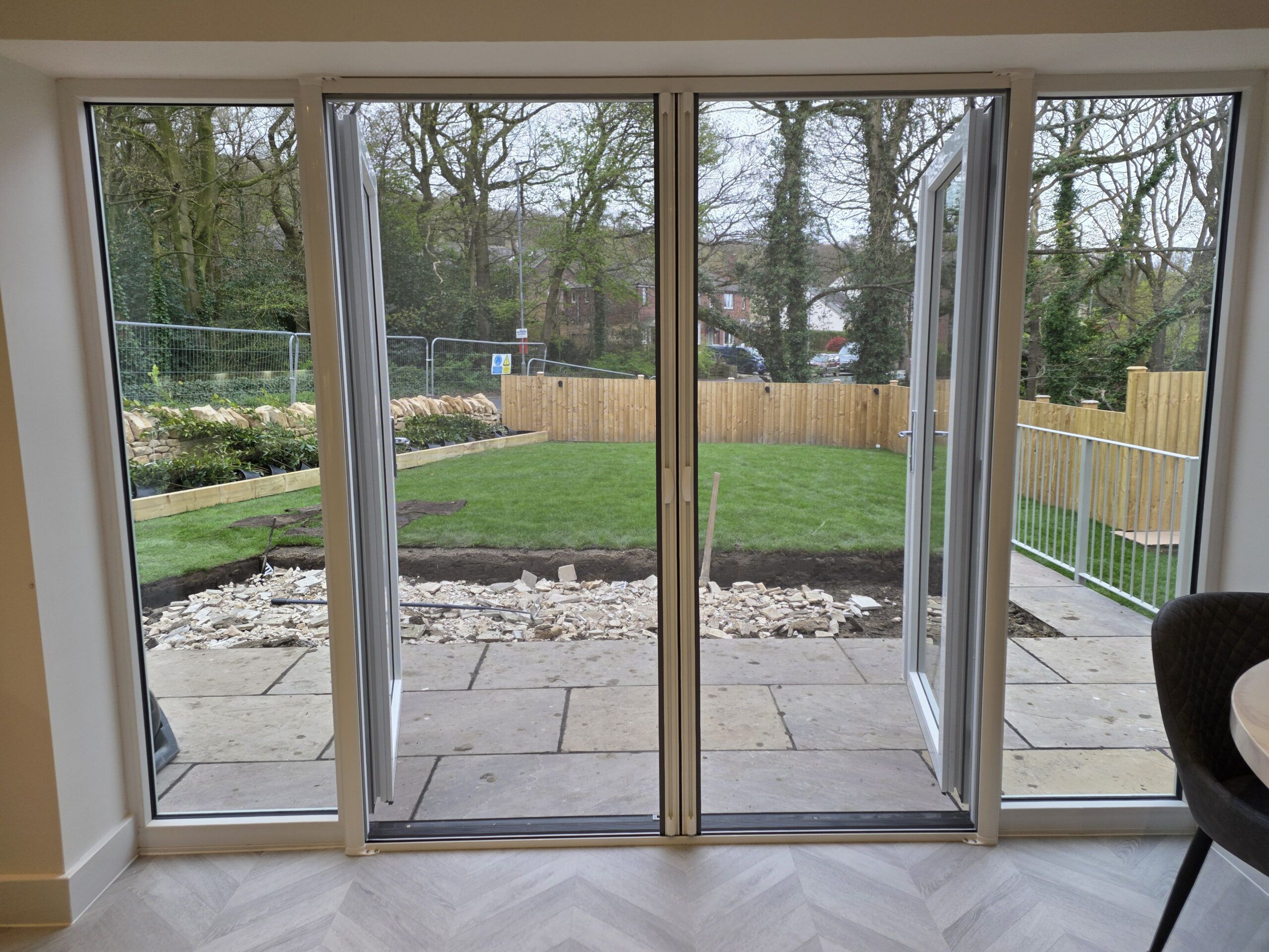
Fly screens for French, patio and bi-fold doors
For the home, the right screen depends on the door and how you use it. For French doors and wide patio openings, our double roller fly screen doors pull across from each side and retract into slim cassettes when not needed, while single doorways suit our roller fly screen doors. Plisse fly screens use a pleated mesh that concertinas neatly aside — a tidy solution for bi-fold doors, conservatory doors and anywhere a low-profile threshold matters. Whatever the door — single, double, sliding, bi-fold, conservatory or a standard back door — we can supply a screen to fit, ready assembled for quick installation or as a pre-cut kit made to your dimensions, so there’s no need to reach for the saw.
Built to last, indoors or out
The frame profiles are aluminium, finished in a UV-stabilised polyester coating that resists chipping and fading and wipes clean easily. All of our screen doors can be installed inside or outside, are guaranteed rust-free, and will give years of low-maintenance, trouble-free service. If you need technical dimensions, they can be downloaded from each individual product page.
The right mesh for the job
Every screen can be tailored to what’s actually bothering you. Standard mesh keeps out houseflies, bees, moths, wasps and mosquitoes; if you’re somewhere with smaller biting insects, a finer mesh with a smaller aperture keeps out most midges too. Materials range from fibreglass and PVC through to aluminium and stainless steel for the heavy-duty end of the range — so there’s a sensible option for a kitchen back door and an industrial-strength one for a loading bay.
Need something heavier-duty for a business or commercial site? See our
Commercial Fly Screens range →
| Screen type | Typical setting | How it works | Max width | Frame / mesh | Fitting |
|---|---|---|---|---|---|
| Single roller | Home | Spring-tensioned mesh pulls across and retracts into a slim aluminium cassette | up to 1.5 m | Decor grey; 20/30 midge mesh; toughened pet mesh; UV-reflecting | Inside or outside, onto wood, UPVC or metal; 10 mm recess tolerance |
| Double roller | Home — most popular | Two mesh panels meet in the middle and retract to each side | up to 3.5 m | As single roller | As single roller (guides in two sections above 2.3 m) |
| Plissé (pleated) | Home — wide / step-free | Concertina mesh folds into the cassette and holds any position | Wide openings, incl. bi-folds | Pleated mesh; cassette colours to match your doors | Very low base guide (no trip hazard); photo checked before quoting |
| Commercial fly screen door | Commercial kitchens & premises | Hinged panel door with a base kick plate, centre push plate and self-closer | Made to your exact size | 50 mm × 15 mm mitred & riveted aluminium frame; charcoal mosquito mesh | Ready-assembled; screw the hinges to your existing frame or subframe |
| Commercial heavy-duty | Busy commercial kitchens & high-traffic premises | Diamond metal grille protects the mesh and adds security; internal shoot bolt can be retrofitted | Made to your exact size | 50 mm × 15 mm frame; stainless steel mesh behind the grille | Ready-assembled; universal hinge fitting |
| Heavy-duty, solid base | High foot-traffic & delivery-cart premises | Same diamond-grille construction as the heavy-duty door, with a reinforced solid base built to take constant knocks | Made to your exact size | 50 mm × 15 mm frame; stainless steel mesh behind the grille | Ready-assembled; universal hinge fitting |
| Heavy-duty, double-action | Hands-free premises — kitchens, cafés, warehouses | Double-action hinges let the door swing both in and out; brush strip at the base helps keep out rodents too | Single doors up to 1050 mm; double doors up to 2100 mm | 50 mm × 15 mm frame; stainless steel mesh behind the grille | Subframe fitted first, then the ready-assembled door(s) hinge onto it |
| Strip mesh (walk-through) | Kitchen staff, trolleys & deliveries — constant foot traffic | Overlapping weighted mesh strips swing aside and fall straight back; 30% overlap standard or 50% for exposed/windy doorways | Single or double commercial doorways | Suntex industrial polyester strips; 403-grade stainless steel rail & fittings | Screw the rail up, hook the strips on; strips lift off individually to wash |
| PVC strip curtains | Warehouses, workshops & internal partitioning | Clear or ribbed PVC strips that flex aside for forklifts, trolleys and staff, then fall back into place; also helps hold in room temperature | Made to your opening | Thick tough PVC, 200 × 2 mm strips (standard) up to 300 × 3 mm (wider industrial entrances); clear or ribbed | Fixed rail; wipes clean, no ongoing maintenance |
| Perforated PVC strip curtains | High-traffic areas wanting extra airflow & visibility | Evenly perforated PVC strips let air circulate while still cutting down flies, dust and noise | Made to your opening | Perforated PVC, transparent | Fixed rail, same as standard PVC strip curtains |
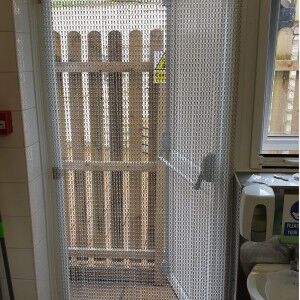
| Chain fly screen | Home & commercial | A curtain of linked aluminium chain — walk straight through | Most widths (wide openings in sections) | Anodised aluminium chain, 1.8 mm wire — heavier chain, fewer gaps | Ready-assembled at 2200 mm; hang on the brackets, remove links to height |
Fly screen doors — your questions answered
What’s the best fly screen for French or patio doors?
Double roller fly screens are the usual choice — one cassette each side, meeting in the middle, and retracting out of sight when not in use. Plissé screens are a strong alternative where you’d prefer a very low threshold or want to leave the screen part-open. For a single French or patio leaf, a single roller (up to 1.5 m) is often all you need.
Will a fly screen door fit bi-fold doors?
Yes. A double roller covers openings up to 3.5 m, and a plissé screen suits wide bi-fold runs because it holds any position rather than needing to fully retract. Chain screens also work across wide openings and are supplied in sections. Send a photo of the run and we’ll tell you which is the better fit.
Can I walk through the screen with my hands full?
Yes — that’s exactly what chain screens and strip curtains are for. You walk straight through and they fall back into place behind you, which is why they’ve been the commercial doorway standard for decades. For a screened door you open and close, a roller screen is the better choice.
How do I measure my doorway?
First decide where the screen will sit — inside the reveal, on the outer frame, or across the face of the opening — because that changes which measurements matter. Then use a steel tape, work in millimetres, and take the width and height in at least two places each. Note anything that reduces the fixing area: handles, trickle vents, cills, thresholds, tiles or architraves. If two readings don’t match, measure again. Each door type has its own measuring guide, and if you send us a photo we’ll check it before anything is cut.
Do I need to be good at DIY to install one?
Not especially. Chain and strip-mesh screens arrive ready-assembled and hang on the supplied brackets in a few minutes; roller screens screw to the frame with a bit of care. Kits are pre-cut to your exact dimensions — no sawing. If you’d rather not fit it yourself, we offer a full measuring and fitting service.
How much do fly screen doors cost?
Every screen is made to your opening, so price depends on size and type. As a guide, excluding VAT: chain screens from £140, strip-mesh doors from £179, single roller from £270, double roller from £295, commercial heavy-duty doors from £498, and plissé doors from £671. Send us your sizes for an exact quote.
Which mesh keeps out midges and the smallest flies?
Standard insect mesh stops houseflies, wasps and moths. If you’re somewhere midge-prone — much of Scotland, or near water — ask for the finer 20/30 midge mesh. It’s a tighter weave, so it trims airflow and light very slightly, which is why we don’t fit it everywhere as standard; it’s the right call where midges are the actual problem.
Will a fly screen door survive pets?
Our heavy-duty screens with stainless steel mesh stand up to serious punishment, and toughened pet mesh is available for domestic roller doors. In the interests of honesty: a determined dog at full speed will test any screen ever made, so no mesh is truly pet-proof — but pet mesh is a big step up from standard.
What about magnetic fly screens for doors?
Magnetic screens are the cheapest option and fine as a short-term fix, but the mesh and fixings are usually lightweight, the magnets pull apart in a breeze, and they rarely last a full season on a well-used door. We make magnetic screens for windows, where they make sense; for a door that gets real use we’d steer you towards a roller or chain screen that will still be working in five years.
Are your screen doors suitable for commercial kitchens and food premises?
Yes — all of our door screens are approved by the Food Standards Agency, making them suitable for commercial kitchens, food preparation and food storage areas that need to satisfy Environmental Health requirements. For a full screen door in a busy kitchen, the commercial heavy-duty range has a reinforced frame and a self-closing option for hands-free use.
Can the screens be fitted outside?
Yes. The aluminium frames and UV-stabilised coating are fully weatherproof and guaranteed rust-free, so the screens can be installed internally or externally without fading, chipping or corroding.
Not sure what you need? Our dedicated team is always happy to help — just drop us an email at sales@premier-env.co.uk. Screening the windows as well? Have a look at our fly screens for windows.