
A lot of UK gardens look ready for magazine photos but fall apart in daily use. The paving looks smart. The furniture matches. The lighting is warm. Then the weather turns, the air goes still, the midges arrive, and everyone heads back inside with their drinks half-finished.
That's the gap most advice ignores. Good outdoor living spaces aren't just attractive. They work in British conditions, across more of the year, with fewer compromises. That means designing for rain, damp, wind, temperature swings, ventilation, and insect pressure from the start, not treating them as afterthoughts.
Beyond the Patio A New Vision for Outdoor Living
A patio on its own is just a surface. An outdoor living space is something else entirely. It behaves like an extra room, even if it isn't fully enclosed. It needs structure, shelter, airflow, lighting, storage, comfortable routes in and out of the house, and protection from the things that make people stop using it.
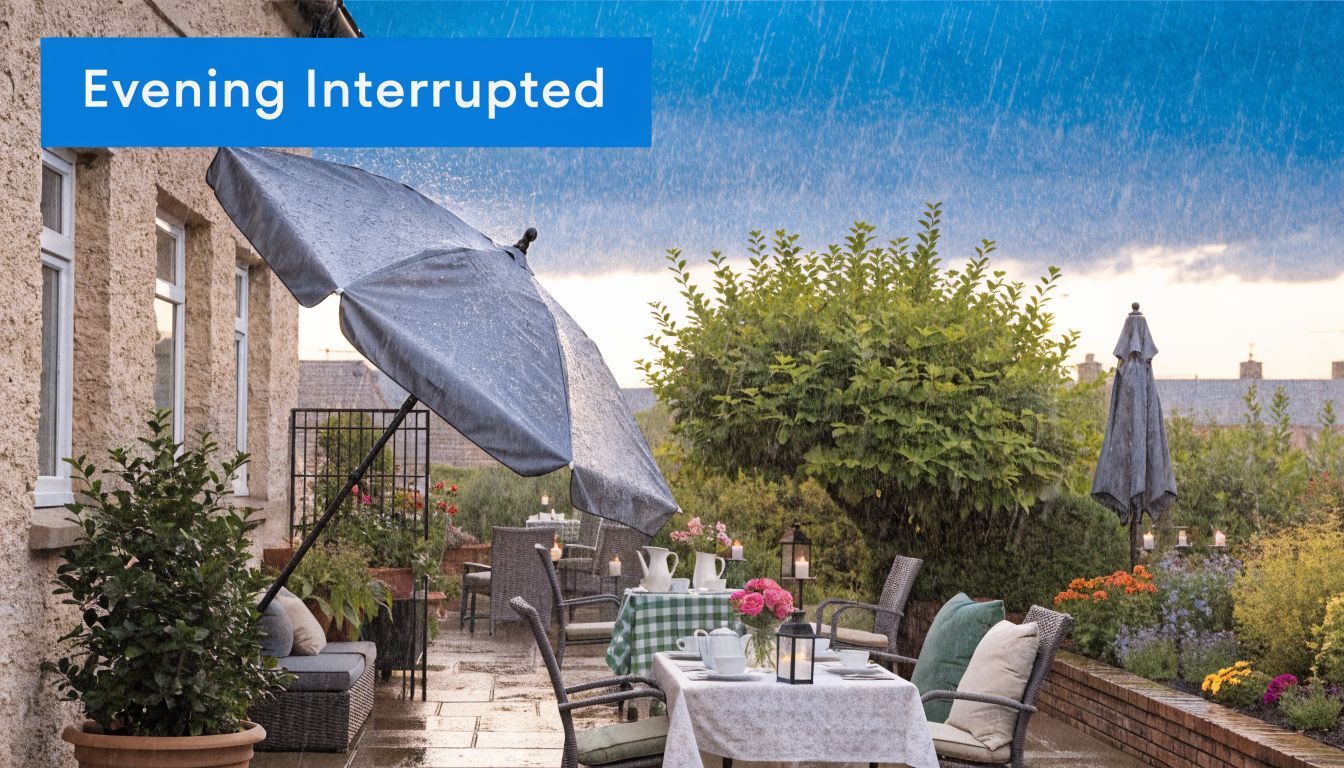
That last point matters more than many homeowners realise. The same source notes a 25% rise in midge populations after wet summers. That's a direct reminder that the dream and the reality often don't line up in practice, especially in the UK climate (outdoor living trend data).
What a usable outdoor room actually needs
A successful scheme usually combines a few essential elements:
- Shelter with purpose so light rain doesn't end the evening and strong sun doesn't make lunch uncomfortable.
- A layout that supports how you live rather than how a showroom vignette looks.
- Materials that cope with moisture and winter conditions rather than ageing badly after a few seasons.
- Openable screening and enclosure elements that let air move while controlling pests and debris.
- Connections to doors and thresholds that make the space feel part of the house, not detached from it.
Outdoor space only feels luxurious when it's easy to use. If every nice evening comes with a workaround, the design hasn't finished the job.
Plenty of broad inspiration from warmer regions can still be useful if you read it critically. For example, some landscaping ideas for Arizona homes are helpful for zoning and visual flow, even though the UK demands much more attention to moisture, shelter, and pest control.
If your goal is to make a terrace or garden seating area feel like an extension of the house, start by thinking less about “patio décor” and more about how to screen a patio without losing light, views, or fresh air.
Your Foundation Planning for Purpose and Place
Most expensive mistakes happen before any ground is broken. People choose finishes too early, then try to force real life into a layout that doesn't suit the site or the way they use the garden.

Start with use, not style
Ask one hard question first. What is this space mainly for?
A quiet morning coffee spot needs something very different from a family dining terrace. A hospitality terrace has another set of priorities again, including circulation, cleaning access, and how staff move food and drink between inside and outside. If you don't define the primary function, every later decision becomes blurred.
I usually advise clients to rank uses rather than list them all as equal. That keeps the design honest.
- Primary use. Dining, lounging, cooking, working, entertaining, or commercial service.
- Secondary use. Reading corner, children's overflow space, evening drinks, winter sun trap.
- Low-priority extras. Fire feature, decorative planting wall, outdoor television, built-in benching.
Read the site properly
A good plan comes from observation, not guesswork. Stand in the garden at different times of day. Watch where light falls, where the wind hits, and which areas stay damp longest after rain.
Check these points before you commit to a layout:
- Sun path. A west-facing terrace may feel ideal until glare and evening heat make dining awkward.
- Prevailing wind. A beautiful pergola is unpleasant if draughts hit the seating position every evening.
- Privacy lines. Upper-storey overlooking changes how enclosed the space needs to feel.
- Thresholds and access. Wide doors and level transitions make the space easier to use and furnish.
- Drainage behaviour. If water sits on the site now, decorative changes won't solve it later.
Practical rule: if the route from kitchen to outdoor dining is awkward indoors, it will feel even worse carrying plates in the rain.
Budget in layers
Not every element carries equal value. Spend first on groundworks, drainage, structural fixings, and the parts that affect comfort. Decorative upgrades can be phased.
Looking outside the UK can still provide helpful insights. Guidance on sustainable paving solutions for Australian driveways is useful for understanding how permeable surfaces manage water, even though UK detailing needs to reflect colder winters and different regulations.
One more point often missed. Doors shape the whole experience of indoor-outdoor flow. Before locking in furniture plans, review how made to measure patio doors will open, stack, and interact with furniture, screens, and circulation.
Built to Last Choosing Materials for the UK Climate
The UK is unforgiving on poor material choices. What looks crisp in a brochure can become slippery, stained, cracked, or labour-intensive once it faces standing moisture, leaf fall, winter freeze, and repeated cleaning.

The biggest structural mistake I see is specifying on appearance alone. In the UK, materials that fail to resist freeze-thaw cycles can be disastrous; water saturation can cause 9% volumetric expansion, exerting immense pressure. National surveys show 28% of hard outdoor surfaces fail within 5-7 years due to poor material choice, a problem avoidable by using frost-resistant block paving or other properly specified materials (freeze-thaw guidance and survey summary).
Paving choices that age well
For most high-use terraces, I'd rather see a sensible, durable specification than a fashionable one that creates maintenance issues.
Porcelain works well when it's chosen with proper slip resistance and laid on a correctly prepared base. It gives a clean finish and consistent colour, but poor installation shows quickly. Edge detailing matters, and cheap trims can undermine the whole job.
Natural stone can be excellent, but it has to be selected for exterior use in the UK. Some stones weather beautifully. Others absorb too much moisture and become troublesome. Clients often love the variation, then dislike the maintenance.
Frost-resistant block paving and permeable paving systems are often underrated for outdoor living spaces. They can look refined when detailed properly, and they tend to cope better with movement, drainage, and long-term repairs.
Decking and timber structures
Decking isn't automatically the premium option. It solves some level-change issues well, but it also introduces a few risks.
- Timber decking has warmth and character, but it needs regular care and careful species selection. In shaded gardens it can become slippery and tired-looking if maintenance slips.
- Composite decking reduces some upkeep, though the better boards perform much better than budget ones. Surface temperature, board span, and subframe detailing all matter.
- Pergolas and roof structures need durability at joints and fixings, not just a good-looking frame. Water management at the top of the structure affects everything beneath it.
Details that separate good from poor
The visible finish gets attention. The hidden detail does the heavy lifting.
Look closely at:
- Falls and drainage paths so water leaves the surface cleanly.
- Movement joints and bedding systems so the terrace can cope with seasonal change.
- Slip resistance in the wet, especially on dining routes and steps.
- Boundary interfaces where paving meets doors, planters, and soft landscaping.
If the space includes screened openings or semi-enclosed sections, tougher mesh choices can also support durability where pets, wind-blown debris, or frequent use are factors. For that kind of application, stainless steel mesh can be worth considering where standard soft mesh would be too vulnerable.
Materials should earn their place twice. Once on day one, and again after five winters.
Creating the Comfort Zone Ventilation and Insect Control
Most outdoor living spaces fail on comfort, not appearance. They get too hot under cover, too stuffy when enclosed, or too irritating to sit in once insects and pollen move through. That's why ventilation and screening should be treated as part of the architecture.
UK Building Regulations require ventilation in covered patios, but this can increase midge and pollen ingress by 70-90%. Integrating bespoke screens with pollen-filter mesh not only blocks these irritants but can also lower internal temperatures by 3-5°C during heatwaves, cutting air conditioning energy use by up to 35% (ventilation and screening performance details).
Why open air isn't always comfortable
People often assume more openness automatically means more comfort. In reality, an exposed opening can create a trade-off you feel immediately. You get airflow, but also insects, drifting pollen, blown leaves, and less control over the microclimate.
That's especially obvious in covered patios, outdoor kitchens, garden rooms, and wide bi-fold openings. If the space is close to planting, water, fields, or hedgerows, the problem becomes more obvious at dusk.
A better approach is controlled ventilation. Let the space breathe, but decide what comes through.
Screening as a design system
High-quality screens don't need to look add-on or domestic in the worst sense. Done properly, they sit cleanly within the openings, preserve sightlines, and disappear when not required.
Different applications suit different systems. The right choice depends on opening width, traffic pattern, frequency of use, and whether the client prioritises views, airflow, allergy reduction, or resilience.
| Screen Type | Best For | Key Benefit | Consideration |
|---|---|---|---|
| Retractable roller screens | Single doors, frequent access points, openings where a clean disappear-away option matters | Neat appearance when not in use and straightforward day-to-day operation | Needs accurate measuring and good alignment |
| Plissé screens | Wide openings and bi-fold style access | Smooth operation across larger spans with a low-visual-impact finish | Bottom track detailing needs care |
| Sliding screens | Patios and broader glazed sections | Stable and practical for repeated use | Requires enough stacking or run-back space |
| Pollen-filter mesh screens | Homes where seasonal irritants affect comfort | Better control of airborne irritants while maintaining airflow | Slightly more specialised specification |
| Pet-resistant or heavier-duty mesh | Busy family homes, stronger wear points, commercial settings | Better resilience against knocks and repeated contact | Can look more robust than fine domestic mesh |
If a covered seating area needs doors, windows, heaters and lighting to feel usable, it also needs a clear plan for ventilation and pest control.
For openings that need a discreet solution and regular in-and-out use, retractable fly screens are one practical route because they keep airflow while avoiding the visual bulk of fixed barriers.
What works and what usually doesn't
There's a clear difference between stopgap bug control and an integrated solution.
What works
- Made-to-measure screens fitted to the actual opening.
- Mesh choice matched to the problem, whether that's midges, pollen, pets, or heavy traffic.
- Early coordination with doors, lintels, drainage tracks, lighting, and power points.
- Simple operation so people use the system day to day.
What doesn't
- Loose magnetic netting on premium openings.
- Chemical-only approaches that don't change the underlying usability of the space.
- One-size-fits-all kits on irregular or large-format openings.
- Leaving screens until the end and trying to force them into a design that never allowed for them.
For projects that need bespoke options for patios, doors, or commercial settings, Premier Screens Ltd manufactures made-to-measure systems with different mesh types including midge, pollen, and pet-resistant options. That matters because the right screen specification depends on how the space is used, not just on opening size.
Outfitting the Space Furniture Lighting and Ambience
Once the hard structure works, furnishing should support behaviour. The best outdoor living spaces feel calm because each element has a role. Seating sits where people want to sit. Light lands where people need it. Heat supports the season instead of fighting the weather.
Build zones, not clutter
Most gardens don't need more furniture. They need better arrangement.
A simple way to get there is to create three distinct zones, even if they overlap visually.
- Dining zone with upright seating, proper table clearance, and direct access from the kitchen.
- Lounge zone with softer seating, side tables, and a more sheltered aspect.
- Transition zone at the threshold, often left too tight, where people pass through, set things down, and reorient themselves.
Keep circulation routes generous. If chairs need moving every time someone walks through, the plan is too crowded.
Light in layers
Single-source lighting almost always feels flat outdoors. Good schemes layer light by task and mood.
Use a combination such as:
- Ambient light from wall fittings, overhead structures, or warm concealed strips.
- Task light for cooking, serving, and steps.
- Accent light to pick out planting, textured walls, or a feature tree.
Avoid over-lighting. A bright terrace next to a dark garden can feel harsh and exposed. Lower, warmer light usually makes the space feel more settled.
Evening comfort comes from contrast control. You want enough light to use the space, not so much that it feels like a car park.
Heating and softness
Heating should match the way the space is occupied. Electric heating tends to suit covered, seated areas where warmth needs to be directed and reliable. Fire features can add atmosphere, but they also bring smoke drift, storage needs, and clearance issues that don't suit every site.
Textiles matter too, though they need discipline. Use outdoor fabrics that dry well and store loose cushions properly. Rugs can help define zones, but only if they're suitable for exterior use and don't stay damp for long periods.
The finishing touches should support maintenance as much as style. Easy-clean tabletops, stackable occasional seating, concealed storage, and plant containers with proper drainage all make the space easier to live with.
Understanding Costs Compliance and Return on Investment
Budget conversations are easier when the project is broken into systems rather than treated as one large decorative spend. That's how you avoid overspending on finishes while underfunding the parts that affect performance.
Where to invest first
The strongest value usually sits in the elements that are difficult to change later.
Prioritise these early:
- Ground preparation and drainage because failure here affects everything above.
- Structural shelter and fixings because retrofitting often costs more and looks worse.
- Threshold design and door coordination because that controls usability every day.
- Screening and environmental control in any space intended for regular evening or shoulder-season use.
Where can you save? Usually in accessories, movable furniture, and decorative extras that can be upgraded later once the bones are right.
Compliance matters more in commercial settings
For hospitality, food service, and commercial kitchen environments, outdoor areas sit under a different level of scrutiny. Pest control isn't a styling choice. It's part of operational hygiene.
That changes how owners should think about specification. Open service windows, outdoor prep areas, and covered dining zones need measures that support airflow without inviting insects into customer or food-handling spaces. Cleaning access, durability, and ease of use matter just as much as appearance.
For residential clients, compliance is often more about planning, thresholds, electrical work, drainage, and making sure covered spaces don't create problems with airflow or overheating. In both cases, a professional design-and-build approach usually pays for itself by reducing awkward retrofits.
Thinking about return
Return on investment isn't only about resale. It's also about frequency of use, season length, maintenance burden, and whether the space replaces demand on rooms inside the house.
For homeowners, a well-resolved outdoor room often delivers value in everyday living. It creates another place to eat, work, host, or sit peacefully without feeling temporary.
For commercial operators, the logic is more direct. If customers can sit comfortably for more months of the year and staff can operate the area cleanly and efficiently, the space earns its keep more consistently. That makes durable, serviceable components easier to justify than decorative upgrades that don't change how the area performs.
Your Project Checklists and Seasonal Maintenance Guide
A good project runs better when the brief is clear before you ask for prices. That applies whether you're a homeowner planning one terrace or a trade buyer specifying multiple openings.
Homeowner checklist
- Define the main use before choosing style references.
- Map sun, wind, privacy and drainage across the day and across seasons.
- Set absolute requirements such as cover, dining capacity, storage, or screen protection.
- Choose materials for wet and winter conditions, not just colour and texture.
- Coordinate doors, thresholds and furniture layout so movement feels natural.
- Plan ventilation and insect control together, especially for covered or enclosed sections.
- Leave room in the budget for the invisible work that keeps the space performing.
Trade and commercial checklist
- Confirm operational use of the area, including service routes and cleaning needs.
- Review compliance requirements for pest control, ventilation, and access.
- Specify mesh and frame type by environment, not by habit.
- Check fixing details and opening sizes early to avoid site improvisation.
- Account for wear points where traffic, pets, trolleys, or repeated access affect longevity.
- Build in maintenance access for tracks, drainage channels, and adjacent finishes.
Seasonal maintenance that protects the investment
Keep maintenance simple and consistent.
In autumn, clear leaves from drainage runs, tracks, and corners where moisture sits. In winter, inspect paved surfaces, joints, and any areas prone to pooling water. In spring, clean frames, wash mesh carefully, and test moving parts before the heavy-use season starts. In summer, pay attention to shading, airflow, and whether furniture placement still supports how the space is being used.
Small checks done regularly prevent bigger repair jobs later.
If you're planning an outdoor space that needs to work in real UK conditions, Premier Screens Ltd can help with made-to-measure fly screen solutions for patios, doors, windows, and commercial openings. The key is getting the specification right early, so ventilation, views, and usability all work together rather than against each other.
