
Guide To Buying SS Mesh Sheet For UK Use
If you're looking at an ss mesh sheet listing and wondering why one product is described by mesh count, another by aperture, and another by grade, you're not alone. Most buyers start with a simple job in mind. Keep flies out of the kitchen. Add a tougher screen to a patio door. Stop pets damaging a lower panel. Then the specification sheet lands in front of them and suddenly the choice feels more industrial than practical.
That confusion is common in both homes and commercial sites. A homeowner wants a screen that doesn't spoil the view. A facilities manager wants something that will stand up to daily use, routine cleaning and inspection. Both are trying to answer the same question. Which stainless steel mesh will do the job properly without paying for the wrong thing?
After decades making and supplying bespoke screening systems across the UK, the pattern is always the same. People rarely need more information. They need the right information, translated into buying decisions that make sense on a real building. That's where many generic product pages fall short. They list technical terms but don't tell you what those terms mean once the screen is fitted to a window, door or serving hatch.
Your Guide to Choosing the Right Stainless Steel Mesh
A typical enquiry goes like this. Someone has an outward-opening kitchen window that needs insect protection. They've found an ss mesh sheet online and now they're comparing “20 x 20”, “304”, “wire diameter” and “open area” without any real sense of what matters most. Another buyer has a patio door in a damp coastal location and assumes any stainless mesh will do. It won't.
The right choice comes down to use, location and the balance you want between airflow, visibility, pest exclusion and toughness. For some jobs, standard insect screening is exactly right. For others, a finer mesh is needed to deal with smaller nuisance insects. On a high-contact door, the deciding factor may be durability rather than openness.
The biggest buying mistake isn't choosing stainless steel. It's choosing stainless steel with the wrong specification for the job.
For UK buyers, that matters more than many people expect. Damp air, condensation, routine washdowns and exposed external openings all put pressure on a screen system over time. A mesh that looks suitable on paper can prove frustrating in daily use if the opening is too coarse, the wire too heavy, or the alloy poorly matched to the environment.
If you're weighing up domestic insect screens, patio door screens or commercial applications, it helps to start with practical examples rather than catalogue jargon. A more focused breakdown of domestic options is covered in our guide to the best fly screen mesh options for UK homes.
What follows is the way experienced screen manufacturers assess ss mesh sheet in practice. Not as a raw material alone, but as part of a working screen that needs to fit, last and do its job every day.
What Makes Stainless Steel Mesh "Stainless"
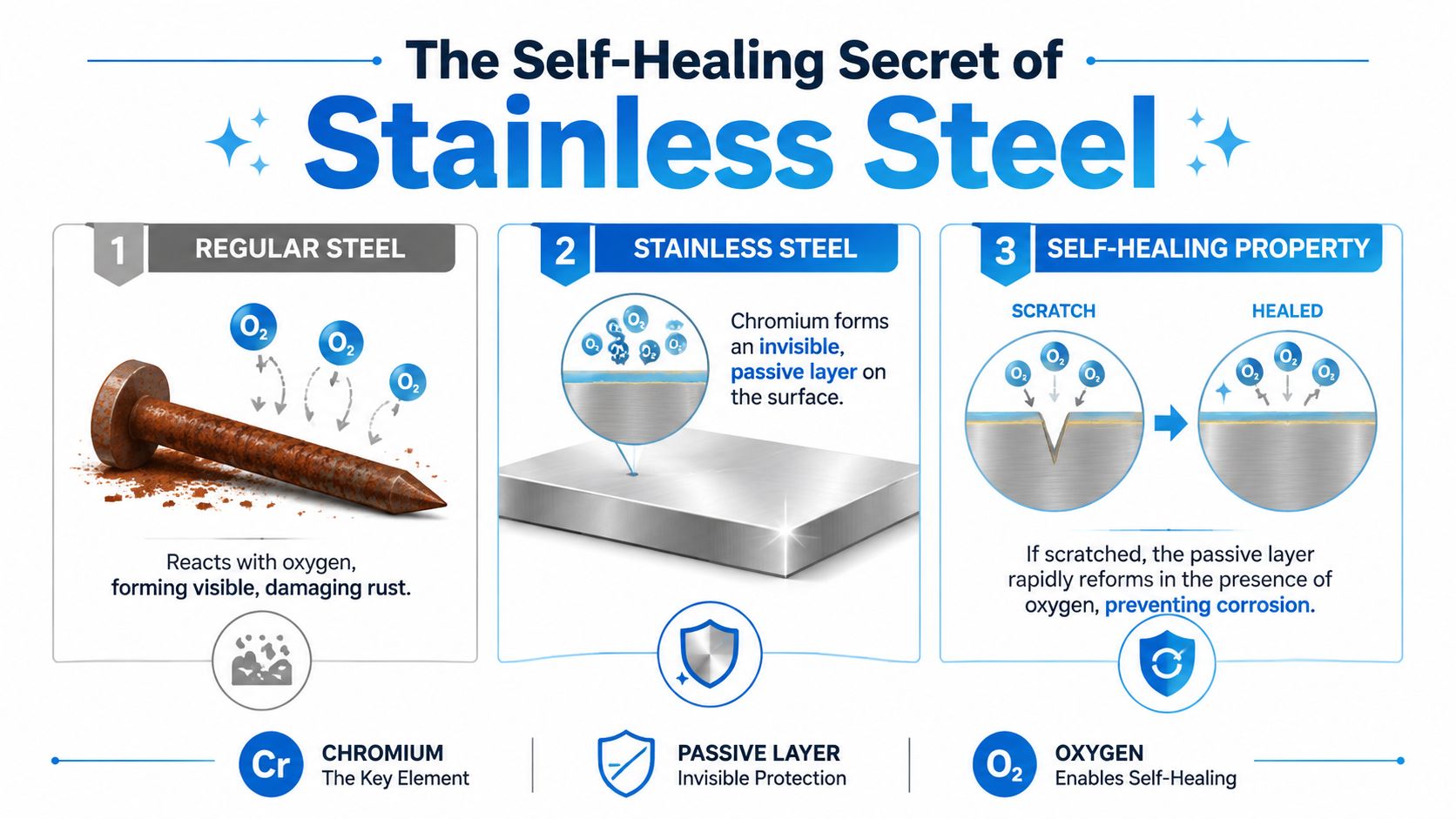
Stainless steel isn't magic, but it does behave very differently from ordinary steel. The key point is that the chromium in the alloy forms a thin passive surface layer that protects the steel underneath. If that surface is scratched, the layer reforms in the presence of oxygen. In practice, that gives stainless mesh its reputation for long service life in damp conditions.
Why this matters on UK properties
That passive layer is the reason stainless mesh is often the sensible choice for windows, doors and service openings that see moisture. In the UK, screens spend a lot of time dealing with humidity, condensation and wet weather. In some locations, especially near the coast, the air also carries salt that makes life harder for ordinary steel.
A UK procurement specification for SS 304 wire mesh lists 18 to 20% chromium, 8 to 10.5% nickel, and a minimum tensile strength of 515 MPa in line with ASTM A580/A580M, which is why 304 is widely treated as the practical benchmark for moisture-exposed screening work (UK SS 304 procurement specification).
304 for most jobs
For everyday insect screens, many door screens and plenty of commercial internal uses, 304 stainless steel is the sensible starting point. It offers the corrosion resistance most UK buyers need without drifting into over-specification.
That makes it a good fit for:
- General domestic screens where the opening is exposed to weather but not severe salt exposure
- Wash areas and utility rooms where moisture is routine
- External doors in normal inland settings where you want long life and low maintenance
- Commercial settings where hygiene matters and the mesh must cope with regular use
If the job is a standard inland property or a typical commercial interior, 304 is usually where the conversation should begin.
When 316 is worth it
There are jobs where 304 is still workable, but not ideal for the long term. Coastal properties are the obvious example. So are exposed façades, plant areas, and commercial kitchens where the screen gets frequent contact with moisture and cleaning chemicals.
Practical rule: If the environment is harsh enough that you're already worried about corrosion, you're usually better off judging the mesh on lifecycle, not purchase price.
For UK buyers, 316 is the grade to look at when chloride resistance matters more. That's why it often earns its place on coastal projects and tougher washdown environments. You may pay more upfront, but you're buying a material better suited to that exposure rather than buying “stronger stainless” for general purposes.
The right way to think about grades is simple. 304 is the reliable standard. 316 is the upgrade for harsher conditions. If you choose with the environment in mind, the rest of the specification becomes far easier to narrow down.
Decoding SS Mesh Specifications
Once the alloy is settled, the next challenge is reading the actual mesh specification. Many buyers encounter difficulty with this, because the numbers look precise but don't explain themselves.
In the UK, stainless steel mesh is commonly specified by mesh count, wire diameter and aperture, rather than by a single strength figure. A 20 x 20 mesh means 20 openings per linear inch, and woven mesh can be made with apertures as small as 0.026 mm for specialist uses (wire mesh glossary with UK-relevant specification terms).
Mesh count
Mesh count tells you how many openings appear across one linear inch. Similar to thread count in fabric, this count affects visibility, airflow, and what can physically pass through the screen.
A lower count gives a more open structure. A higher count gives a finer screen. Neither is automatically better. The right count depends on what you're trying to block and how much air you want moving through the opening.
Wire diameter
Wire diameter is the thickness of the individual wires. This matters more than most buyers realise.
If two meshes have the same count, the one with the thicker wire will have smaller clear gaps between the wires. It will also tend to be more rigid. That can be useful for high-contact areas, but the price you pay is lower open area and a heavier visual look.
Aperture
Aperture is the clear opening between the wires. For screen buyers, this is often the most practical measurement because it tells you what the mesh is really doing.
Aperture affects:
- Insect exclusion
- Air movement
- Light transmission
- Visual openness
- Cleaning behaviour
If you're choosing for fly control, pollen reduction or a tougher barrier, aperture is one of the first numbers to pin down.
Buyers often focus on mesh count first. In practice, aperture is usually what decides whether the screen feels right once installed.
How the three work together
These values don't sit separately. They work as a set.
- Higher mesh count usually means finer screening
- Thicker wire usually means more rigidity
- Smaller aperture usually means more exclusion and less openness
That relationship is why one ss mesh sheet may suit a window vent while another is better for a screened panel on a door.
Quick Spec Chart Common Mesh Types Explained
| Mesh Type (Premier Screens) | Mesh Count (Openings per Inch) | Typical Use | Blocks |
|---|---|---|---|
| Standard insect mesh | Fine screening specification | Windows, standard doors, general home use | Common flying insects |
| Superfine midge mesh | Higher-count fine screening | Rural homes, patio doors, nuisance insect areas | Smaller flying insects and midges |
| Pollen mesh | Fine specialist screening | Bedrooms, living spaces, allergy-conscious homes | Insects and airborne pollen reduction |
| Toughened pet-resistant mesh | Heavier-duty screening format | Lower door sections, homes with pets | Insects, plus better resistance to clawing and pushing |
| Security-oriented stainless mesh panel | Application-specific heavier spec | Screened panels, higher-contact openings | Insects plus improved resistance to distortion |
The important point is that a spec sheet isn't just describing the material. It's describing behaviour. Once you know how mesh count, wire diameter and aperture interact, the jargon stops being a barrier and starts becoming useful.
How Mesh Specs Determine Real-World Performance
A specification only matters if you can predict how the screen will perform in use. That means turning the numbers into real outcomes. Can air still move? Will the mesh feel visually heavy? Will it stand up to knocks? Will it stop the insects you have?
Airflow and visibility
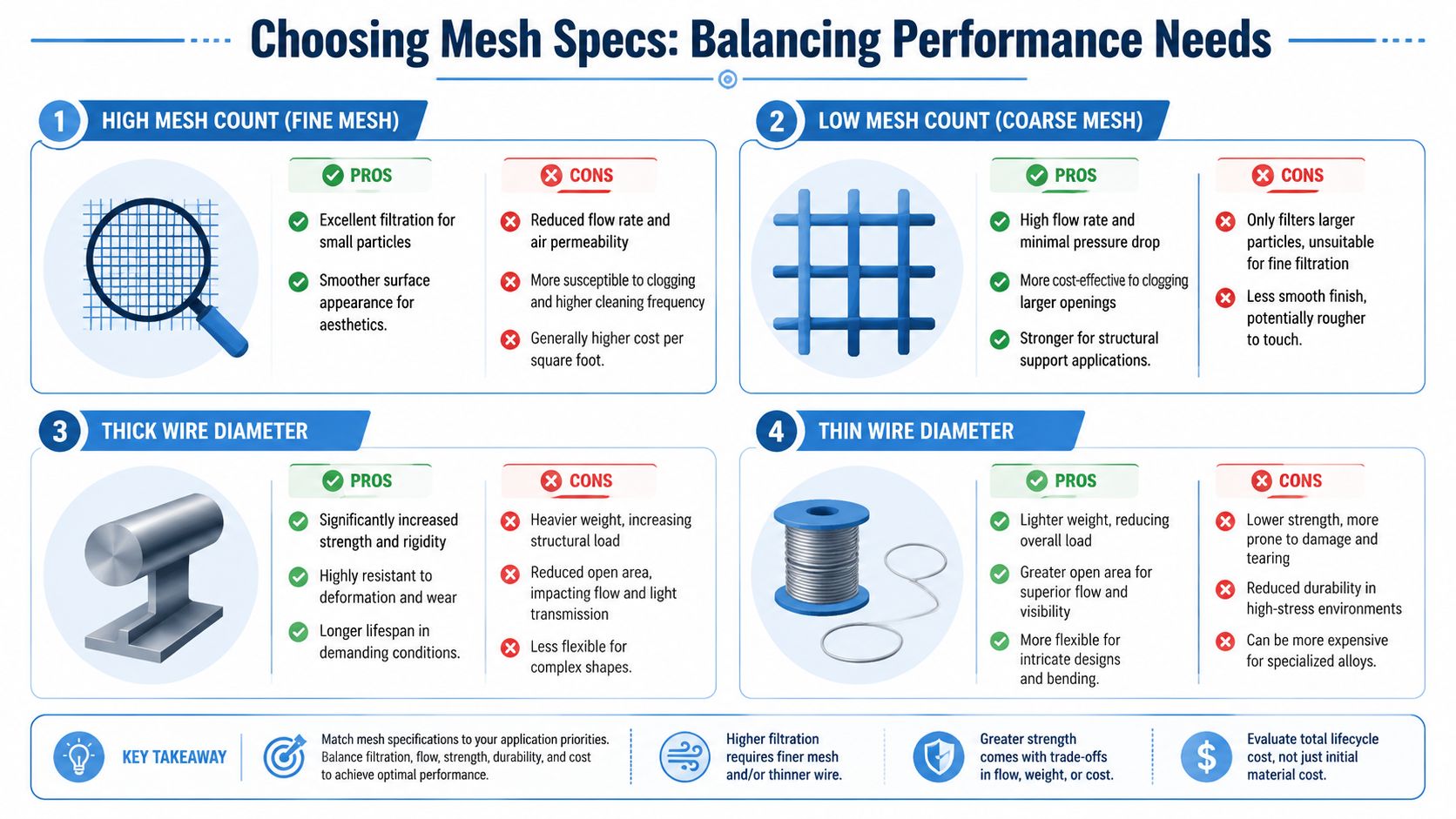
A more open mesh usually feels better on a door or window because it lets the opening breathe and keeps the view cleaner. But openness isn't free. If the mesh is too open for the target pest, the screen won't solve the problem that prompted the purchase in the first place.
A T304 10-mesh example uses 0.635 mm wire, has a 1.905 mm opening, and provides 56% open area. By contrast, a 2-mesh sheet with heavier 12 G wire is more rigid but has much lower open area, which reduces airflow significantly (T304 mesh opening and open area data).
That trade-off is why a coarse, rigid sheet may look attractive for strength, yet feel wrong on a kitchen window or patio door where airflow is one of the main reasons for fitting a screen.
Pest exclusion
The smaller the clear opening, the more capable the mesh becomes at excluding smaller insects and particles. That's useful in rural settings, around gardens, or on sites where nuisance pests are a regular complaint.
But finer isn't always better. A very fine mesh can slightly soften the view and may need more attention if the opening gathers grease, dust or airborne debris. On a busy site, that maintenance reality matters.
Rigidity and durability
Wire diameter changes how the screen behaves under physical stress. Thicker wire gives the mesh more stiffness and helps it resist deformation. That's useful for:
- Doors that get regular traffic
- Lower panels where pets make contact
- Commercial openings where staff handle screens often
- Areas where accidental knocks are likely
Thinner wire can look neater and preserve open area, but it won't tolerate the same abuse.
A strong screen isn't always the one with the heaviest wire. It's the one whose specification matches the way the opening is actually used.
What works and what doesn't
What works is matching the mesh to the dominant need. Fine mesh for small insects. More open mesh where ventilation is king. Heavier-duty wire where contact and abuse are expected.
What doesn't work is assuming one ss mesh sheet can cover every scenario. A patio screen, a kitchen hatch and a pet-exposed back door may all involve stainless mesh, but they rarely need the same specification. The right buying decision comes from accepting the trade-off, not trying to avoid it.
Common Applications for Stainless Steel Mesh Screens
In practice, buyers don't purchase ss mesh sheet for its own sake. They buy it because they need a screen to solve a problem on a particular opening. The best specification is the one that fits that use case without turning a simple job into an industrial overbuild.
Domestic windows and patio doors
A lot of UK homeowners want the same three things. Fresh air, an unobtrusive view and fewer insects indoors. For a standard bedroom or kitchen window, the answer is often a straightforward insect screen with a balanced mesh that doesn't feel heavy to look through.
Patio doors are different. They get more handling, they span a larger opening and they often sit next to gardens where insect pressure is higher. That's where the mesh choice becomes more application-specific. Current market demand increasingly reflects this, with more interest in superfine insect and pollen screens for homes rather than one-size-fits-all industrial mesh (stainless mesh as an application-specific choice for homes and commercial use).
Commercial kitchens and food areas
Food premises need more than a tidy-looking screen. They need a screen system that supports hygiene, cleaning and insect control in a way that stands up to day-to-day operation.
In kitchens, the right choice often comes down to:
- A mesh and frame combination that can be cleaned properly
- A specification suitable for moisture-heavy and high-traffic areas
- A design that preserves ventilation
- A setup consistent with Food Standards Agency screening expectations
If you manage catering facilities, schools, restaurants or food production areas, our guide to fly screens for commercial kitchens gives a more practical overview of screen types and site considerations.
Pet-resistant and tougher contact zones
A standard insect screen and a pet-resistant screen are not the same thing. If a dog pushes repeatedly at the bottom of a door, or a cat uses the panel as a climbing surface, the mesh needs a tougher specification and an appropriate frame arrangement.
Buyers often make the wrong call by choosing purely on fineness. The issue isn't the insect. It's the contact load. In these situations, a heavier-duty screen assembly often makes more sense than chasing the finest mesh available.
Security and architectural panels
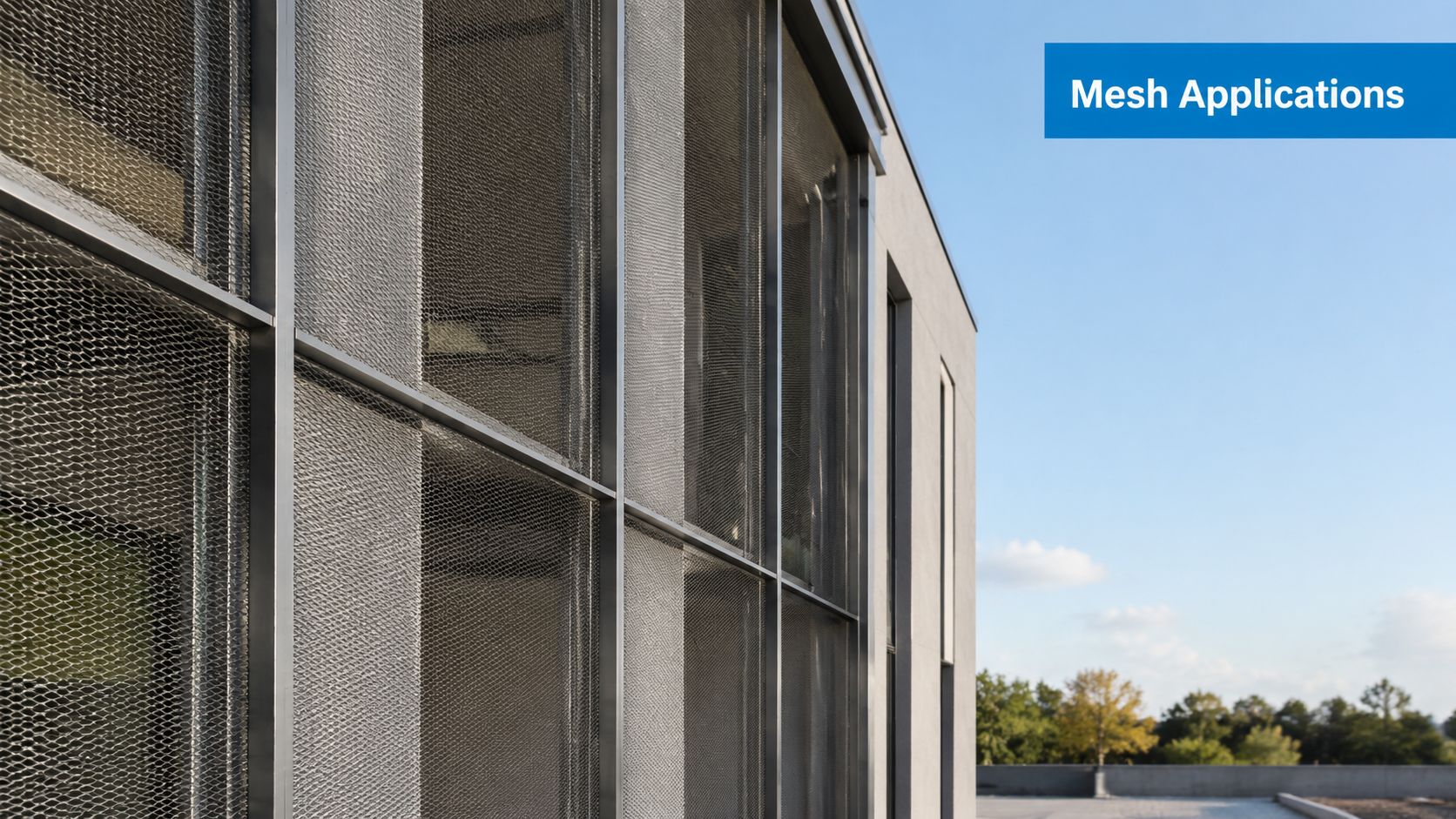
Some stainless mesh applications sit somewhere between screening and protection. External screened panels, service area guards and architectural infills often rely on the stiffness and durability of stainless mesh rather than fine insect exclusion alone.
Those jobs still depend on the same principles. Opening size, visibility, rigidity and exposure all matter. The difference is that impact tolerance and sheet behaviour become a larger part of the buying decision.
How to Choose the Right SS Mesh Specification
A buyer often gets to this stage with a data sheet full of mesh counts, wire diameters and alloy grades, but still no clear answer for a kitchen hatch, patio door or bin store vent. The right spec comes from the opening, the use, and the level of abuse the screen will take in service. That matters just as much in a family home as it does on a food premises where FSA-aligned screening is part of day-to-day compliance.
Start with the opening, not the catalogue
A bedroom window, a back door used all day, and a serving hatch all ask different things of the mesh. Buyers who start with “304 or 316?” usually jump too far ahead.
Work through the choice in this order:
What is the screen meant to stop or withstand?
For insect control, aperture size and percentage open area are usually the first checks. For pets, repeated contact, or rough handling, wire diameter and the overall screen build matter more.Where is it being fitted?
A sheltered inland window has different demands from a coastal elevation, a school kitchen, or a washdown area in food production.How will it be used every day?
A lightly used top-hung window can take a finer, lighter screen than a doorway that gets pushed, slammed, or cleaned constantly.
That sequence saves guesswork.
Balance insect exclusion, airflow and visibility
Fine mesh keeps out smaller insects, but it also reduces free area. Heavier wire improves strength, but it can make the screen look denser and cut light slightly. There is no single sheet that is best at everything.
For most domestic insect screens, the sensible target is a mesh that gives good air movement and a clear outward view while still dealing with the insects common to the site. If the property backs onto water, farmland or dense planting, the nuisance level often justifies a tighter specification. For pet screens and commercial doors, accept the compromise early. A tougher panel will usually look less delicate because it is less delicate.
I regularly see buyers chase the finest mesh available, then fit it into an opening where impact and handling are the actual problem. That is how screens get replaced too soon.
Choose 304 or 316 based on exposure and cleaning regime
For many UK inland installations, 304 stainless steel is the practical baseline. It performs well in normal external and internal conditions if the mesh is specified and maintained properly.
316 stainless steel earns its extra cost where chloride exposure or aggressive cleaning is part of the job. That includes coastal properties, sea-facing apartment blocks, busy commercial kitchens, and some food settings where cleaning chemicals are used routinely. In those cases, the better corrosion resistance can mean fewer staining issues and a longer service life.
This is the same logic used in adjacent specification work. If you are also assessing perimeter products or external metalwork, the principles in choosing the right fence material are similar. Match the material to the environment and duty level, not to habit.
Match the mesh format to the buyer
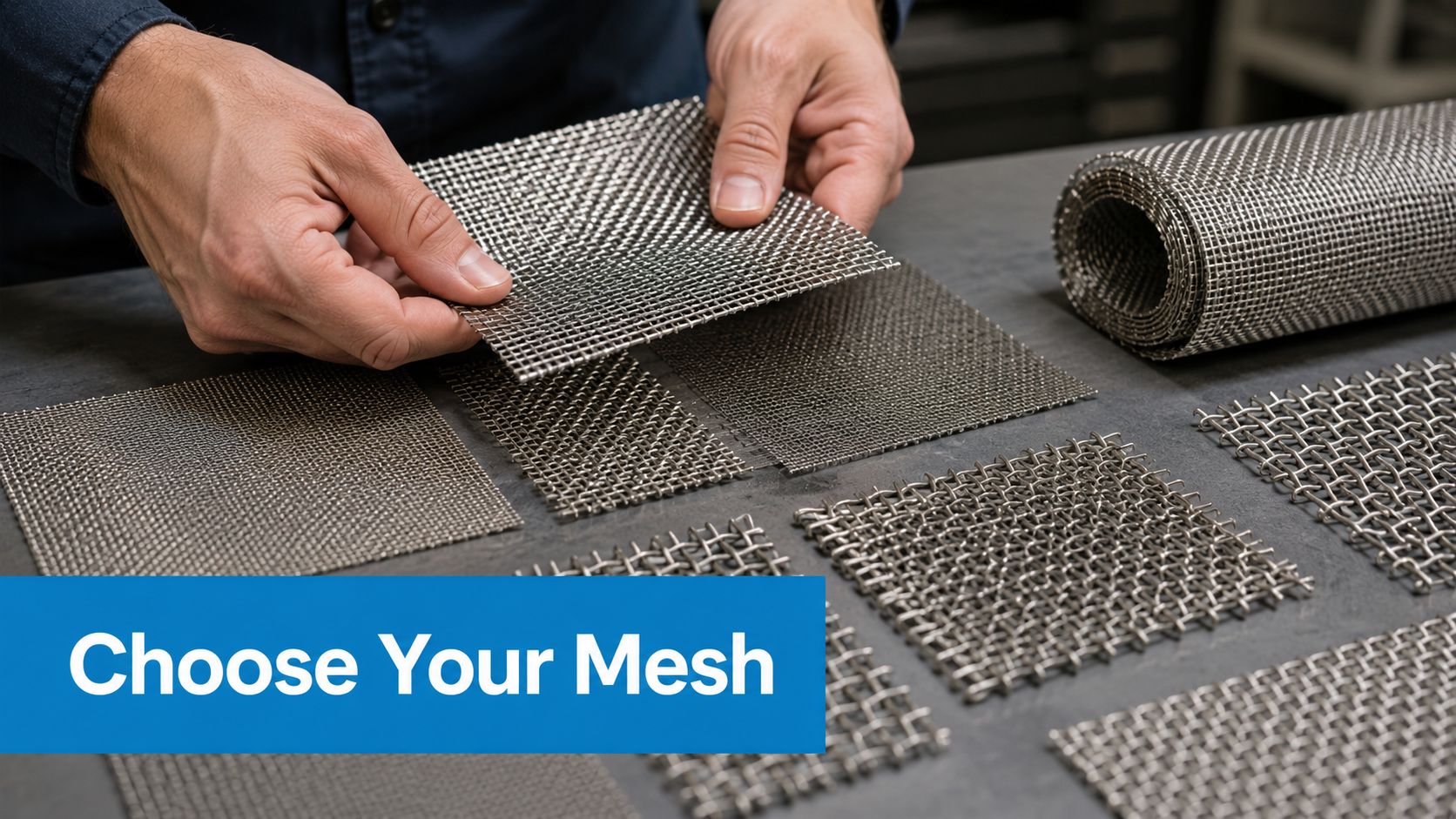
Loose ss mesh sheet suits fabricators, maintenance teams with workshop capability, and projects where the frame detail is already settled. Many property owners do not need raw mesh. They need a finished screen that fits the opening properly, operates cleanly, and uses a frame and fixing method suited to the building.
For homeowners deciding between sheet, roll, and complete assemblies, this guide to choosing a fly screen mesh roll explains where each option makes sense.
For food businesses, there is another layer to the decision. The screen has to be cleanable, durable, and suitable for the opening without creating maintenance problems. A mesh that looks right on paper but is awkward to remove, traps grease, or distorts in use can create avoidable issues during inspection and day-to-day operation.
Installation, Maintenance and Bespoke Ordering
Stainless mesh lasts well, but poor handling can shorten its life or spoil the finish before it ever reaches the opening. Most problems come from contamination, rough cutting or choosing DIY methods that don't suit the opening.
Handling and fitting tips
- Keep the mesh clean during fabrication. Dirt and workshop contamination make installation harder and can mark the finished screen.
- Avoid contaminating stainless with ordinary steel tools or filings. Surface contamination can create staining that buyers wrongly assume is the stainless failing.
- Support the sheet properly when cutting or trimming. That helps prevent distortion and leaves a cleaner edge for framing.
- Match the frame and fixing method to the opening. Good mesh in the wrong frame still produces a poor screen.
Cleaning and upkeep
- Use routine gentle cleaning. In most settings, regular removal of dust, grease and debris is enough.
- Pay more attention in kitchens and exposed external locations. Screens in those areas collect more airborne contamination.
- Inspect corners, edges and contact points. That's where damage from handling often shows first.
A lot of “material failures” are actually installation or handling failures.
When bespoke ordering saves time
Loose ss mesh sheet has its place, especially for fabrication-led projects. But many buyers don't need a raw material problem. They need a finished screen that fits first time, works properly and looks tidy once installed.
If that sounds closer to your situation, it's worth reviewing options from firms that cut and assemble to opening size rather than expecting site teams to improvise. A useful starting point is this guide to companies supplying custom cut mesh for doors in 2026.
Frequently Asked Questions about SS Mesh
Is stainless steel mesh rust-proof
Not in the absolute sense people often mean. Stainless steel resists corrosion because of its passive surface layer, but the correct expectation is corrosion resistance, not invincibility. In the wrong environment, with poor maintenance or contamination from other metals, even stainless can show problems.
Is woven mesh different from welded mesh
Yes. The two constructions behave differently. Woven mesh is often used where precise apertures and screening performance matter. Welded mesh is usually associated with more structural or panel-based applications. The right choice depends on whether your priority is fine screening, rigidity, panel strength or architectural use.
Can I cut ss mesh sheet myself
You can, but the key question is whether you should. For small, straightforward jobs with the right tools and good handling practice, site trimming is possible. For visible domestic screens, commercial doors or food areas, poor cutting and poor framing usually create more trouble than they save. The mesh edge, frame tension and fit at the opening all matter.
Is stainless mesh better than fibreglass for every screen
No. Stainless mesh is an excellent option where durability, corrosion resistance and a longer-life specification matter. But “better” depends on the opening. Some jobs call for lighter or more specialised screening materials because the performance target is visibility, pollen reduction, or a particular type of retractable system rather than metal durability.
What's the biggest mistake buyers make
Treating all mesh as interchangeable. Buyers often focus on the word “stainless” and assume the rest is detail. It isn't. Grade, aperture, wire thickness, openness and the way the screen is used all affect whether the finished result feels right.
How do I choose between insect, pet and security-focused mesh
Start with the main failure you're trying to avoid.
- If insects are the issue, choose around exclusion and airflow.
- If pets are the issue, focus on tougher construction and impact resistance.
- If the opening needs a more sturdy barrier, assess rigidity, support and the whole screen assembly, not just the mesh itself.
A good screen is always a matched system. The mesh matters, but so do the frame, the opening, the environment and the way people use that space every day.
If you need help choosing the right ss mesh sheet or a complete made-to-measure screen, Premier Screens Ltd can advise on practical options for UK homes, commercial kitchens and public buildings. The aim is simple. Match the mesh, frame and fixing method to the opening so the screen performs properly from day one.