
What Is a Window Reveal and How to Measure It Correctly
Ever wondered what that ‘frame inside the frame’ of your window is actually called? That’s the window reveal—the internal surface that connects the window frame itself to your interior wall. It's the recessed ledge you see when looking at a window from inside your home.
What Is a Window Reveal? A Simple Explanation
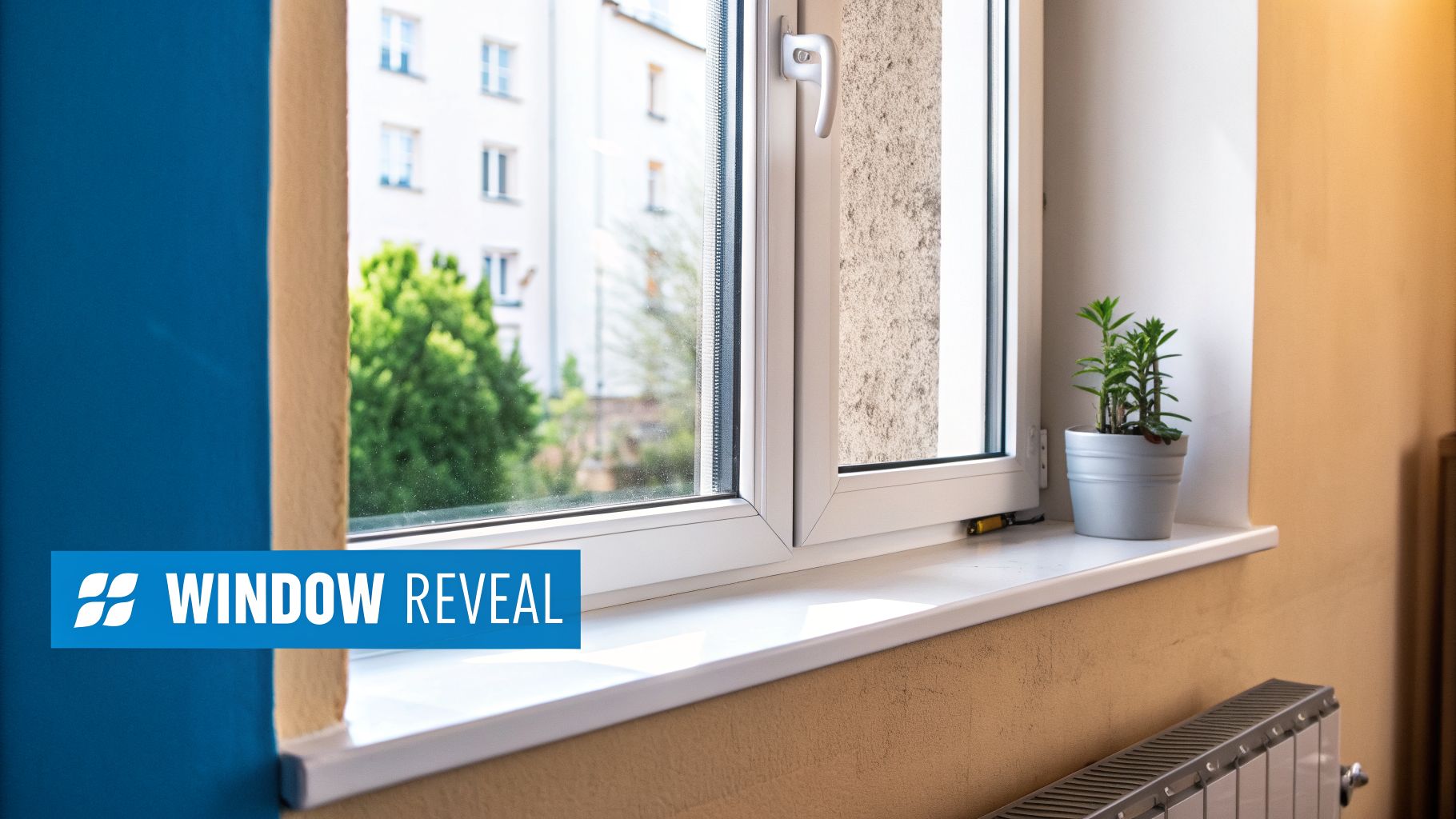
Think of the window reveal as the "stage" for your window. Just as a stage frames a performance, the reveal frames your view of the outside world, creating depth and character. It’s the timber, plaster, or uPVC surface that runs from the face of your interior wall right up to the window frame.
While it might seem like a minor architectural detail, its dimensions are absolutely critical for home improvement projects, especially when fitting anything inside that recess. Understanding your reveal is the first step to achieving a professional, gap-free installation of products like blinds or bespoke fly screens.
Window Reveal Terms at a Glance
This quick reference table helps you understand the key terms used by professionals. Knowing these terms ensures you can order correctly and get the perfect fit.
| Term | Simple Definition | Actionable Insight for Fitting Screens |
|---|---|---|
| Inner Reveal | The part of the reveal inside your home that you can see and touch. | This is the crucial surface where Premier Screens are mounted. Its depth and squareness determine which of our systems will work for you. |
| Outer Reveal | The corresponding surface on the building's exterior. | Important for external screen installations, this area dictates how a screen will attach and seal on the outside, especially for inward-opening windows. |
| Return Reveal | The two vertical sides and the top horizontal surface of the reveal. | The width and height of your screen are measured between these surfaces. They need to be straight for a gap-free fit, which is why we advise a three-point measurement. |
| Rebated Reveal | A reveal with a step or groove cut into it, often to house the window frame. | A rebate can reduce the available fitting depth. If you have one, measure the narrowest flat surface to ensure our screen cassette will fit. |
Understanding these simple terms is the first step, but it’s the practical application that really counts.
Why the Reveal Really Matters for Your Home
Getting to know your window reveal is the first step towards a successful installation of many products, but it’s non-negotiable for bespoke fly screens. The depth and squareness of this small area dictate which systems will fit, how they will look, and how well they will perform.
For instance, a shallow reveal might not have enough space for the cassette of a retractable screen to sit neatly inside. An uneven or "out-of-square" reveal can create frustrating gaps along the edges, defeating the entire purpose of a screen by giving pests a clear entry point.
This is precisely why a "one-size-fits-all" approach so often fails. A successful, gap-free installation depends entirely on accounting for the unique measurements of your specific window reveal.
At Premier Screens, we specialise in creating made-to-measure solutions engineered to fit your reveals perfectly. By understanding this simple concept, you're already on the right path to choosing a product that provides a seamless, professional finish—keeping insects out while letting fresh air in. When it comes to fly screens, it’s the single most important factor for a successful project.
Understanding Different Types of Window Reveals
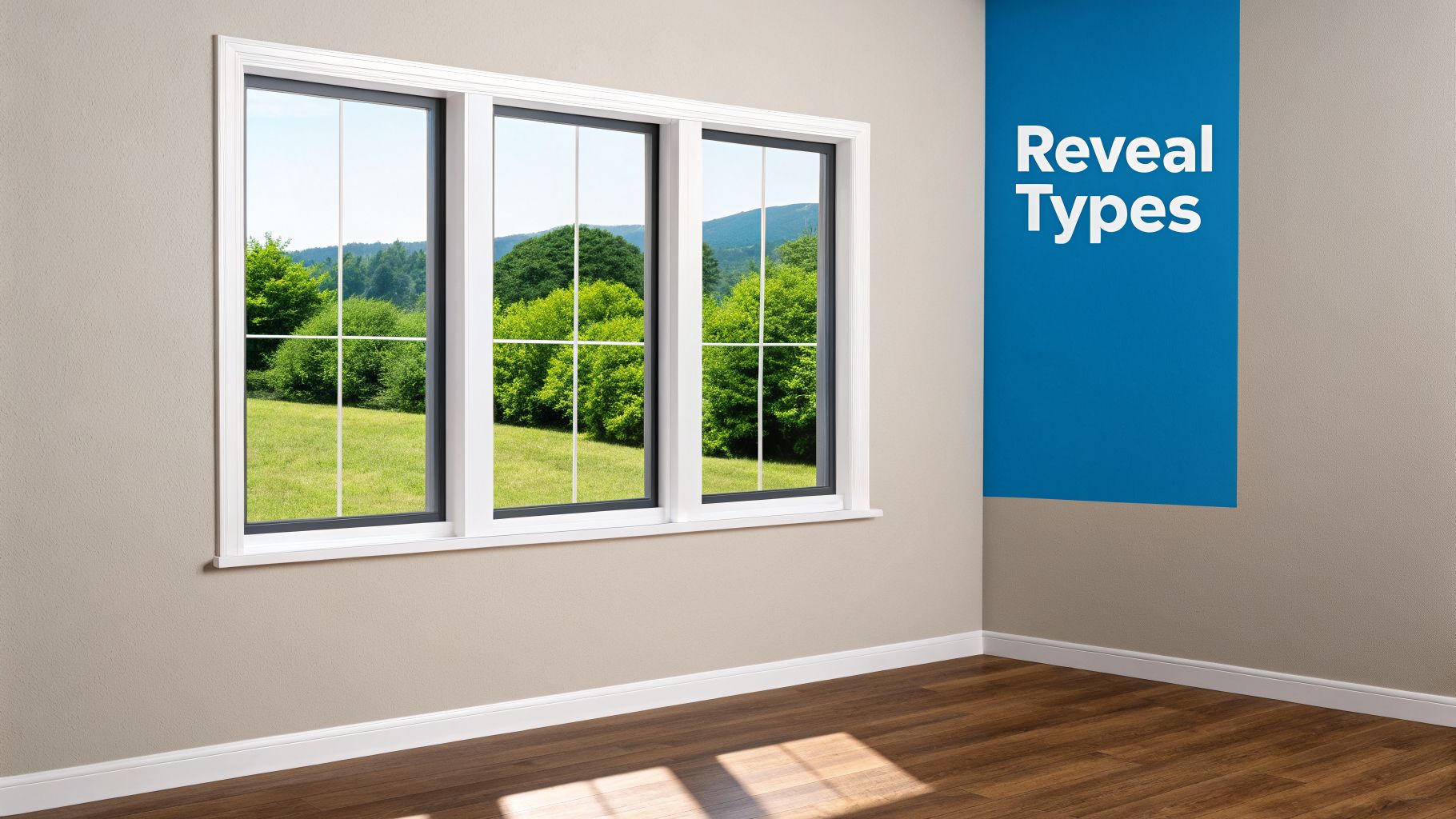
When it comes to fitting products like fly screens, you’ll quickly find that not all window reveals are the same. The style of your reveal has a massive impact on how a screen can be installed, and figuring out which type you have is the first step to a perfect, gap-free fit.
Most windows will have one of two common styles: a square reveal or a splayed reveal. Each has its own look and, more importantly, its own set of rules for installation.
The Square Reveal
A square reveal is exactly what it sounds like. The sides of the recess—what we call the returns—are set at a clean 90-degree angle to the window pane. It creates a simple, box-like frame around the glass.
This is the standard for most modern homes and new builds, and it’s the most straightforward design to work with. Actionable insight: If you have a square reveal, you have the most options for a neat 'reveal-fit'. Products like the roller fly screens from Premier Screens can be installed with the cassette and side channels sitting flush for a discreet, highly effective finish.
The Splayed Reveal
On the other hand, you might have a splayed reveal, where the sides angle outwards, widening from the window into the room. You’ll see this a lot in older properties, especially those with thick stone or brick walls.
Architecturally, the splay was a clever way to maximise the amount of daylight pouring into a room. While it looks great, that angle can be a real headache for standard screen systems that are designed to sit flush against a flat surface.
A splayed reveal doesn't mean you can't have a fly screen; it just means we need to think a bit differently. A 'face-fit' installation, where the screen is mounted onto the wall surrounding the opening, is often the perfect workaround. At Premier Screens, we provide face-fit options for this exact scenario.
Key Technical Terms: Return and Rebate
Now, let's get into a couple of technical terms you’ll hear thrown around: 'return' and 'rebate'. Getting to grips with these is crucial.
Return: This is simply the surface of the reveal itself—the top, bottom, and two sides. When someone asks for the reveal’s depth, they’re asking for the measurement of the return, from the window frame out to the edge of the wall.
Rebate: A rebate is a step or groove cut into the edge of the reveal, usually where the window frame itself is seated. This can create an uneven surface and, critically, reduce the amount of flat, usable space you have for fitting a screen.
These details really matter. For instance, a rebated reveal might need build-out frames to create a flush mounting surface for your screen. Without them, you’d end up with gaps. Specialised jobs, like window installation in log walls, introduce even more unique factors. Knowing what to look for empowers you to measure up accurately and choose a solution that will fit perfectly from day one.
Why Reveal Dimensions Are Critical for Fly Screens
It’s one thing to know what a window reveal is, but it’s another thing entirely to understand just how much it can affect a fly screen installation. This is where the technical details meet the real world, and where a few millimetres can be the difference between a perfect fit and a complete failure. It isn't just about looks—it's about whether the screen can do its job.
When it comes to measuring up, two things are absolutely vital: the reveal depth and its squareness. Get these wrong, and a straightforward job can quickly become a headache, leaving you with a screen that simply doesn’t keep the bugs out.
The Problem with Insufficient Reveal Depth
Think of the reveal depth—the distance from the front of your window frame to the face of the wall—as the 'parking space' for your fly screen. If that space is too shallow, some of the best screen systems on the market just won't fit.
Take our popular retractable cassette screens, for example. The mesh neatly rolls away into a tidy housing, or 'cassette'. This cassette needs a certain amount of depth to sit flush inside the reveal, giving you that clean, integrated look.
- Insufficient Depth: If your reveal is shallower than the cassette, the housing will stick out from the wall.
- Actionable Insight: At Premier Screens, our roller systems typically require around 45-50mm of depth. If you have less, the solution is to 'face-fit' the screen onto the wall instead, a standard option we offer for a seamless finish.
It’s a classic case of a small detail having a huge impact.
The Challenge of an Out-of-Square Opening
Now, let's talk about squareness. Ideally, every window opening would be a perfect rectangle with four perfect 90-degree corners. But in the real world, especially in older buildings, that’s rarely the case. Over time, walls settle and plaster becomes uneven, meaning openings can end up 'out-of-square'.
This means the width at the top of your window reveal might be several millimetres different from the width at the bottom. An off-the-shelf screen is made for a perfect rectangle, so when you try to install it in an imperfect opening, you run into problems.
An out-of-square window reveal is the number one cause of unsightly gaps between the screen frame and the wall. Even a tiny gap of 2-3mm is a wide-open invitation for flies, mosquitoes, and other pests, completely defeating the point of having a screen in the first place.
This is where a Premier Screens made-to-measure solution proves its worth. Standard, one-size-fits-all products simply can’t account for these common imperfections. We build each screen to the exact (and smallest) dimensions of your opening, guaranteeing a tight, gap-free seal. You can explore our extensive range of custom-fit fly screens for windows to see how different systems can be adapted.
Ultimately, taking the time to measure properly isn't just a good idea—it's the only way to get the professional, lasting result you expect from a quality product. It’s the key to making sure your investment works perfectly from day one.
How to Measure Your Window Reveal for a Perfect Fit
Getting your measurements spot-on is the single most important part of the job. A few millimetres out can be the difference between a perfect fit and a screen that’s either gappy or impossible to install. This is our professional guide to measuring your window reveal correctly, so you can order your DIY kit with total confidence.
First, let's talk tools. Always use a rigid, steel tape measure. Leave the cloth or plastic ones in the sewing box; they can stretch or sag, and that tiny inaccuracy is all it takes to throw off your final fit.
The Three-Point Measurement Technique
Very few window openings are perfectly square, especially in older properties. Over time, plaster shifts and frames settle. That’s why you need to take three measurements for both the width and the height to account for any little imperfections.
- Measure the Width: Take three separate measurements across the opening—one near the top, one right in the centre, and another near the bottom.
- Measure the Height: Do the same again, but this time vertically. Measure on the far left, in the centre, and on the far right.
- Note Everything Down: Write down all six measurements as you take them. Don’t be tempted to round numbers up or down—precision is what we're after here.
The Golden Rule of Measuring: Always, always use the smallest measurement for both the final width and the final height. This ensures your Premier Screens made-to-measure screen will slide neatly into the tightest part of the opening without jamming.
By ordering to the narrowest dimension, you guarantee a fit, even if the reveal is slightly wonky. It's the trade secret to achieving a seamless, gap-free result that looks truly professional.
How to Check if Your Reveal Is Square
Curious just how square your reveal is? There’s a quick check you can do with your tape measure. First, measure diagonally from the top-left corner to the bottom-right. Then, measure the opposite diagonal from the top-right to the bottom-left.
If the two diagonal measurements are the same, congratulations—your reveal is perfectly square! If they differ by more than 5-10mm, the opening is 'out-of-square'. Don’t panic. This is incredibly common, and our three-point measurement technique is designed to handle it without any issues.
Following these simple steps gives you the exact dimensions we need to build a screen that fits flawlessly. Whether you're ordering a DIY kit or just getting measurements ready for our team, this precision saves everyone time and hassle. You can find more detail on what reveal depths work with specific systems in our guide to roller window fly screens. This way, you'll know for sure that the screen that arrives is engineered perfectly for your space.
Solving Common Window Reveal Problems
So, what happens when your window reveal isn’t quite perfect? It’s rarely a disaster. In fact, these little imperfections are challenges we at Premier Screens see and solve every single day. Let's look at the real-world issues head-on, so you can feel confident that even a tricky 'problem' window can be fitted with a professional, effective fly screen.
Many homes, especially older properties, have their own quirks. You might find shallow reveals that are too narrow for standard screens, or openings that are no longer perfectly square. These are exactly the kinds of issues that off-the-shelf products just can't handle. But with the right know-how, there's always a solution.
This diagram shows the simple, three-step process for getting accurate measurements—the first step in spotting any potential problems early.
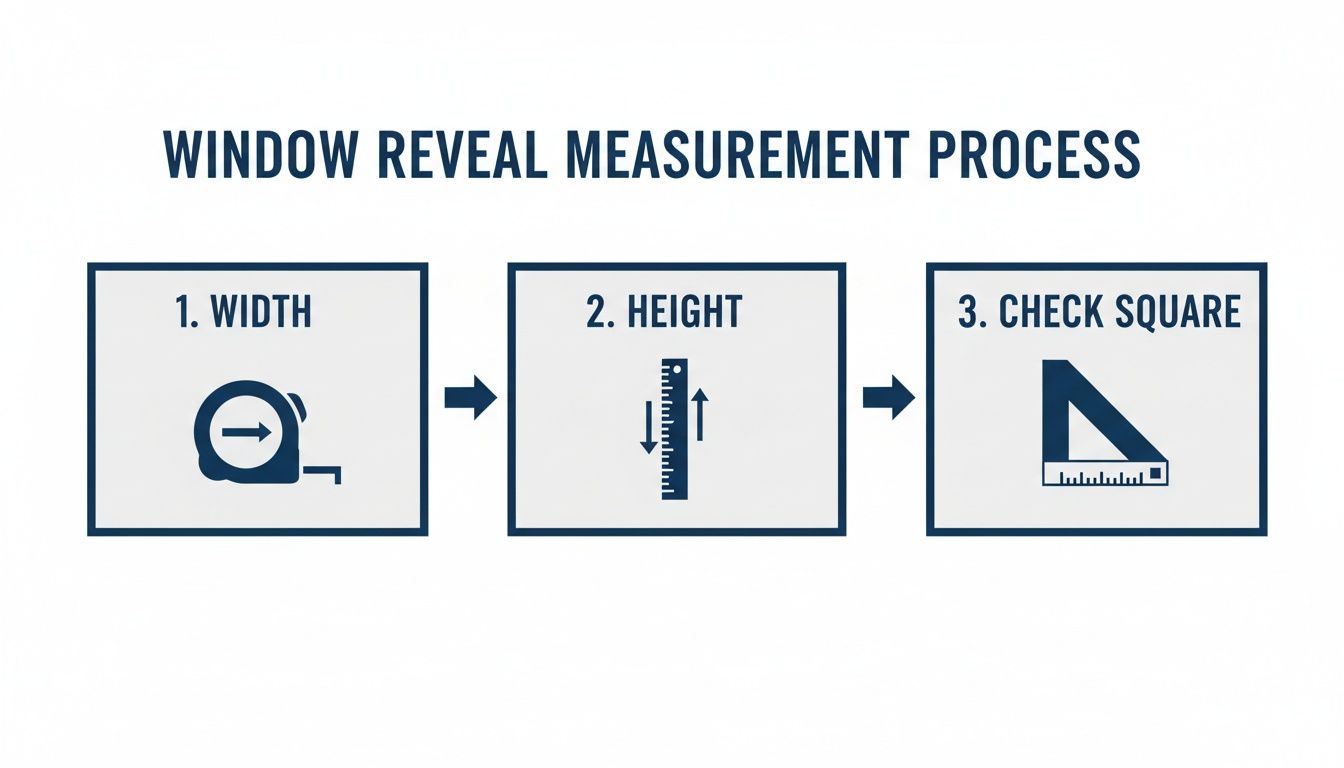
Taking time to measure the width, height, and squareness properly gives you all the information needed to diagnose and fix these common issues.
Dealing with Shallow Reveals
A very common headache is a window reveal that just doesn't have enough depth. Many modern retractable screen systems need a certain amount of space to house the cassette neatly inside the recess. When that space isn’t there, the standard 'reveal-fit' approach is off the table.
The go-to solution is a technique we call 'face-fitting'. Instead of installing the screen system inside the reveal, we mount it directly onto the face of the window frame or the surrounding wall.
- How it works: The screen cassette and its side channels are fixed to the flat surface around the window opening itself.
- The Premier Screens solution: We offer face-fit kits for most of our screen systems. This gives you a secure, fully sealed installation that’s just as effective and completely bypasses the problem of a shallow reveal.
Correcting Out-of-Square Openings
Another frequent challenge, especially in older buildings, is an 'out-of-square' opening. This is where the corners aren't true 90-degree angles, causing the width or height to vary from one point to another. A standard rectangular screen will inevitably leave gaps, which defeats the whole purpose of having a screen in the first place.
Gaps around a poorly fitted screen are an open invitation for pests. Finding ways to prevent spiders from coming inside often starts with sealing these obvious entry points properly.
For openings that are noticeably crooked, a build-out sub-frame is a professional solution. We simply construct a new, perfectly square timber or uPVC frame that sits just inside the existing reveal. The fly screen is then installed into this new frame, guaranteeing a flawless, gap-free seal. Premier Screens can advise on this during a survey.
Managing Uneven Plaster Surfaces
Sometimes, the issue isn’t the reveal’s dimensions but the surface itself. Old, crumbling, or uneven plaster can make it almost impossible to get a secure fixing for the screen's channels. Trying to mount a screen onto a poor surface will only lead to an unstable fit and, you guessed it, more gaps.
In these situations, the solution is all in the prep work. The surface might need to be repaired and smoothed out before we start, or we could use build-out liners to create a solid, flat surface to mount onto. At Premier Screens, tackling these roadblocks is part of what we do. It shows that even the most challenging windows can be fitted with a professional-looking screen that does its job perfectly.
Your Window Reveal Questions Answered
Getting to grips with the specifics of your window reveal can feel a little daunting, but it's the single most important detail for a perfect fly screen installation. To clear things up, we've pulled together the questions our customers—both homeowners and trade buyers—ask us every single day. Think of this as your go-to guide for getting it right.
Can I Fit a Fly Screen if My Window Opens Inwards?
This is one of the most common hurdles we come across. If your window casement swings into the room, a standard screen fitted inside the recess (a reveal-fit) simply won't work—the window would just crash into it.
Actionable Insight: At Premier Screens, we solve this by fitting a purpose-built screen system to the outside of your property. By mounting something like a roller or hinged screen on the outer reveal, we keep your internal window area completely clear. This lets you open and close your window as normal while keeping a tough barrier against pests.
My Reveal Is Tiled, Can You Still Install a Screen?
Yes, absolutely. Tiled reveals, common in kitchens and bathrooms, are no match for our installation team. The trick is to use the right equipment to drill through the tiles without causing any cracks or damage.
Our fitters use specialised diamond-tipped drill bits designed to cut cleanly through porcelain, ceramic, or stone. After that, it’s a simple case of using the right wall plugs to fix the screen frame securely. If you're planning a DIY job, just make sure you have the correct drill bits and a very steady hand.
Actionable Insight: The main thing to watch for with tiled reveals is an uneven surface. If the tiles aren't perfectly flat, small gaps can appear. Our installers run a bead of silicone sealant along the frame to guarantee a flawless, insect-proof seal.
This level of detail ensures your screen isn't just secure, but also looks like it was always meant to be there.
What Happens if I Measure Wrongly?
This is why we always say, "measure three times, order once." Because our screens are custom-made to the millimetre, getting the dimensions right is critical. If your measurements are wrong for a DIY kit, the screen simply won't fit. Too large and it won't go in the opening; too small and you’ll have gaps, which defeats the whole point.
Since every Premier Screens product is bespoke, they are generally non-returnable if the measurement error was made by the customer. We provide detailed guides for this very reason, but if you have even the slightest doubt, we strongly recommend calling our team before you order. A quick five-minute chat can save you a world of frustration.
How Much Reveal Depth Do I Need for a Retractable Screen?
The depth you need depends entirely on the system you choose. As a rule of thumb, our most popular retractable (roller) screens for windows need a clear reveal depth of around 45-50mm. This space allows the cassette housing the screen to sit flush inside the recess, giving you that discreet, built-in look.
- Less than 45mm: If your reveal is shallower, fitting the screen inside the recess might mean the cassette sticks out.
- The Premier Screens Solution: In these situations, "face-fitting" is the perfect alternative. We simply mount the screen directly onto the face of the window frame or the surrounding wall.
It's always best to check the product page for the exact specifications of the system you're interested in. We list all the dimensions you need to help you choose correctly from the start.
Is It Better to Reveal-Fit or Face-Fit My Screen?
Honestly, the "better" option comes down to your windows and what you want the final result to look like. A reveal-fit is often the preferred choice because it tucks the entire system neatly inside the window opening. It's discreet, clean, and has that premium, integrated finish.
However, a face-fit is a brilliant and practical solution when a reveal-fit just isn't on the cards. This could be due to obstructions like bulky handles, an inward-opening window, or a very shallow reveal. When it's done right, a face-fit looks clean and professional, and it provides an equally effective seal against insects. The best method is always the one that gives you a secure, gap-free fit for your specific home. Our team can help you decide.
At Premier Screens Ltd, we have over 30 years of experience finding the perfect solution for every type of window. Whether you need a DIY kit or a full professional installation, we're here to help you achieve an insect-free home. Explore our bespoke fly screen systems at https://www.premier-env.co.uk.