

If you’re opening windows for fresh air but hesitating because your cat likes to perch, climb or push at the mesh, you’re right to be cautious. A proper window screen for cats isn’t just a fly screen with a different label. It’s a safety product, and the difference matters.
In UK homes and flats, the risk usually appears in ordinary moments. A warm afternoon, a sash window cracked open, a bird outside, and a cat that moves faster than you expect. The right screen lets you ventilate the room without turning that open window into a hazard. The wrong one can fail exactly when you need it to hold.
The Hidden Dangers of Standard Insect Screens for Cats
Most standard insect screens are built to stop flies and midges. They’re not built to resist climbing, pushing, twisting claws or repeated impact from a determined cat. That’s the point many homeowners miss.
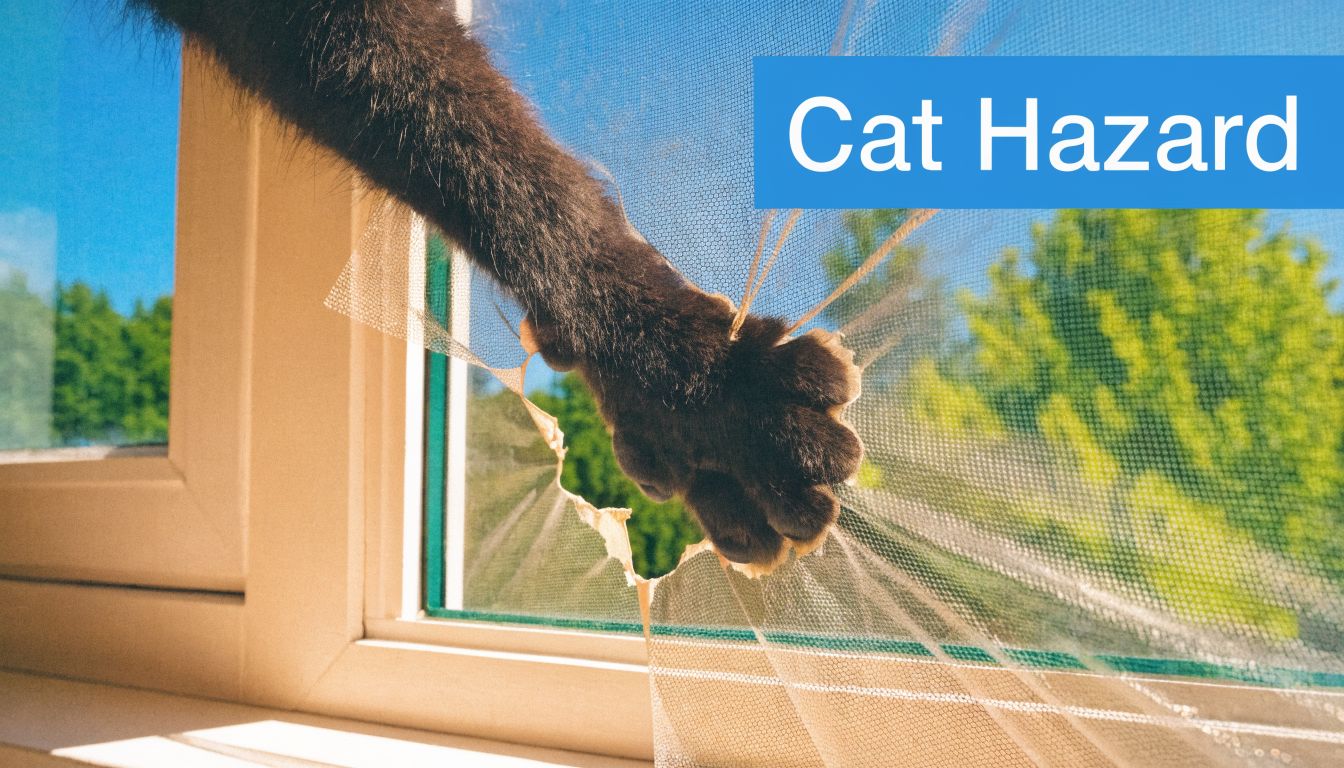
The consequences aren’t theoretical. RSPCA incident reporting on cat falls in the UK states that over 1,200 cat fall rescues occur annually in the UK, with 65% occurring from urban windows. The same verified data also notes that standard insect screens fail in 70% of cat-climb tests, yet they’re still often promoted without pet-proofing warnings.
Why ordinary fly mesh fails
A normal fly screen does one job well. It blocks insects while keeping airflow high. But when a cat climbs it, leans against it, or catches a claw and pulls, the design brief changes completely.
What tends to go wrong is simple:
- The mesh stretches and creates a weak point.
- The weave tears once claws catch the strands.
- The frame flexes enough for the screen to pop loose.
- Small gaps appear around the edge, which are enough for paws, noses or insects.
Practical rule: If a screen was sold primarily for insect control, assume it hasn’t been designed for feline force unless the materials and fixing method say otherwise.
The risk isn’t only falling
Homeowners usually think first about a cat falling through the screen. That’s a valid concern, but it isn’t the only one. A partially failed screen is also a problem because it leaves a dangerous opening that may not be obvious until the cat returns to the sill.
In business settings, especially kitchens, staff areas and managed accommodation, weak screens create another issue. They can undermine ventilation and pest control at the same time. A screen that bows, tears or lifts at the corners doesn’t just look poor. It stops doing the job you bought it for.
What a cat-safe screen must do differently?
A true pet-resistant setup needs to work as a system. Mesh alone isn’t enough. The frame, spline, fitting points and overall tolerances all have to hold together under real use.
That means you should treat a window screen for cats as a bespoke safety barrier with airflow benefits, not as a low-cost accessory. If the product details only talk about visibility, insects and colour options, you’re probably looking at the wrong category.
How to Choose the Right Cat-Proof Mesh and Frame
Choose the screen as a complete safety assembly, not as a piece of mesh with a border. For a cat-safe result, the mesh, frame, corners, spline and fixing method all need to cope with clawing, leaning, repeated window use and normal UK weather.

What the mesh material changes
Standard fibreglass is made for insect control. Cats place a very different load on a screen. Claws catch the weave, body weight pulls the panel out of plane, and repeated pressure around one spot can start a tear long before the damage is obvious from across the room.
Pet-resistant mesh is the right category to ask for. In practice, that usually means a heavier polyester core with a PVC coating, chosen because it resists claw damage better and holds its shape under tension. No, a thicker-looking mesh is not enough. The material specification matters more than appearance.
The finish matters too. A good pet mesh should still give clear airflow and a tidy sightline from indoors. If the weave is so coarse that the room feels dark or the screen looks industrial, it may be strong but poorly suited to a domestic window.
Mesh Type Comparison for Cat Owners
| Mesh Type | Best For | Key Feature | Cat Safety Rating |
|---|---|---|---|
| Standard fibreglass | Basic insect control where pets don’t use the sill | Light and affordable, but tears relatively quickly under claws | Low |
| Toughened pet-resistant mesh | Homes with cats that climb, lean or scratch at windows | Heavy-duty polyester-coated PVC with much higher claw resistance | High |
| Pollen mesh with pet-resistant build | Cat owners who also struggle with open-window allergy issues | Adds allergen reduction alongside pet safety | High |
Pollen-filtering options can be sensible in UK homes where ventilation and hay fever become a problem at the same time. The trade-off is that finer meshes may reduce airflow slightly, so the right choice depends on whether your room needs maximum breeze or a better balance of comfort and containment.
Why frame specification matters
A strong mesh in a weak frame still fails. I see this regularly with low-cost kits. The mesh survives the first few scratches, but the frame bows at the centre, the corners work loose, or the whole panel starts lifting away from the reveal.
For UK properties, polyester-coated aluminium is usually the safest frame material because it stays rigid, finishes cleanly and copes well with moisture changes between winter condensation and summer heat. Plastic sections can look acceptable on day one, but they are more likely to flex, mark or lose their fit over time, especially on larger openings.
Frame depth and wall thickness matter as well. So does corner construction. A neat-looking frame is not enough if the section is too light for the window size.
If the screen is fitting inside the opening, the tolerances also need to be right for the window reveal. If you are unsure what counts as the reveal, this guide explains how a window reveal is defined for measuring and fitting.
What to look for from a UK manufacturer
Ask direct questions before ordering:
- Is the mesh specified as pet-resistant, not just heavy-duty insect mesh?
- What is the frame material? Coated aluminium is usually the better long-term choice.
- How are the corners made and secured? This affects rigidity more than many buyers realise.
- What retention method is used? A cat screen needs a positive, reliable fixing suited to the window type.
- Is the unit made to measure for the exact opening? Small fitting errors can undermine an otherwise good screen.
- Will the finish suit the room and the outside elevation? Safety matters first, but appearance still counts.
A brief mention on standards. In the UK, there is no single consumer label that automatically makes a screen “cat-proof”, so buyers need to check specification rather than trust marketing language. A responsible manufacturer should be able to explain what the mesh is made from, how the frame is built, and where the product is and is not appropriate.
Premier Screens Ltd supplies fly screens for windows using pet-resistant mesh with aluminium framing for both supply-only and fitted projects. The key point is broader than one supplier. Choose a screen built for pet pressure, sized for the actual opening, and finished to a standard you will still be happy to see on the window in a few years.
A Practical Guide to Measuring Your Windows for a Secure Fit
Most screen problems start before installation. They start with bad measurements. If the unit is even slightly undersized, you can end up with side gaps, poor retention or a screen that looks fitted but isn’t secure.

Verified installation data shows how unforgiving this stage is. Undersizing a bespoke screen by just 2mm is responsible for 45% of retrofit failures, while DIY kits with precise measurements achieve a 92% first-fit success rate without adjustment. Those figures come from Premier Screens installation data, but the lesson applies broadly across made-to-measure screens.
Start with the right reference point
The first question is whether your screen will sit inside the reveal or onto the face of the frame. If you’re not sure what the reveal is, this short guide to what a window reveal is helps clarify the measuring point.
For most homeowners, the key is consistency. Measure the exact place where the screen will sit, not the visible glass and not the outer decorative trim.
A reliable measuring method
Use a steel tape as a minimum. A laser tool is better if you have one, especially when you’re trying to work accurately to the millimetre.
- Measure the width in three places. Top, middle and bottom.
- Measure the height in three places. Left, centre and right.
- Record the smallest usable dimension if the opening isn’t perfectly square.
- Check obstructions such as handles, trickle vents and catches.
- Note the window type. Side-hung casement, sash, tilt-and-turn and other designs all affect how the screen should be made and fixed.
A good screen should fit the opening you actually have, not the opening you assume is square.
Common mistake and the better way
A common mistake is measuring quickly from edge to edge and rounding up or down. That works for curtains. It doesn’t work for cat-safe screens.
The better way is to slow down and record exact dimensions in millimetres. Also check whether the frame surface is flat enough for clips or seals to sit properly. Timber windows, older masonry reveals and painted surfaces often have slight irregularities that matter.
Keep a simple measuring sheet with each window labelled by room and orientation. “Front bedroom left casement” is far more useful than “bedroom window”. If you’re ordering several screens at once, that bit of discipline avoids mix-ups later.
Details people forget
Don’t overlook these points:
- Handle clearance: Some handles project further than expected.
- Opening direction: The screen mustn’t block safe use of the window.
- Seal condition: Damaged frame surfaces can affect the final sit.
- Access for cleaning or removal: Especially important upstairs.
Accurate measuring doesn’t just improve appearance. It determines whether the screen closes the opening safely.
Deciding Between DIY Installation and Professional Fitting
Some cat screens are straightforward enough for a careful DIY install. Others are better left to a fitter, especially if the windows are awkward, access is poor, or the property has compliance requirements.
The right decision usually comes down to three things. Your confidence with precise fitting, the number of windows involved, and how serious the consequences are if one unit isn’t retained properly.
When DIY makes sense
DIY works well when the openings are accessible, the measurements are clear, and you’re comfortable using hand tools neatly. A typical install may involve aligning the frame, seating the unit correctly, checking mesh tension, and securing clips or fixings without twisting the frame.
DIY tends to suit:
- Standard residential windows with clear access
- Supply-only bespoke kits where the fitting method is simple
- Homeowners who can work accurately rather than quickly
- Projects where you can test one screen first before doing the whole house
The advantage isn’t just saving on labour. It’s control. You can fit at your own pace and inspect every detail as you go.
When professional fitting is the safer call
Professional fitting becomes the sensible route when a poor install would create risk, rework or disruption. That’s especially true in commercial premises, managed buildings, rental portfolios and kitchens where the screens also need to support hygiene and pest-control requirements.
A fitter can also solve issues that catch DIY installers out, such as uneven reveals, fixings into difficult substrates, and windows that need a removable but secure solution. In commercial settings, screens may need to align with Food Standards Agency guidance, so the install quality matters as much as the product.
If the opening is awkward, high up, or used daily by multiple people, fitting quality isn’t a finishing touch. It’s part of the safety system.
The trade-off in plain terms
DIY gives you flexibility. Professional fitting reduces installation risk.
If you’re already replacing old windows or planning wider renovation work, it can help to think about screens as part of the whole opening, not an afterthought. For broader context on window upgrade planning, this guide to Dallas-Fort Worth window replacement is a useful example of how contractors approach window condition, fit and installation sequencing, even though the project context is outside the UK.
A simple rule works well here. If you can measure accurately, handle small tolerances, and fit a frame square without forcing it, DIY is realistic. If not, fitted service is usually cheaper than replacing a badly installed unit later.
Essential Maintenance for Lasting Cat Screen Safety
A cat-safe screen isn’t a fit-and-forget item. It needs occasional checks, especially after heavy use, cleaning, seasonal weather changes or a period when your cat has been more interested in the window than usual.
Good maintenance isn’t complicated. The aim is to spot wear early, keep the mesh clean, and make sure the frame still sits firmly where it should.
A simple seasonal checklist
Check your screens at the start of spring and then again during periods of regular open-window use.
- Inspect the mesh surface: Look for snagging, abrasion, loose strands or any area that appears polished by repeated claw contact.
- Check the frame corners: Make sure joints remain square and tight.
- Test the retention points: Clips, magnets or other fixings should hold securely without rattle or lift.
- Clean gently: Use a soft brush or cloth with mild cleaning solution, then rinse lightly and allow it to dry.
- Review the seal line: Dirt build-up around the edges can hide small gaps or stop the screen sitting properly.
What to do if you spot a problem
Small defects rarely stay small. If a mesh panel has started to fray, or the frame has loosened in one corner, take the screen out of use until it’s repaired or replaced. That’s particularly important if your cat already treats that window as a perch.
Don’t scrub aggressively or use harsh tools on specialist mesh. Pet-resistant materials are hard-wearing, but repeated rough cleaning can shorten the life of the coating or distort the weave.
Pollen control is becoming part of the brief
Some households now expect their screen to do more than one job. That’s understandable. Allergy UK guidance on pollen-related indoor comfort is relevant here because verified data shows UK hay fever cases are up 25%, 35% of cat-owning households report worsened allergies from open windows, and integrated pollen mesh can reduce airborne allergens by over 70%.
That doesn’t change the maintenance basics. It just means cleaning matters even more. A screen that’s clogged with dust, pollen and general airborne debris won’t perform as neatly or look as good.
Your Cat-Safe Home A Final Checklist
The safest setup is usually the simplest one. Use the right mesh. Fit it properly. Check it regularly. Don’t rely on a standard fly screen to do a job it wasn’t made for.
The shortlist that matters
- Choose a true pet-resistant screen: If the product only talks about insects, move on.
- Insist on a rigid frame: A strong mesh still fails if the frame bends or pulls away.
- Measure in millimetres: Small errors create real gaps.
- Pick the installation route: DIY if you can fit accurately. Professional fitting if the opening, access or use case is less forgiving.
- Maintain the screen through the year: Especially on windows your cat uses often.
A few final practical answers
Magnetic retention can be useful when it’s part of a properly designed removable system, but magnet-only solutions for cat safety should be judged carefully. The question isn’t whether magnets are convenient. It’s whether the whole unit stays secure under pushing and clawing.
Most window types can take a cat-safe screen, but the design should match the opening. Sash windows, casements, tilt-and-turn units and commercial openings all need slightly different thinking. The neatest result usually comes from making the screen for the exact opening rather than trying to adapt a generic panel on site.
If you want the room ventilated, the insects kept out and the cat kept safe, don’t compromise on specification just because the screen looks similar from a distance. In this category, the hidden details are what make the visible result safe.
If you want a made-to-measure window screen for cats with a clean finish and practical UK support, Premier Screens Ltd offers bespoke options for homeowners and businesses, including supply-only and fitted solutions. A quick quote is the easiest place to start if you want to check sizes, mesh options and the right screen style for your windows.
