You open the window for ten minutes to cool the room, and that’s all it takes. A few flies get in, something smaller starts hovering near the light, and by evening you’re choosing between fresh air and a house full of insects. In a restaurant or café, that same problem isn’t just annoying. It becomes a hygiene issue.
That’s why replacement screening windows matter more now than they used to. Generic advice from overseas often misses what affects UK properties: midges in rural and Scottish locations, pollen-heavy spring and summer periods, inward-opening and sash windows, listed-building constraints, and compliance pressure in commercial kitchens. The right screen solves those problems. The wrong one tears early, looks clumsy, restricts use of the window, or fails where it counts.
Why You Need Better Replacement Screening Windows
A lot of people only think about screens when one has already failed. The mesh has split at a corner, the frame has warped, or the old DIY panel never fitted properly in the first place. By then, you’re already dealing with the nuisance the screen was meant to stop.
In the UK, that need is growing. That lines up with what homeowners and site managers see in practice: windows stay shut because people don’t trust the existing screen, or they stay open and pests come straight in.
What poor screens get wrong
A bad replacement usually fails in one of four ways:
- Wrong mesh choice: Standard insect mesh gets fitted where a finer weave was needed for midges or pollen.
- Wrong system: A fixed frame is chosen for a window that needs regular access, cleaning, or escape clearance.
- Wrong measuring method: Off-the-shelf sizes leave gaps, rattle in the opening, or require awkward packing.
- Wrong material for the site: What works in a spare bedroom won’t necessarily last in a busy kitchen or high-traffic commercial space.
Practical rule: If you can see light around the edge of the frame, insects can usually find it too.
Good screening should do three things at once. It should keep pests out, preserve airflow, and work with the window you already have. That sounds simple, but it’s where most cheap or generic systems fall down.
For homes, the goal is comfort without turning the room into a trap for flies, wasps, or midges. For businesses, the considerations are more critical. Screens become part of day-to-day hygiene control, especially when staff need ventilation during service or prep hours. If you’re already reviewing broader IPM strategies for pest control, window and door screening should sit near the top of that list because it prevents ingress instead of reacting after the fact.
One UK manufacturer that offers made-to-measure options for both domestic and commercial sites is Premier Screens Ltd, which supplies bespoke systems in multiple frame and mesh formats.
Choosing the Right Mesh for Your Needs
A screen only works as well as the mesh inside it. Frame colour and opening style affect appearance and convenience, but mesh decides whether you keep out houseflies, midges, pollen, or nothing much at all.
That choice matters more in the UK than many generic buying guides suggest. A flat in Birmingham, a cottage near Loch Lomond, and a food prep area in Surrey do not need the same mesh. British buyers also run into issues that overseas advice often skips, including midge pressure in rural and Scottish locations, seasonal pollen problems, conservation restrictions, and tighter hygiene expectations in commercial kitchens.
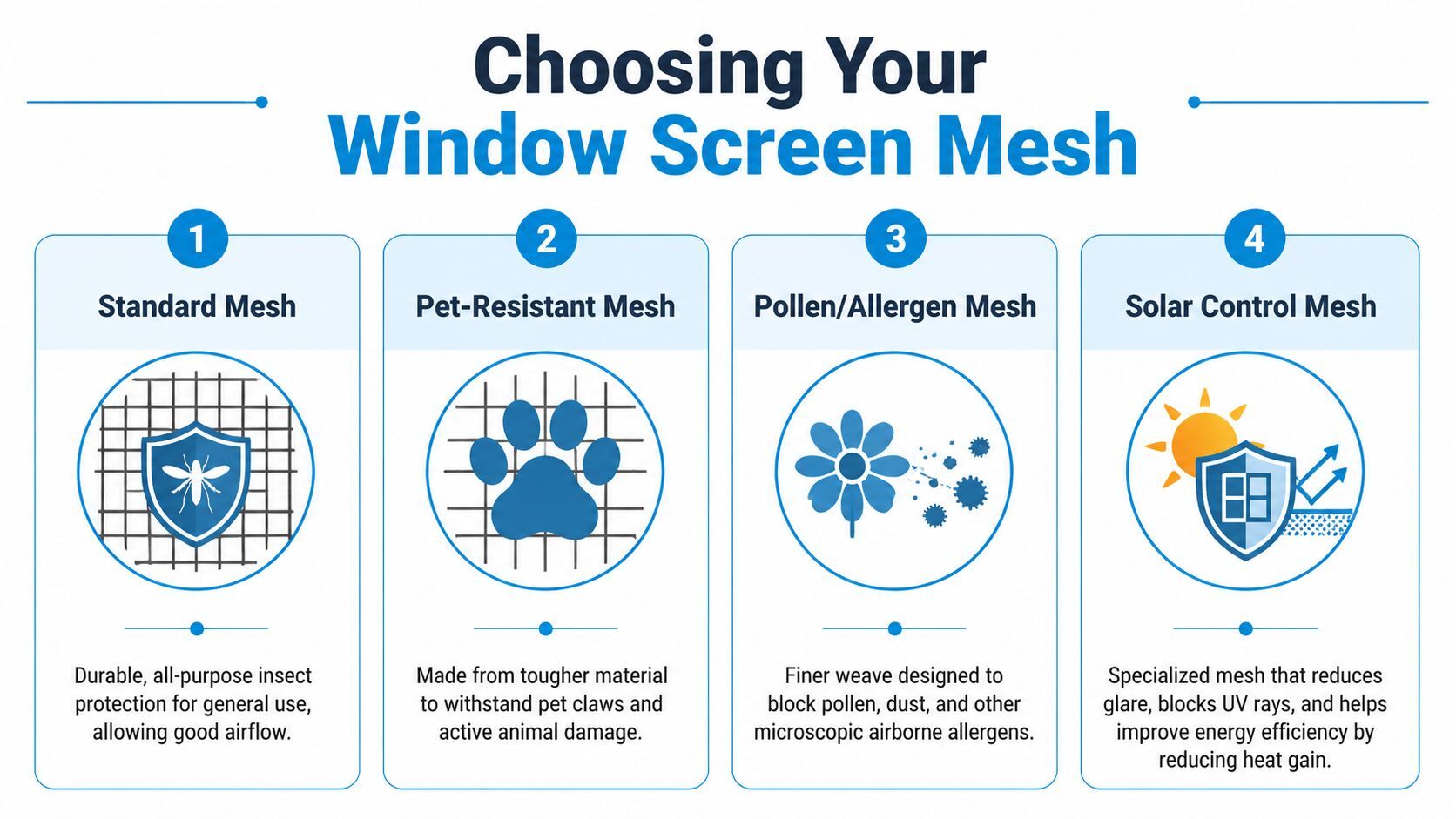
The four main mesh choices
Standard insect mesh is the right starting point for many homes. It suits everyday insect control where the main nuisance is flies, wasps, or larger airborne pests. Airflow and outward visibility are usually better than with specialist meshes, which is why standard mesh remains popular for bedrooms, living rooms, and offices that just need straightforward protection.
Pet-resistant mesh is a sensible upgrade where cats or dogs press against the screen, scratch at it, or charge through doors and low windows. It stands up better to abuse than standard mesh, but it is not a licence to fit the wrong screen in a heavy-traffic opening. The extra strength usually comes with a slightly heavier look and feel.
Pollen mesh is aimed at households where hay fever affects how windows are used during spring and summer. The NHS advises that people with hay fever can reduce exposure by keeping windows shut when pollen counts are high, especially early morning and evening, which is exactly why many buyers look for a filtered ventilation option rather than closing the room up completely, as set out in NHS hay fever guidance. The trade-off is practical. Finer filtration can reduce the open feel compared with standard mesh, so it works best where symptom relief matters more than maximum airflow.
Superfine midge mesh solves a distinctly British problem. Standard insect mesh often deals with larger pests and still leaves you exposed in midge-prone areas. If the property is near standing water, moorland, woodland, or the west coast of Scotland, go finer from the start. Anything else is usually a false economy.
Mesh type comparison for UK homes and businesses
| Mesh Type | Best For | Key Feature | Airflow/Visibility |
|---|---|---|---|
| Standard Mesh | General household insect control | All-purpose barrier for common flying insects | Good balance |
| Pet-Resistant Mesh | Homes with cats or dogs | Tougher material that copes better with claws and impact | Slightly heavier feel than standard |
| Pollen Allergen Mesh | Hay fever and allergy-sensitive rooms | Finer weave aimed at airborne allergen reduction | More filtration, slightly reduced openness |
| Superfine Midge Mesh | Scottish, rural, waterside, and midge-prone areas | Very fine aperture for tiny biting insects | Reduced openness compared with standard |
What works in practice
Match the mesh to the room, not just the property.
Bedrooms often justify pollen mesh if someone in the house suffers badly during peak season. Kitchen windows in family homes usually do well with standard insect mesh unless the site is rural or close to water. Patio doors and back doors benefit from tougher mesh if children, pets, or frequent traffic will test the screen daily.
Commercial sites need a stricter view. In food premises, the screen has to support hygiene rather than just comfort. The Food Standards Agency’s guidance for food businesses states that openings to the outside should be suitably screened where necessary to prevent pests entering, which is why commercial kitchens usually need hard-wearing, cleanable mesh chosen with daily washing and inspection in mind, as outlined by the Food Standards Agency guidance for food premises. In that setting, the cheapest mesh often becomes the most expensive once tears, failed inspections, or repeated replacements are factored in.
One more point is often missed. Finer is not always better. I regularly see buyers ask for the tightest mesh on every opening, then complain that the room feels darker or less open than expected. A better approach is to specify by problem. Use midge mesh where midges are the issue. Use pollen mesh where allergies are the issue. Keep standard mesh where it already does the job.
If you want a closer look at materials, weave types, and where each option suits UK properties, this guide to best fly screen mesh options for UK homes is a useful reference when comparing specifications.
The right mesh fixes the nuisance you actually have. The wrong mesh only gives you a better-looking problem.
Selecting Your Window Screen System and Frame
Once the mesh is decided, the next question is how the screen will operate. This operation often makes many replacement screening windows either effortless to use or mildly irritating every single day.
The best system is usually the one that matches how the window already behaves. Don’t fight the window. Work with it.

Matching the system to the window type
Casement windows often suit hinged or magnetic screens well. Hinged units are dependable where regular access matters. Magnetic options are useful when a homeowner wants easy removal for cleaning or seasonal adjustment without much fuss.
Sash windows need more care. Bulky systems can look wrong or interfere with operation, especially in period properties. Slimmer removable or discreet fitted systems tend to work better, particularly where appearance matters from inside and out.
Tilt-and-turn windows can be awkward if you choose a screen that blocks the opening action. In these cases, a thoughtfully positioned internal frame or retractable arrangement is often the cleaner answer.
Patio doors and wider openings usually point toward sliding, plissé, or other lateral systems rather than a basic fixed panel. People move through these openings constantly. If the screen feels awkward, it gets left open.
Four common systems in plain terms
- Retractable roller screens suit rooms where you want the screen there when needed and largely out of sight when not in use.
- Hinged screens are durable and straightforward. They’re often a practical answer for kitchens, utility spaces, and commercial openings that need quick access.
- Magnetic screens are convenient for homeowners who value simple removal and refitting.
- Sliding units make sense on large glazed openings and patio areas because they preserve access without needing swing clearance.
Why the frame matters as much as the mesh
People can see the mesh, so they talk about it first. In long-term use, the frame often determines whether the screen stays square, keeps tension, and still looks tidy after years of use.
A polyester-coated aluminium frame is usually the right call for UK conditions because it gives a clean finish and stands up better than flimsier alternatives used in many cut-to-size kits. It also matters in commercial spaces, where cleaning regimes, repeated use, and knocks from traffic expose weak joinery quickly.
If you’re trying to decide between a discreet domestic system and something tougher for harder use, focus on three questions:
- How often does this opening get used?
- Does the screen need to be removable or retractable?
- Will the frame sit in a visible heritage or design-sensitive area?
Answer those truthfully and the shortlist gets much smaller.
How to Measure and Order for a Perfect Fit
Most ordering mistakes happen before the screen is made. The product is fine. The numbers aren’t. A made-to-measure screen only works if the measurements reflect the actual fixing space and any obstructions around it.
That’s why it helps to separate two ideas early: reveal fit and face fit.
Reveal fit and face fit
A reveal fit places the screen within the window recess. It’s often the neatest option where the recess is square enough and there’s enough depth for the chosen frame.
A face fit fixes the screen onto the surrounding frame or wall surface rather than sitting inside the recess. That’s useful where handles, vents, uneven reveals, or shallow openings make an internal fit unreliable.
If you’re unsure which term applies to your opening, this explanation of what is a window reveal helps clarify what you’re measuring.
A measuring method that avoids most errors
Use a metal tape, not a cloth one. Measure in millimetres. Write everything down immediately.
Follow this order:
- Measure width in three places. Take the top, middle, and bottom.
- Measure height in three places. Take left, centre, and right.
- Note the smallest dimension if the opening is uneven.
- Check for obstacles. Handles, trickle vents, tile returns, shutters, and alarm contacts all matter.
- Photograph the opening. A quick photo often catches details you forget to write down.
What buyers often miss
The biggest trap is measuring the visible glass instead of the actual fixing area. The second is assuming the recess is square because it looks square. Older UK housing stock proves otherwise daily.
Listed and heritage properties need extra care because the preferred fixing method may be limited. Inward-opening windows also need more thought than buyers expect, since the screen position has to preserve function rather than block it.
Measure the space the frame will occupy, not the part of the window you happen to look through.
Bespoke ordering is usually less risky than trimming a generic kit on site. The product arrives built around the opening rather than forcing the opening to accept whatever came out of the box.
DIY Installation vs Professional Fitting
Some replacement screening windows are very realistic DIY jobs. Others shouldn’t be treated that way, especially once access, compliance, or volume enters the picture.
For a standard house window with easy access and a simple frame system, supply-only can work well. For a business with multiple openings, staff traffic, food prep areas, or strict opening schedules, professional fitting is usually the sensible route.
When DIY makes sense
DIY tends to suit homeowners who are comfortable with a tape measure, basic fixings, and patient setup. It’s most successful when the opening is accessible, the order is accurate, and the chosen system is uncomplicated.
DIY is a practical option when:
- The window is easy to reach: Ground floor or safe internal access makes fitting simpler.
- The reveal is straightforward: Square openings remove much of the guesswork.
- You’re fitting one or two units: A small project is easier to control than a whole-house rollout.
- You’re happy following instructions carefully: Screen fitting isn’t hard, but it does punish rushing.
For buyers going down that route, these fly screen installation instructions are a useful reference before ordering, not just after delivery.
When professional fitting is the better decision
Professional fitting earns its keep when the margin for error is low. That includes commercial kitchens, public buildings, higher-level windows, awkward reveals, and large grouped orders.
A fitter also sees problems before they become delays. Slightly bowed frames, uneven substrate, poor fixing points, and access constraints are easier to handle on site if the installer deals with them every week.
A homeowner can often fit one screen well. A business usually needs several screens fitted quickly, consistently, and with no disruption.
If you manage a hospitality site, school, office, university building, or multi-room property, the true benefit isn’t only the fitting itself. It’s avoiding callbacks, snagging, and downtime because a door screen clashes with traffic or a kitchen unit was fixed in the wrong place.
Understanding Costs Compliance and Commercial Benefits
A homeowner usually asks, "What will this cost me?" A facilities manager asks, "Will this stand up to daily use, cleaning checks, and inspection?" Both are sensible questions, but they lead to different screen specifications.
For houses and flats, cost is usually driven by the opening size, frame style, mesh choice, and how awkward the window is to work with. Older British properties often add another layer. Deep reveals, out-of-square openings, timber frames, sash windows, and listed building restrictions can all push a simple order into bespoke territory.
Commercial buyers need to look past unit price quickly. In a kitchen, care home, school, café, or food production area, the cheaper screen is often the one that costs more after a few months because it bends, clogs, tears, or slows staff down.
What affects cost in the real world
The lowest-price option is normally a fixed or removable screen on a straightforward window. Costs rise when the job needs finer mesh for midges, pollen control for allergy sufferers, stronger aluminium framing, made-to-measure sizing, or a system that opens regularly for access and cleaning.
The property type matters too.
A modern square opening is easier to screen than a bay window, an older sash, or a unit sitting behind bars, shutters, or external plant. Commercial projects add another layer again. Site coordination, repeat measurements across multiple openings, phased delivery, and installation around trading hours all affect the final figure.
Compliance matters in food settings
In commercial kitchens and food handling areas, fly screens are part of basic pest control, not an optional extra. The Food Standards Agency's guidance on pest control expects premises to prevent pest access and protect food areas, which is why openable windows are commonly screened in practice where insects are a risk, as set out in the Food Standards Agency's safer food, better business guidance. That is the UK context many buyers miss when they read generic advice written for the US market.
A compliant screen also has to be practical. It needs to fit tightly, remove or open for cleaning where required, and cope with grease, heat, and repeated handling. A cheap domestic frame clipped into a busy prep area rarely stays serviceable for long.
What commercial buyers should check before ordering
Ask direct questions before approving the specification:
- Is the screen suited to the room? A back-office window and a hot kitchen line need different mesh and frame arrangements.
- Can it be cleaned properly? FSA-minded buyers should avoid designs that trap grime or make routine hygiene checks awkward.
- Will staff use it without complaint? If access is poor, screens get propped open, removed, or damaged.
- Is the frame material right for the workload? Powder-coated aluminium usually makes more sense than light domestic trims in high-use areas.
- Can the supplier handle scale? Multi-room and multi-site orders need consistency in sizing, labelling, and delivery.
If you are buying for a larger site, this guide to commercial fly screens for large businesses covers the operational side well.
The return is practical, not theoretical
Good screening protects ventilation without inviting flies, wasps, and other pests indoors. In homes, that often means better comfort in summer, less trouble from midges in parts of Scotland and the North, and some relief for households trying to reduce airborne pollen coming through open windows.
In commercial settings, the value is even clearer. Better screens support hygiene standards, reduce nuisance complaints, and cut the chances of ad hoc fixes that look poor and fail inspection. They also last longer when the system matches the use case from the start.
Even in domestic settings, maintenance has a cost implication. A screen that can be cleaned properly will usually stay presentable and functional for longer. For a useful benchmark on what a thorough clean should involve, see this guide to professional screen cleaning for homes.
Maintaining Your Screens and Troubleshooting
You usually notice a screen needs attention on the first warm day you want the window open. The mesh looks dusty, the frame feels sticky, or a small gap appears in one corner and the midges still get in. In UK conditions, especially near the coast, in high-pollen areas, or in busy kitchens, that decline starts earlier than many buyers expect.
A screen should be easy to keep serviceable. If routine cleaning is awkward, it often gets left until dirt builds up in the mesh, tracks clog, and fixings start to strain. In homes, that means poorer airflow and more visible grime. In commercial kitchens, it can become a hygiene issue if grease and dust are allowed to sit on the frame and mesh.
A practical cleaning routine
Clean little and often. A soft brush or vacuum attachment will lift loose dust, pollen, and cobwebs without stressing the mesh. After that, wipe frames with mild soapy water and a soft cloth. Rinse sparingly and dry the corners properly, especially on aluminium frames fitted in damp rooms or exposed elevations.
Be gentler with fine insect mesh, midge mesh, and pollen-control mesh. Hard scrubbing can distort the weave and reduce performance.
For households that want a clearer idea of what a proper cleaning service covers before deciding whether to do it in-house, this guide to professional screen cleaning for homes gives a helpful benchmark for the standard of finish to aim for.
Problems you can usually sort on site
A lot of faults are maintenance faults, not product failures.
- Debris in tracks or channels: Clean out grit, dead insects, and paint flakes before assuming the screen has gone out of line.
- Stiff sliding or awkward operation: Check for dirt build-up, swollen seals, or fixings that have been overtightened.
- Poor magnetic contact: Look for a twisted frame, worn strips, or a build-up of grease and dust on the closing edge.
- Small tears in standard domestic mesh: A temporary patch can hold for a while on a low-risk window, but it is rarely a long-term fix.
- Corners lifting away from the reveal: Recheck the fit and the mounting surface. Uneven plaster, old timber movement, and seasonal expansion are common causes in UK properties.
One point that gets missed in listed buildings and older homes is movement. Timber frames shift. Reveals are not always square. If a screen worked well in spring and binds in late summer, the opening may have moved slightly rather than the screen being badly made.
When replacement makes more sense than repair
Repeated patching usually costs more in time than it saves in money. Once the mesh has gone brittle, the frame has twisted, or the same panel has failed in more than one place, replacement is normally the cleaner answer.
Use a simple test. If the screen no longer sits flat, no longer seals properly, or no longer comes clean, stop treating it as a minor maintenance job. Replace it.
That matters even more in commercial settings. A patched or distorted screen can undermine pest control procedures and create avoidable questions during hygiene checks. For sites working to FSA expectations, a clean, intact, properly fitted screen is far easier to defend than an old unit that has clearly been kept going past its useful life.
Inspect screens at the start of spring, again in peak summer, and before autumn shut-downs in commercial premises. That schedule catches most issues before they turn into complaints, call-backs, or failed ventilation when you need the windows open most.
Frequently Asked Questions
Can replacement screening windows work in listed buildings or conservation areas
Often, yes. The right answer depends on how the screen is fixed and how visible it will be from inside and out.
For listed buildings and homes in conservation areas, low-visibility removable systems usually make the most sense. Magnetic, reveal-fit, or lift-out screens are often easier to justify than anything that looks permanent or needs fresh drilling into original timber or stone. Check the property restrictions before ordering, especially if the windows are part of the building’s protected character.
What if my windows open inwards
Inward-opening windows can still be screened. The screen needs to sit in the correct position so handles, hinges, and the sash travel are not obstructed.
That usually points to an internal-fit or reveal-mounted system. Tilt and turn windows need even more care because the opening action is different from a standard side-hung casement.
Are screens worth fitting to only one or two windows
Yes. Start with the primary windows you use.
In most UK homes, that is the bedroom window that stays open on warm nights, the kitchen window near bins or garden doors, or the sitting room window that catches the evening sun and the midges with it. In a commercial property, start with the openings that create the highest hygiene risk or the most staff complaints.
Do screens make a room feel darker
A little, depending on the mesh. Fine insect mesh and pollen mesh are more visible than standard fly mesh, so there is always a trade-off between airflow, visibility, and protection level.
In practice, most customers prefer a slight reduction in clarity over a room full of insects or a shut window in hot weather. The difference is usually far less noticeable once the screen is fitted and the room is in normal use.
Can single-glazed properties still benefit
Yes. Older UK homes often benefit most because they rely more heavily on window ventilation in warmer months and are more likely to have awkward openings, uneven reveals, or timber frames that do not suit off-the-shelf products.
Screening does not replace proper window upgrades, and it is not a substitute for insulation work. It does make day-to-day ventilation more usable, especially where flies, midges, and pollen are the reason windows stay shut. If you are also looking at grants or efficiency upgrades, check current scheme rules directly before assuming a screen product will qualify.
What guarantee should I expect
Ask for the guarantee in writing. Check what is covered and for how long.
There is a difference between cover for the aluminium or timber frame, the mesh itself, moving parts such as plungers or hinges, and the installation workmanship. For a commercial site, also ask what happens if a damaged panel needs a quick remake, because downtime matters more than the paper warranty.
Which room should I start with if I’m replacing screens gradually
Start where the open window causes the biggest nuisance or the biggest risk.
For homes, that is usually a bedroom, kitchen, or garden-facing room. For businesses, it is normally food prep areas, bin stores, back-of-house ventilation points, or any opening that would attract attention during a hygiene inspection. In commercial kitchens, the right screen also needs to stand up to regular cleaning and fit into your pest control and FSA compliance procedures.
If you need made-to-measure replacement screening windows for a home, kitchen, office, or multi-site commercial property, Premier Screens Ltd can help you choose the right mesh, frame, and fitting approach for the opening you have.
We manufacture a full range of made-to-measure fly screens for windows — get an instant online quote.