
A Guide to Fly Screens for Commercial Kitchens
In a commercial kitchen, professional fly screens are not just a nice-to-have; they are a non-negotiable part of your food safety setup. Getting this wrong doesn't just create a nuisance—it opens your business up to serious risks that can damage your compliance, your finances, and your reputation. This guide provides actionable insights to help you choose, install, and maintain the right system to protect your operation.
Why Your Commercial Kitchen Needs Professional Fly Screens
A single fly buzzing into your kitchen is far more than just an irritation. Think of it as a direct threat to your whole operation. These pests don't discriminate; they travel from bins, drains, and other unsanitary spots straight to your food prep surfaces, bringing a cocktail of dangerous pathogens along for the ride.
This is a direct pathway for contamination and introduces a serious health hazard. Flies are well-known carriers for bacteria like Salmonella, E. coli, and Campylobacter, all of which can cause severe foodborne illnesses.
The True Cost of a Pest Problem
The fallout from a fly infestation is serious and it hits your business from all sides. The most immediate danger is, of course, to public health, but the damage to your finances and brand can be just as devastating.
A pest problem can quickly lead to:
- Failed Health Inspections: A low Food Hygiene Rating can destroy customer trust in an instant and turn away new business.
- Legal Penalties: Local authorities have the power to issue hefty fines or even shut you down if hygiene standards aren't met.
- Brand Damage: In the age of online reviews, one photo or negative comment about pests can cause lasting harm to your reputation.
Actionable Insight: Treat every open window or door as a potential breach in your food safety protocol. The simple act of installing professional screens is the most effective first step in mitigating the risk of contamination, failed inspections, and brand damage.
A Non-Negotiable Asset for Food Safety
Ultimately, installing professional fly screens is your first line of proactive defence. It's a critical part of your food safety management system and shows both inspectors and customers that you're committed to hygiene. The experts at Vergo UK point out that flies risk foodborne illnesses through contamination, which can lead to failed health checks and business closures. Even just the sight of insects can be enough to put customers off for good.
At Premier Screens, we understand exactly what's at stake. With over 30 years of UK-based manufacturing experience, we're not just selling a product. We provide a compliant, reliable solution that's been engineered to protect your kitchen, your customers, and your hard-earned reputation.
Understanding UK Food Safety Laws and FSA Requirements
When you're running a commercial kitchen, navigating food safety regulations can feel like a minefield. But on the subject of pest control, the law is refreshingly straightforward. For any UK food business, the rules laid down by the Food Standards Agency (FSA) aren't just suggestions—they are mandatory requirements designed to keep the public safe and your business protected.
It all boils down to a simple truth: an open door or window is an open invitation for pests. This isn't just about good hygiene; it's a critical point of legal compliance that an Environmental Health Officer (EHO) will be looking for the second they walk through your door.
The Legal Framework Demystified
The main legislation here is crystal clear. In the UK, the Food Safety (General Food Hygiene) Regulations, which stem from EC 852/2004, are very specific. Chapter 2(1)(d) of these regulations states that all commercial kitchens must fit windows and doors that open to the outside with insect-proof screens.
But it doesn't stop there. The law also says these screens must be easily removed for cleaning. This is a crucial detail. It's designed to stop both pests getting in and dirt building up on the screens themselves.
This legal requirement has two equally important parts:
- An Insect-Proof Barrier: The screen must effectively block flies, wasps, and other airborne pests.
- Easy to Clean: The entire system must be designed for tool-free removal, allowing your team to conduct regular, thorough cleaning.
This dual focus ensures your solution doesn't become part of the problem. A screen that's a nightmare to clean can quickly harbour the very bacteria it was installed to prevent.
From Compliance to Customer Confidence
Meeting the letter of the law is the minimum standard. The real goal is to foster a food safety culture that protects your hard-earned reputation. Your Food Hygiene Rating is a direct reflection of this, and a high rating is one of the best marketing tools you have. It tells every potential customer that you take their safety seriously.
On the flip side, a poor rating—often triggered by something as basic as inadequate pest control—can cripple a business overnight. If an EHO spots a kitchen with no compliant fly screens, it's a guaranteed mark-down on your score. This can lead to formal warnings or, in serious cases, even closure orders.
Actionable Insight: View your fly screens as an essential piece of kitchen equipment, just like your ovens or refrigerators. Integrate their cleaning and inspection into your daily HACCP checklists to demonstrate proactive compliance and operational excellence to inspectors.
Exceeding Standards with Premier Screens
Simply ticking a box by installing any screen isn't enough; it has to be the right screen for a demanding commercial environment. This is where Premier Screens solutions excel. Our systems are engineered specifically for the heat, steam, and constant traffic of a professional kitchen. Our designs don't just meet the exact wording of FSA regulations—they're built to exceed them.
Adhering to strict standards is crucial, and understanding HACCP food safety principles is a great way to guide your overall pest control strategy. Our screens are made with durable, food-safe materials and feature mechanisms that allow for quick removal without any tools. This makes the deep cleaning required in a professional setting simple and fast, ensuring your kitchen doesn't just pass inspections but excels. It's about giving you complete confidence and peace of mind that your operation is fully protected and compliant.
Matching the Right Fly Screen System to Your Kitchen Workflow
A fly screen is only as good as its ability to blend into the natural rhythm of your kitchen. The best systems don't get in the way; they become a seamless part of your team's daily operations, making compliance and efficiency feel effortless. It’s all about finding that perfect match between the type of opening, how much it’s used, and the jobs being done nearby.
Think of it this way: you wouldn't use a delicate paring knife for butchery. The same logic applies when choosing fly screens for commercial kitchens. The goal is to install a solution so intuitive that your staff barely notice it's there, all while it provides a constant, impenetrable barrier against pests.
Analysing Kitchen Traffic and Access Points
First things first, watch your kitchen in action. Where's the most foot traffic? Which doors and windows are constantly in use, and which are only opened for short periods? The answers will point you directly to the most practical and compliant screen for each specific spot.
Every kitchen has its own unique flow, but most have these common access points:
- High-Traffic Main Entrances: These are the doors for deliveries or staff, and they see constant action. Any screen here needs to be exceptionally durable and allow for easy, hands-free passage.
- Servery Hatches and Windows: Often only open during service hours, these openings need a screen that can be deployed quickly when the rush starts but stays out of the way when not needed.
- Kitchen Windows for Ventilation: When a window's main job is to let out steam and bring in fresh air, the screen must offer maximum airflow without compromising protection. The amount of space around the window is a big factor here, too.
To cut through the complexity of the legal requirements, we've put together a simple flowchart. It maps out the basic compliance pathway for any opening in a UK commercial kitchen.
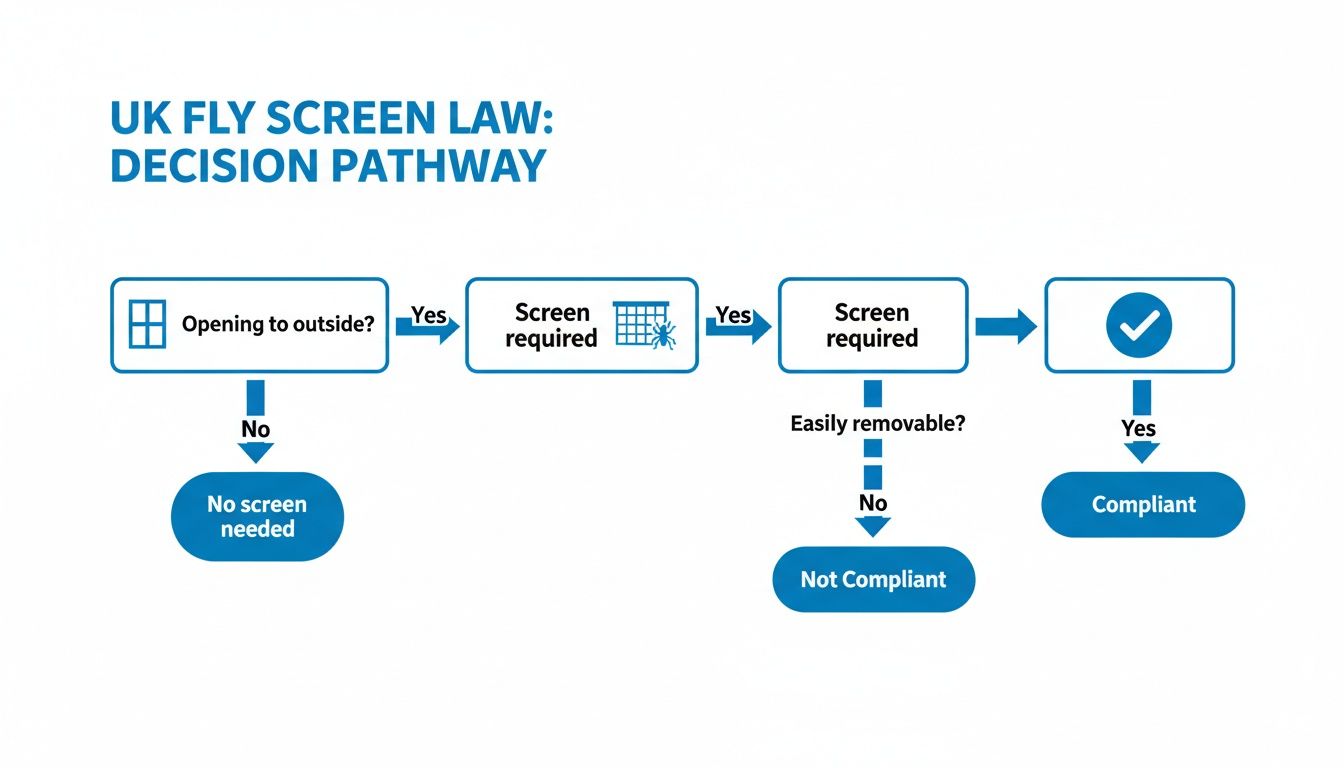
As the decision tree makes clear, any opening that leads outside from a food preparation environment legally requires an easily cleanable screen to meet UK food safety standards.
To help you navigate the options, here’s a quick rundown of the most common systems and where they fit best.
Commercial Fly Screen Systems at a Glance
This table gives a quick-reference comparison of different fly screen types to help kitchen managers identify the best fit for various applications, from main entrances to service windows.
| Screen Type | Best For | Key Benefit | Consideration |
|---|---|---|---|
| Retractable | Windows used occasionally | Discreet; protects mesh from grease when not in use | Moving parts require occasional checks |
| Hinged | Frequently used windows for ventilation | Robust, simple, and easy to unclip for deep cleaning | Needs clearance space to swing open |
| Sliding | Large sliding windows or patio-style doors | Mirrors the door's action; space-efficient | Tracks need to be kept clear of debris |
| Plissé | Bi-fold doors or very wide openings | Folds away neatly; requires minimal floor space | Pleated mesh can collect dust if not maintained |
| Double‑Action | High-traffic staff or delivery doors | Hands-free operation; extremely durable | Higher initial investment |
| PVC Strip | Internal doorways or back-of-house exits | Cost-effective and allows trolley access | Can become dirty; less of a complete seal |
Choosing the right system means it will get used correctly, ensuring your kitchen remains compliant and pest-free day in, day out.
Retractable and Hinged Systems for Windows
For the average kitchen window, retractable and hinged screens are fantastic, reliable choices. A retractable screen is the ultimate low-profile solution. It disappears into a neat cassette when not in use, keeping the mesh protected from airborne grease and kitchen grime. This makes it a perfect fit for windows that aren't open all day.
A hinged screen, on the other hand, is like a miniature door for your window. It’s a real workhorse—sturdy, easy to open, and can be unclipped in seconds for a proper clean. This makes it a go-to for windows that are frequently opened for ventilation.
Actionable Insight: Choose a retractable screen for windows near cooking stations to protect the mesh from grease when closed. Opt for a hinged screen for general ventilation windows, as its simple design encourages frequent use and easy cleaning.
Sliding and Plissé Screens for Larger Openings
When you're dealing with larger openings like sliding patio doors, a matching sliding fly screen just makes sense. These systems run on their own parallel tracks, mimicking the movement of the door itself. They’re a sturdy and space-efficient way to protect wider spans.
For really wide spaces like bi-fold doors, where a traditional screen would be awkward, a plissé screen is an elegant and clever alternative. It uses a distinctive pleated mesh that folds away like a concertina, taking up almost no floor space and being incredibly easy to operate.
High-Traffic Solutions for Doorways
Doorways are the biggest challenge in any commercial kitchen. They have to stay sealed against pests without slowing people down, especially when staff are rushing with hot pans or heavy boxes. This is where the heavy-duty options shine.
- Double-Action Doors: These are the gold standard for any busy kitchen entrance. With a solid lower kick plate and a flexible top panel, staff can simply push through from either direction, and the door swings securely shut behind them.
- PVC Strip Curtains: A highly practical and budget-friendly barrier, these overlapping strips let staff and trolleys pass through easily while stopping pests in their tracks. They are perfect for internal doorways leading to storage areas or external bin yards.
Choosing correctly ensures your investment not only ticks a legal box but actively contributes to a safer, more productive kitchen. For a closer look at our toughest door solutions, you can learn more about our commercial heavy-duty fly screen doors and see how they hold up in demanding environments.
Beyond the specific regulations, a solid pest control strategy is a cornerstone of wider food safety systems. For more context on building a complete safety framework, this HACCP food safety guide for pizzerias offers some great insights. By carefully matching your screen system to your kitchen's workflow, you turn a simple piece of compliance into a genuine operational asset.
Choosing the Right Mesh for Complete Pest Protection
The frame of a fly screen gives it structure, but it’s the mesh that does the real work of stopping pests dead in their tracks. Think of it like this: the frame is the wheel, but the mesh is the tyre tread. You need the right tread for the right conditions, and getting this detail right is what separates basic compliance from total, failsafe protection.
For most commercial kitchens, a standard insect mesh is the go-to choice. It’s a robust, reliable defence against common pests like houseflies and wasps. This option provides an excellent balance of protection, airflow, and durability, ticking all the fundamental boxes for the Food Standards Agency.
But what if your kitchen faces unique challenges? For many businesses, the standard stuff is more than enough. However, when your location throws a curveball, upgrading your mesh isn’t just an option—it’s a strategic move to fortify your defences and give you complete peace of mind.
When to Upgrade Your Mesh
The standard mesh is a fantastic all-rounder, but sometimes you need something more specialised. Take a look at your kitchen’s surroundings. Are you in a rural area, tucked away near a farm, or close to a body of water like a river or lake? These environments are often buzzing with smaller insects that can sometimes wriggle through a standard weave.
Here’s when an upgrade becomes a really smart investment:
- Near Water or Rural Areas: These spots are breeding grounds for midges and other tiny flying insects.
- High-Pollen Environments: If you're surrounded by parks or fields, pollen can be a headache for staff and a hygiene concern.
- High-Traffic Doorways: Doors that are constantly swinging open need a mesh that can take a few knocks and bumps without giving up.
Superfine Midge Mesh for Maximum Protection
If your kitchen is plagued by those tiny, infuriating insects like midges, gnats, or thrips, our superfine midge mesh is exactly what you need. This mesh features a much tighter weave—with aperture sizes typically less than 1mm—making it physically impossible for these minuscule pests to get through.
Actionable Insight: If your kitchen is near standing water, fields, or farms, specify superfine midge mesh during your order. This targeted upgrade provides a complete barrier against tiny insects that standard mesh can miss, preventing a major nuisance before it starts.
While the tighter weave does slightly reduce airflow compared to the standard mesh, that trade-off is invaluable for kitchens in high-risk midge zones. It guarantees your ventilation remains completely pest-free, protecting your food, your staff, and your reputation from the nuisance these tiny insects can cause.
Pet-Resistant Mesh for Ultimate Durability
For doorways that see a lot of action, durability is just as crucial as pest control. This is especially true for back doors opening onto pub gardens or staff smoking areas. These screens have to stand up to constant use, accidental bumps from trolleys, and general day-to-day battering.
Our pet-resistant mesh (often called tuff mesh) is engineered for exactly these scenarios. It’s made from a much thicker, stronger vinyl-coated polyester, which makes it leagues ahead of standard fibreglass mesh when it comes to resisting rips, tears, and punctures. While it was originally designed to stand up to a cat's claws, its incredible toughness makes it the perfect choice for demanding commercial kitchens.
Choosing this mesh for your most-used doorways means fewer repairs and a much longer service life for your screen, giving you a better return on your investment in the long run. It’s the practical, resilient solution for any access point that takes a daily beating, ensuring your barrier against pests stays intact, no matter what. By matching the mesh to the threat, you build a defence system that’s truly fit for purpose.
Installation and Maintenance for Lasting Compliance
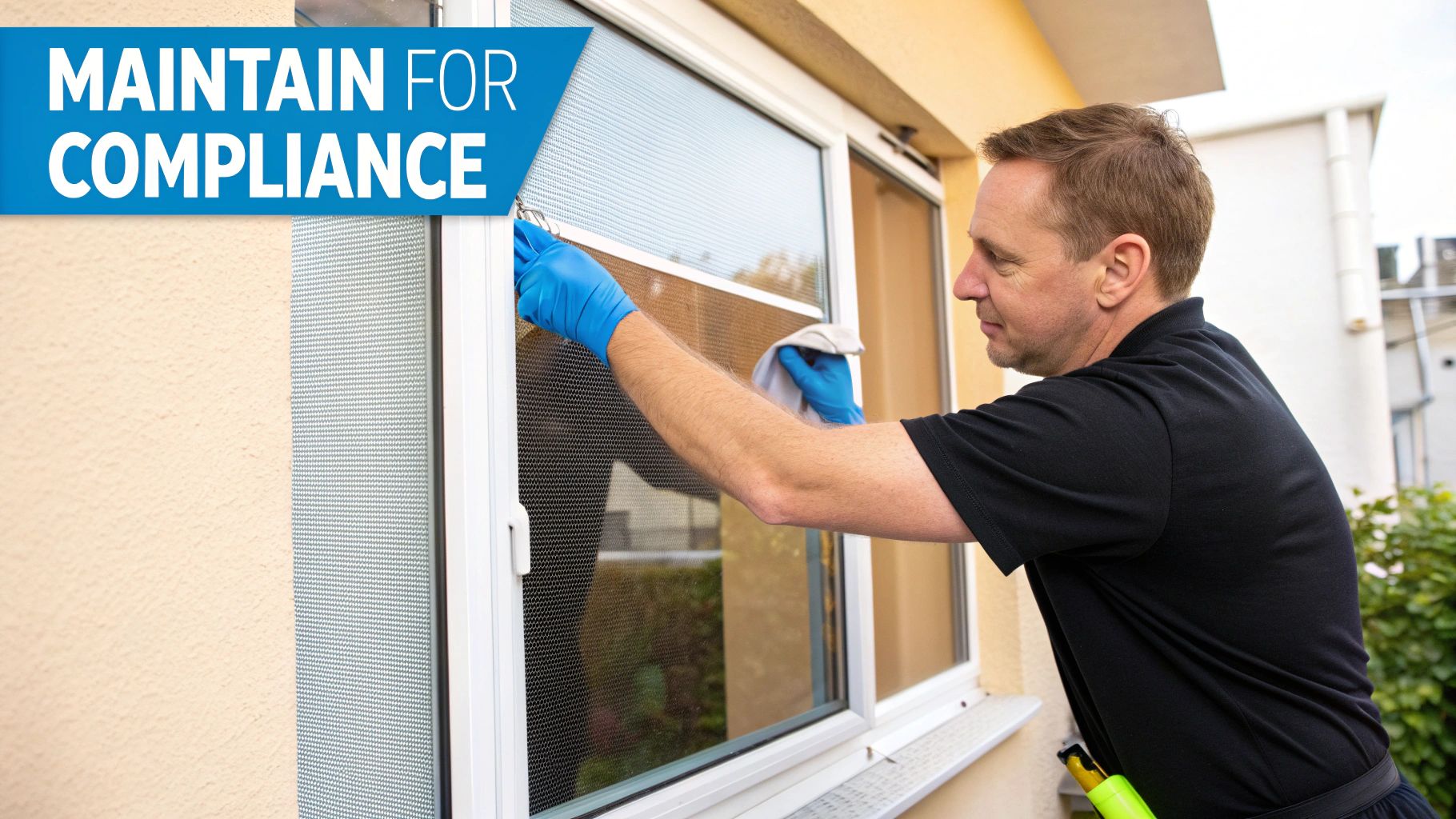
Your fly screens for commercial kitchens aren't just a purchase; they're a long-term asset working around the clock to protect your business. And just like any piece of professional kitchen kit, their effectiveness and lifespan hinge on two things: getting the installation right and keeping up with simple, consistent care.
Nail these two, and you’ll ensure your investment keeps you compliant and inspection-ready for years to come.
The whole process starts with a perfect fit. An improperly installed screen with even the tiniest gap is basically a flashing neon sign for pests, rendering it useless in the eyes of an Environmental Health Officer. This is exactly why a professional installation is the gold standard for any serious food business.
Our experienced UK-based team guarantees a secure, gap-free fit for every window and door, completely eliminating any potential weak points. We make sure every system is fitted correctly to meet strict food safety standards, giving you total peace of mind from day one. It's this professional touch that ensures your screens work as intended and can handle the daily chaos of a busy kitchen.
Professional Installation vs Supply-Only
For our trade clients or businesses with skilled in-house maintenance teams, we do offer a supply-only option. This gives you access to our full range of commercial-grade, made-to-measure screens to fit yourself.
That said, for the vast majority of food businesses, our full installation service is the most reliable and straightforward route to guaranteed compliance.
Actionable Insight: A correctly fitted fly screen is a silent guardian of your Food Hygiene Rating. But a poorly maintained one can become a hygiene risk itself, trapping grease and airborne particles. Schedule screen cleaning into your weekly kitchen deep-clean rota to make it a non-negotiable habit.
At the end of the day, the goal is a compliant, unbroken barrier. Whether our team installs your screens or you do, the responsibility for ongoing maintenance falls to your kitchen staff. A simple, consistent cleaning routine is all it takes to maximise the lifespan of your screens and keep them up to FSA standards.
Your Simple Maintenance Checklist
Regular cleaning is completely non-negotiable and should be built right into your kitchen’s daily or weekly hygiene schedule. A well-kept screen is easy to clean, functions smoothly, and provides the unwavering protection you need.
Just follow this straightforward process to keep your screens in top condition:
- Remove the Screen: Our commercial screens are designed to be removed in seconds without any tools. Simply unclip or slide them out of their housing.
- Clean the Mesh: Use a soft brush with warm, soapy water to gently scrub both sides of the mesh. Steer clear of harsh or abrasive chemicals that could damage the material.
- Wipe Down the Frame: Clean the aluminium frame with a damp cloth and a mild detergent to cut through any grease or grime that's built up.
- Inspect for Damage: Before putting it back, give the screen a quick once-over. Check the mesh for any rips or tears and make sure all the moving parts are working as they should.
- Reinstall Securely: Once it's completely dry, just pop the screen back into place. Make sure it fits snugly with no gaps.
This quick check is all it takes to preserve the integrity of your pest defence system. For more detailed, step-by-step guidance, you can always refer to our official fly screen installation instructions, which also have some great maintenance tips. By making this simple routine part of your workflow, you protect your investment and ensure your kitchen remains a fortress against pests.
The Real ROI of Investing in Professional Fly Screens
Thinking of professional fly screens for commercial kitchens as just another box to tick is a massive missed opportunity. It’s far more accurate to see them as a smart, strategic investment that delivers a tangible return, strengthening your business from the inside out. The benefits go way beyond simply satisfying an inspector.
This investment is your frontline defence, safeguarding your most valuable assets. It directly protects your brand's reputation and that all-important Food Hygiene Rating—something that can take years of hard graft to build but only moments to tarnish. All it takes is one pest-related incident or a single negative online review to undo all your hard work.
More Than Just Compliance
The financial case for high-quality screens is impossible to ignore. Just think about the direct cost of food contamination. A single incident could force you to bin thousands of pounds worth of stock, a loss that completely dwarfs the initial cost of a professional screening system. This preventative measure is, in essence, a form of insurance against avoidable waste and financial ruin.
But the impact doesn't stop there. A pest-free environment makes a real difference to your team.
- Boosted Staff Morale: A clean, comfortable workspace shows you care about your team's wellbeing, which is a big factor in keeping good staff around.
- Increased Productivity: When your staff aren't distracted or stressed by swatting away pests, they can focus entirely on their jobs. The result is a more efficient and productive kitchen.
Actionable Insight: By reframing the purchase from a reluctant necessity to a proactive business decision, you unlock its true value. Professional fly screens are not a cost centre; they are an investment in reputation, safety, and operational efficiency.
Unlocking Hidden Savings and Next Steps
There are also hidden savings to consider. By allowing you to keep windows and doors open for natural ventilation, professional fly screens can significantly cut down your reliance on expensive air conditioning during the warmer months. This lowers your energy bills while creating a fresher, more pleasant working atmosphere for your people.
Ultimately, investing in the right screening system protects your revenue, improves your workplace, and provides complete peace of mind. It’s a proactive step towards total food safety and operational excellence.
Ready to secure your kitchen? It's easy to take the next step with our UK-based team. You can get an instant online quote for a bespoke solution or schedule a professional site survey to discuss your specific needs.
Your Questions Answered
When it comes to fitting out a commercial kitchen, there are always questions. To help you get the clarity you need, we've put together answers to some of the most common queries we get from kitchen managers and business owners.
Are Fly Screens a Legal Requirement for All UK Commercial Kitchens?
Yes, without a doubt. The Food Safety Regulations are crystal clear on this: any window, door, or other opening to the outside in a food prep area must be fitted with an insect-proof screen. It’s one of the first things an Environmental Health Officer will look for.
This isn’t a guideline or a recommendation; it's a non-negotiable rule. Failing to have compliant screens in place can seriously impact your Food Hygiene Rating and even lead to bigger problems down the line.
What Makes a Commercial-Grade Screen Different from a Residential One?
It really comes down to durability and hygiene. A commercial kitchen is a punishing environment—think constant steam, grease, strong cleaning chemicals, and staff rushing in and out. Screens built for this world, like those from Premier Screens, use heavy-duty materials like powder-coated aluminium that won’t corrode or warp.
The key difference is that professional commercial screens are designed for easy, tool-free removal. Food safety laws demand that screens can be taken down and cleaned thoroughly. Many residential screens just aren’t built for that, making them unsuitable for a professional setting where hygiene is paramount.
Can We Install the Fly Screens Ourselves to Save Money?
While we do offer a supply-only service for trade clients who know what they're doing, we strongly recommend professional installation for any commercial kitchen. A perfect, gap-free fit isn't just nice to have—it's essential for compliance.
Our Premier Screens installation service takes all the guesswork out of it. We guarantee the screens are fitted correctly to meet food safety standards, ensuring there are no weak points for pests to exploit. It’s the best way to get total peace of mind that your investment is working as it should.
How Often Do Our Kitchen's Fly Screens Need to Be Cleaned?
Think of your screens as another piece of kitchen equipment—they need to be on the cleaning rota. Keeping them clean ensures they work properly and last longer, protecting both your food and your reputation. A simple schedule is all it takes to keep your fly screens for commercial kitchens in top condition.
- Daily/Weekly: For high-traffic doors and windows, a quick wipe-down of the frames and mesh with a mild detergent is a good habit.
- Monthly (At a Minimum): Plan for a deeper clean at least once a month. This means removing the screens completely to wash them properly.
- As Needed: If your kitchen is particularly greasy or in a dusty area, you'll need to do those deep cleans more often to stop any build-up.
Ready to make sure your kitchen is fully protected and compliant? The expert team at Premier Screens Ltd is here to help you find the perfect, made-to-measure solution. Take a look at our range and get your instant online quote at https://www.premier-env.co.uk.